
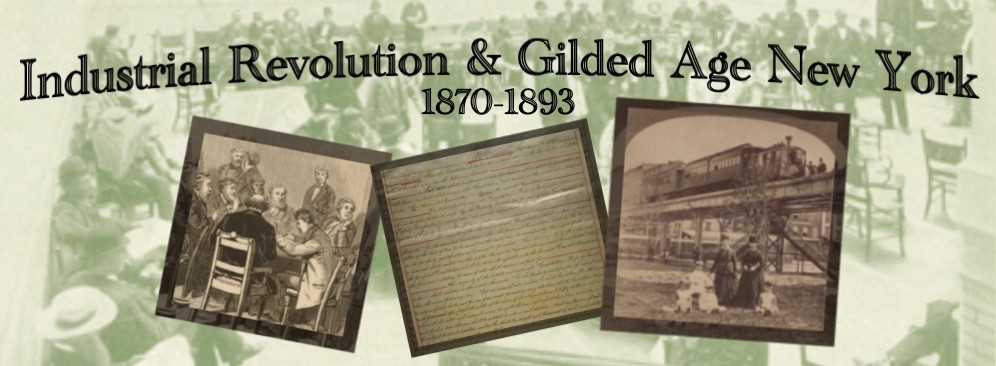
Industrial Revolution & Gilded Age New York

The Gilded Age was a formative era for the nation and New York, its most populous state.  The decades that followed the Civil War brought massive industrialization and urbanization to the Empire State, transforming the economic and cultural lives of its residents.  Great wealth was amassed by businessmen who have gone down in history as “Captains of Industry” and “Robber Barons,” but for the laboring masses, many of them recent immigrants, the Industrial Revolution meant low wages, poor working conditions and substandard, overcrowded housing.  It was also the era when the promise of Reconstruction failed, and while Black New Yorkers were mainly spared the harsh segregation and deadly violence of the South, the Empire State was not always a beacon of racial progress.

The term “Gilded Age” comes from the title of a novel by Mark Twain and Charles Dudley Warner.  It refers to the process of gilding, of applying a bright, shiny layer of gold to a less attractive surface.  In government and politics, the Gilded Age in New York was a time of widespread corruption compounded by a highly partisan political scene that ensnared judges and lawyers in scandal.  In 1870, in response to the plundering of tens of millions of dollars from New York City’s municipal treasury by the notorious “Tweed Ring,” many prominent attorneys, including Samuel J. Tilden and William M. Evarts, came together and formed the New York City Bar Association, which took the lead in bringing William M. “Boss” Tweed and his cronies to justice.  The New York City Bar Association’s formation, followed by the New York State Bar Association in 1876 and the American Bar Association in 1878, introduced powerful constituencies focused on strengthening the courts, the legal profession and the administration of justice and which established the framework for the law as a self-regulating legal profession.

Massive population growth and booming industrialization greatly increased the demand for legal and judicial services.  The courts struggled to keep pace with rapidly growing caseloads.  By the late 1860s, the Court of Appeals was so backlogged that it took several years to hear an appeal.  In 1869, a responsive amendment to the Judiciary Article of the State Constitution established a new Court of Appeals with a chief judge and six associate judges selected by popular election to 14-year terms. Although the restructured Court operated more efficiently even this change could not relieve the pressures of calendar congestion, which would remain a constant problem through the end of the century.

The broad range of legal matters filed in the trial and appellate courts from 1870 into the 1890s offers a fascinating view into daily life and commerce in Gilded Age New York, touching on cases in tort, contract, criminal, matrimonial, family, civil rights, wills and estates, election, takings, intellectual property and environmental law.  These cases include lurid crimes that shocked the public; high-society divorces; abused and neglected children; and political corruption.  It is also during this period that the Court of Appeals started to emerge as the nation’s preeminent common law court, not only addressing the novel and important issues of its day but issuing decisions that foreshadowed the coming Progressive Era.  The Court of this era can be seen moving away from consistent protection of legal interests associated with economic development and toward a recognition of the harms of massive industrialization to workers, individuals and small property owners, particularly in context of expanded tort liability.

The legal profession, too, can be seen transitioning from the pre-Civil War era of the great courtroom orators like Daniel Webster.  With the rise of large corporations a new class of lawyer came into being, one who thrived outside the courtroom, an expert in corporate law and financial transactions skilled in drafting complex documents.


Samuel J. Tilden People ex rel. Tweed v. Liscomb

Judges of the Era

Judges of the Court of Appeals

Effective July 4, 1870, based on 1869 Constitutional Amendment

Robert Earl

1869-1894
1824-1902 Associate Judge of the New York State Court of Appeals, 1869-1894 / Chief Judge, 1870; 1892 by Veronica Benigno ...

Martin Grover

1867-1875
1811-1875 Ex Officio Judge of the New York State Court of Appeals, 1859 / Associate Judge, 1867-1875 by Heather Davis ...

Charles Andrews

1870-1897
1827-1918 Associate Judge of the New York State Court of Appeals, 1870-1897 / Chief Judge, 1881-1882, 1893-1897 by Brian Quinn Charles ...

Charles James Folger

1870-1881
1818-1884 Associate Judge of the New York State Court of Appeals, 1870-1879 / Chief Judge, 1880-1881 by Sebrina A. Barrett ...

Charles Anthony Rapallo

1870-1887
1823-1887 Associate Judge of the New York State Court of Appeals, 1870-1887 by Matthew R. Dunn Law is educated Justice.1 ...

Sanford Elias Church

1870-1880
1815-1880 Chief Judge of the New York State Court of Appeals, 1870-1880 by Kristin A. Mattiske This son of a ...

Commissioners on Appeals, 1870-1875

Robert Earl

1824-1902 Associate Judge of the New York State Court of Appeals, 1869-1894 / Chief Judge, 1870; 1892 by Veronica Benigno ...

Alexander Smith Johnson

1817-1878 Associate Judge of the New York State Court of Appeals, 1852-1857; 1874 / Chief Judge, 1858-1859 by Clifton R ...

John Hazard Reynolds

1819-1875 John Hazard Reynolds was born Jun. 21, 1819, in Moriah (Moreau?), N.Y. He studied law in Kinderhook, Columbia County, ...

Ward Hunt

1810-1886 Associate Judge of the New York State Court of Appeals, 1865-1867 / Chief Judge, 1868-1869 by Laury A. Betha ...

John A. Lott

1806-1878 Associate Judge of the Court of Appeals, 1870 by Jason C. Rubinstein Although John A.1 Lott served as a ...

Charles Chauncey Dwight

1830-1902 Charles Chauncey Dwight served in 1868 and as commissioner in 1874 and 1875. Born in Richmond, Berkshire County, Mass., ...

Second Division of the Court of Appeals, 1889-1892

Albert Haight

1842-1926 Associate Judge of the New York State Court of Appeals, 1881-1912 by Heather Davis In Alden Chester's 1925 work, ...

David Lyman Follett

1836-1899 Justice of the Second Division of the Court of Appeals, 1889-1892 David Lyman Follett was born in Serburne (Chenango ...

George Beckwith Bradley

1825-1916 Justice of the Second Division of the Court of Appeals, 1889-1892 George Beckwith Bradley was born Feb. 5, 1825, ...

Charles F. Brown

1845-1929 Justice of the Second Division of the Court of Appeals, 1889-1892 Charles F. Brown was born in Newburgh (Orange ...

Joseph Potter

1821-1902 Justice of the Second Division of the Court of Appeals, 1889-1892 Joseph Potter was born in Easton (Washington County), ...

Judson Stuart Landon

1832-1905 Justice of the Second Division of the Court of Appeals, 1889-1892 / Ex-Officio Judge of the Court of Appeals, ...

Other Notable Judges

George G. Barnard

1824-1879
1824-1879 George G. Barnard was born in Poughkeepsie and graduated from Yale College.  He studied law under his more distinguished ...

Albert J. Cardozo

1828-1885
1828-1885 If the name Cardozo today means Benjamin Cardozo and if it stands for a distinguished model of judging, in ...

Frederick Smyth

1832-1900
1832-1900 Frederick Smyth was born in Ireland in 1832, the son of a Galway City Sherriff.  He emigrated to New ...

John K. Hackett

1821-1879
1821-1879 John K. Hackett was born in Utica, New York, in 1921.  His parents, James Henry and Katherine Hackett, “were ...

Randolph B. Martine

1844-1895
1844-1895 Randolph B. Martine, the son of a grocer and real estate dealer, was born in New York City in ...

James Campbell Matthews

1844-1930
1844-1930 James C. Matthews, the first Black Judge in New York State, was born in New Haven, Connecticut in 1844.  ...

Important Figures

Notable Attorneys

William F. Howe

1828-1902 William F. Howe was the most notorious criminal lawyer of the Gilded Age.  From the early 1860s through the ...

Abraham H. Hummel

1849-1926 Abraham Hummel was the junior partner of Howe and Hummel, the most notorious law firm of the Gilded Age.  ...

Francis L. Wellman

1854-1942 Francis L. Wellman, born in Massachusetts in 1854, graduated from Harvard College in 1876, and Harvard Law School in ...

De Lancey Nicoll

1844-1917 John Randolph Dos Passos was born in Philadelphia in 1844, the son of an immigrant from the Portuguese island ...

William A. Beach

1809-1884 William A. Beach was born in 1809, in Saratoga County, New York, the son of a wealthy merchant.  After ...

John R. Dos Passos

1844-1917 John Randolph Dos Passos was born in Philadelphia in 1844, the son of an immigrant from the Portuguese island ...

Attorneys General

Denis O’Brien

1837-1909 Associate Judge of the New York State Court of Appeals, 1880-1907 by Justin R. Long Denis O'Brien would likely ...

Francis C. Barlow

1834-1896 Francis C. Barlow, New York State Attorney General from 1872 to 1873, was born in Brooklyn and raised in ...

Marshall B. Champlain

1824-1879 Attorney General of New York, 1868-1869 Marshall Bolds Champlain was born on December 22, 1824, in Stafford, Genesee County, ...

Daniel Pratt

1806-1884 Daniel Pratt served in 1850. Born on Aug. 22, 1806, in Greenwich, Washington County. Union College graduate, 1835. Admitted ...

Other Notable Figures

William M. “Boss” Tweed

1823-1878 William M. “Boss” Tweed was a spectacularly corrupt public official who played an outsized role in the politics of ...

Allan McLane Hamilton

1848-1919 Dr. Allan McLane Hamilton, MD, LLD, FRS,[1] the grandson of founding father Alexander Hamilton, was one of the leading ...

Important Cases

Civil Rights Cases

People v. King

1888
110 NY 418 (1888) Black New Yorkers in the Gilded Age were mainly spared the harshest forms of segregation and ...

People ex rel. King v. Gallagher

1883
93 NY 438 (1883) People ex rel. King v. Gallagher garnered little public attention when it was decided in 1883 ...

Contracts, Intellectual Property, & Workers’ Rights Cases

Laning v. New York Cent. R.R. Co.

1871
49 NY 521 (1871) The “fellow servant rule” was a common law doctrine which held that employers were not liable ...

Manhattan Brass & Mfg. Co. v. Thompson

1874
58 NY 80 (1874) Gilded Age women who wanted to pursue economic opportunities faced restrictive laws and paternalistic attitudes.  In ...

Clements v. Yturia

1880
81 NY 285 (1880) Following the Civil War, the New York State courts heard substantial commercial litigation arising out of ...

Tabor v. Hoffman

1889
118 NY 30 (1889) The Empire State’s status as a national center of industry, commerce and technology has often placed ...

Corruption Cases

The Tweed Ring Judges

1872
George G. Barnard, Albert J. Cardozo and John H. McCunn William M. “Boss” Tweed (1823-1878) was a spectacularly corrupt public ...

People ex rel. Tweed v. Liscomb

1875
60 NY 559 (1875) William M. “Boss” Tweed (1823-1878) was a flamboyantly corrupt public official who became the “Grand Sachem” ...

Eminent Domain, Railroad, & Erie Canal Cases

Eckert v. Long Island R.R. Co.

1871
43 NY 502 (1871) The rapid expansion and operation of railroads in the nineteenth century had an enormous impact on ...

Story v. New York Elevated R.R. Co.

1882
90 NY 122 (1882) The rapid rise of railroads and other forms of public transit during the second half of ...

Sipple v. State of New York

1885
99 NY 284 (1885) The construction and operation of the Erie Canal generated many legal disputes and issues that helped ...

Lahr v. Metropolitan Elevated Ry. Co.

1887
104 NY 268 (1887) The decision in Story v. New York Elevated R.R. Co. (90 NY 122 [1882]) holding that ...

Environmental Law Cases

Campbell v. Seaman

1876
63 NY 568 (1876) The rapid industrialization of the Gilded Age brought increasing litigation by individuals and property owners seeking ...

Family Law & Matrimonial Cases

Mary Ellen McCormack and the Early Case that Shined Light on Child Abuse in Gilded Age New York

1874
On April 10, 1874, a little girl appeared before Justice Abraham R. Lawrence in the New York County Supreme Court.  ...

People ex rel. Van Riper v. New York Catholic Protectory

1887
106 NY 604 (1887) In Gilded Age New York, there was no Family Court system or developed network of public ...

Thorp v. Thorp and Van Voorhis v. Brintnall

1882 & 1881
90 NY 602 (1882) and 86 NY 18 (1881) Throughout most of its history New York State made it difficult ...

Chellis v. Chapman

1891
125 NY 214(1891) Until 1935, breach of promise to marry was a valid cause of action in New York.  Under ...

Famous & Sensational Cases

Maurer v. People

1870
43 NY 1 (1870) On November 2, 1869, New York’s voters gave their approval to various amendments of the Judiciary ...

People v. Rosenzweig

1871
1871 On August 26, 1871, a naked young woman was found stuffed inside a trunk at the Hudson River Railroad ...

Flanagan v. People

1873
52 NY 467 (1873) The insanity defense was a feature of many high-profile murder cases during the Gilded Age.  The ...

People v. Stokes

1873
53 N.Y. 164 (1873) On January 6, 1872, James Fisk, Jr., one of the most notorious “robber barons” of the ...

Stolen Election Cases

People ex rel. Daley v. Rice

1891
The Stolen Senate of 1891 129 NY 449 (1891) In the election of 1891, Roswell P. Flower, a Democrat, was ...

Nichols v. Onondaga Board of Canvassers

1891
The Stolen Senate of 1891 129 NY 395 (1891) In the election of 1891, the Democrats won the governorship and ...

About the Period

New York State Bar Association

1876 The rise of formally organized bar associations in the second half of the nineteenth century was an integral development ...

New York City Bar Association

1870 The rise of formally organized bar associations in the second half of the nineteenth century was an integral development ...

The Tombs (1838-1902) (1902-1941) and the Tombs Angel, Rebecca Salome Foster (1848-1902)

Origins of “The Tombs” In 1838 construction was completed on a massive granite building housing the Court of Special Sessions, ...

Emergence of Law Schools in New York State

The roots of American legal education go back to fourteenth century England and the Inns of Court established in London ...

The Judiciary Commission of 1890

In 1886, as the Court of Appeals’ calendar problems grew more urgent, New Yorkers at the polls overwhelmingly approved the ...

A New Judicial System: The Judiciary Article of 1869 and the Court of Appeals of 1870

The Constitution of 1846 had established a statewide Court of Appeals and divided the intermediate appellate courts into eight districts.  ...
×
Product added to cart

No products in the cart.