
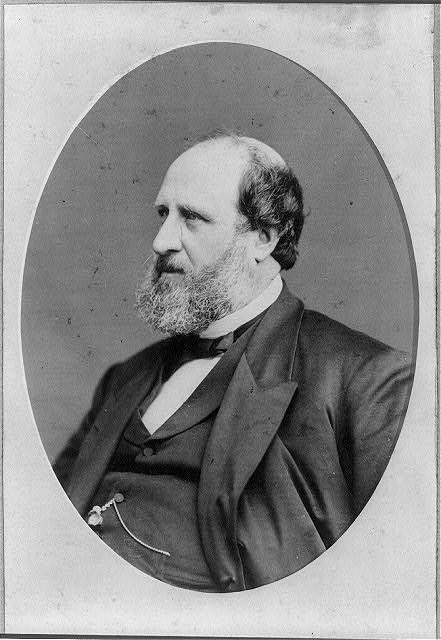
1823-1878
William M. “Boss” Tweed was a spectacularly corrupt public official who played an outsized role in the politics of Gilded Age New York and personally enriched himself by stealing millions of dollars. “City investigators ultimately estimated that Tweed and his city “ring,” during a three-year period, had made off with a staggering $45 million from the local treasury-an amount larger than the entire annual U.S. federal budget before the Civil War.”[1]
Early Life
A chairmaker by trade, Tweed grew up in a tough lower east side neighborhood of Manhattan where fisticuffs were common. Described as “a tall overgrown man, fall of animal spirits [and] a swaggering gait,” Tweed led a gang of local toughs as a teenager.[2] He joined the local volunteer fire company, the “Americus Big Six,” and soon became foreman of the squad’s 75 members. The physically imposing Tweed was as shrewd and intelligent as he was popular and outgoing. He was good with numbers and attended a New Jersey boarding school long enough to acquire basic accounting skills that would serve him well.[3]
Tammany Hall
In 1852, Tweed was elected as an Alderman from his Seventh Ward neighborhood. The following year he was elected to Congress, but he found himself frustrated and bored with “hearing a lot of snoozers discuss the tariff.”[4] Tweed gradually worked his way up the ladder at Tammany Hall, the Democratic Party’s New York City-based political organization, getting appointed to key positions in local government–school commissioner in 1856, county supervisor in 1858 and deputy street commissioner in 1861–while building up a ring of loyal cronies among other city officials. Ironically, when the state legislature created the New York County Board of Supervisors with oversight powers to prevent financial corruption and mismanagement by city officials, Tweed formed a ring within the Board which forced vendors to pay them a 15% tribute in order to do business with the city.[5]
By the early 1860s, Tweed was the “Grand Sachem” or “Boss” of Tammany Hall. “Big and boisterous,” the now wealthy, sharply dressed Tweed “lit up the room,” slapping shoulders, shaking hands and cracking jokes, often at “his own girth.”[6] As Boss, he controlled Democratic Party patronage to virtually all positions in city government from the highest officeholders down to the lowest laborers and street cleaners. Although Tweed was elected to the New York State Senate in 1867, his real base of power remained Tammany Hall and the patronage it dispensed to the many thousands of New Yorkers who depended on Tammany for their jobs and livelihoods. Tammany also won the loyalty of the countless new immigrants, many of them Irish, who poured into New York City during the Gilded Age. Many of these newcomers were quickly naturalized as citizens and added to the Democratic voter rolls in return for jobs, housing and other forms of assistance and acclimation to city life.
During the devastating 1863 Draft Riots, Tweed “plunged headfirst into the maelstrom—mixing with rioters and shopkeepers on the street, huddling with political leaders, updating police with tips and rumors.”[7] There was little that anyone could do to stop the rampaging mobs until federal troops arrived, but Tweed was credited for his visible leadership and earnest efforts to tamp down violence and restore calm.
An Ingenious Array of Corrupt Schemes
With little or no legal training, Tweed was certified as an lawyer under dubious circumstances by one of his judicial cronies, Judge George G. Barnard, who was later impeached and removed from the bench. Tweed devised an ingenious array of corrupt schemes to enrich himself, including using his law office as a cover to extort money in return for political favors that he disguised as legal services. Some of his schemes were as simple as creating or buying companies to overcharge the city for their services. Others were more complex, such as conspiring with railroad barons Jay Gould and James Fisk, Jr., to seize control of the Erie Railroad from Cornelius Vanderbilt. Tweed’s participation included spearheading passage of legislation to legitimize the fake Erie Railroad stock certificates that enabled Gould and Fisk to gain control of the railroad.[8]
In 1869, state government controlled the “city’s police force and school board, the fire department, the docks, and even the city budget.” [9] Senator Tweed proposed a new city charter that would restore home rule and transfer these powers and functions back to the city. With Tweed bribing and otherwise persuading state lawmakers, the new charter passed easily in 1870, giving Tweed total control of the city’s purse strings just as a new courthouse was being built on Chambers Street in lower Manhattan.[10] Originally budgeted at $250,000, the new courthouse ultimately cost the city’s taxpayers $13 million, with the excess diverted almost entirely to the Tweed Ring.[11] Favored contractors selected to work on the courthouse were told to multiply their invoices by multiples of five, ten or even a hundred, and the overcharges were kicked back to Tweed and his cronies via a complex scheme of bank transactions.
Boss Tweed also became the city’s third largest landowner as he routinely purchased real estate ahead of city improvements that caused property values to soar. Among Tweed’s possessions at the time of his arrest were two steam-powered yachts, a Fifth Avenue mansion, an estate in Greenwich, Connecticut, and a shirtfront diamond pin valued at over $15,000 (or approximately $360,000 in 2025).[12]
Tweed’s tentacles reached into the courts. One historian noted that “[t]he courts, at his behest, were keeping the naturalization mills grinding at tenfold capacity, not even asking to see the men they naturalized.”[13] These immigrant men, most of them recent arrivals from Ireland, were naturally enrolled as Democrats, guaranteeing the dominant voting majorities that kept Tammany politicians in power. Meanwhile “election judges could tally votes so rapidly that the aggregate of Democrat votes cast soon exceeded the total registration.”[14]
Forces of Reform
While Tweed seemed unassailable for a time, strong forces were massing against him. The New York Times, the city’s only Republican newspaper, maintained an “unremitting editorial offensive against the Ring and its boss,” and the influential Harper’s Weekly published a series of “devastating cartoons” by Thomas Nast that Boss Tweed feared much more than any newspaper editorial: “I don’t care what people write, for my people can’t read. But they have eyes and can see as well as other folks.”[15]

In February 1870, Samuel J. Tilden and other prominent lawyers founded the Association of the Bar of the City of New York, the first association of its kind in the United States, for the express purpose of eliminating judicial corruption and restoring the dignity and honor of the bar. Tilden’s anti-corruption crusade was a major factor in Boss Tweed’s demise, catapulting him to the Governorship in 1874 and, very nearly, to the Presidency in 1876.[16]
Tweed’s downfall began in July 1871 when the replacement for a deceased auditor in the Comptroller’s office discovered evidence of massive theft and disclosed it to the New York Times. Exposure of the Tweed Ring’s extensive fraud and embezzlement sparked public outrage leading to his investigation and prosecution. In September, a group of leading citizens–the Committee of 70–came together at a Cooper Union rally for the purpose of investigating and prosecuting the Tweed Ring. Shortly thereafter, Justice Barnard unexpectedly turned on Tweed and issued an injunction that barred him and the Ring members from spending or borrowing city funds.[17] A week later, Tilden persuaded Comptroller Connolly to cooperate with investigators.
Tilden Builds a Case Against Tweed
Tilden led an examination of financial and bank records that reconstructed the money trail for 190 different payments approved by Tweed, Connolly and Mayor Hall in 1870. The resulting affidavit and spreadsheet created by Tilden was “pure dynamite.”[18] In numerous columns laid said by side the spreadsheet traced deposits and transfers as they moved from bank account to bank account until they ended up in a final column representing the personal bank account of William M. Tweed. Of the $5.7 million in approved payments almost $933,000 ended up in Tweed’s personal bank account.[19]
When Governor John Hoffman, a former Tammany man himself, was shown the concrete evidence of Tweed’s theft, he quickly authorized the State Attorney General, Marshall B. Champlain, to appoint a special prosecutor to bring the Tweed Ring to justice. Charles O’Conor, a longtime leader of the bar and close friend of Tilden was selected as a special prosecutor.
Failing to Keep the Irish in Line
Tweed’s demise was accelerated by violence between Catholic- and Protestant-Irish Americans. In July 1871, Tweed canceled the annual Protestant march commemorating the 1690 military victory of William of Orange over Catholic forces in Ireland. The previous summer’s march had led to widespread violence and eight deaths. Tweed’s refusal generated an intense backlash from the city’s Protestant elites who feared the growing power of the Irish. “Tweed, already feeling the heat from some initial exposes of Tammany corruption, decided he had no choice but to acquiesce.” Even though thousands of troops were deployed to keep the peace, Irish protestors clashed with Protestant marchers. Over 60 civilians and three soldiers were killed, and hundreds were wounded. “One of the reasons many in the upper and middle classes had grudgingly acquiesced in Tammany’s hold on power was its presumed ability to maintain political stability.” What good was Tweed if he “could not keep the Irish in line?”[20]
Tweed Arrested
Tweed was arrested in October 1871 and released on $1 million dollar bail. He was forced to resign his city and Tammany Hall positions. His January 1873 trial ended in a hung jury. Prosecutors suspected jury tampering. Tweed was retried in November and convicted of more than 200 misdemeanor charges of neglect of duty and official misconduct. He was sentenced to 12 years in prison and ordered to pay a $12,750 fine. The prosecution sought consecutive sentences that would have added up to over a hundred years in prison. Agreeing in part, Judge Davis grouped certain counts together and imposed 12 one-year sentences to be served consecutively. In People ex rel. Tweed v. Liscomb 60 N.Y. 559 (1875), the Court of Appeals ruled that the trial court’s imposition of consecutive sentences was illegal. In a deeply unpopular decision, the Court granted Tweed’s writ of habeas corpus, limited his sentence to one year and ordered him released from prison.[21]
Tweed’s Escape
Tweed was promptly rearrested in connection with a civil suit filed on behalf of the state to recover over $6.3 million in stolen funds. Unable to make bail in the case, which was set at a then-unprecedented $3 million, Tweed was returned to debtor’s prison where he was allowed occasional home visits. In December 1875, during one of those visits, Tweed escaped and fled to Cuba and then to Spain where he worked for a time as a common seaman on a Spanish ship before Spanish authorities recognized him from Thomas Nast’s famous political cartoons in Harper’s Weekly. Tweed was arrested, turned over to American authorities and returned to debtor’s prison in November 1876.
Death in Prison
Tweed meanwhile had been tried in absentia in the civil restitution suit and a judgment had been entered against him for $6.3 million. Tweed, now destitute, had no chance of making restitution. During the winter of 1876-77, Tweed began cooperating with a special investigative committee to which he disclosed the details and inner workings of the Tweed Ring in return for the possibility of an early release. State Attorney General Charles Fairchild denied Tweed’s early release request on the ground that the information offered was without value.
Tweed died in prison on April 12, 1878. His last words, reportedly, were, “Well, Tilden and Fairchild have killed me. I hope they are satisfied now.”[22]
No Monopoly on Corruption
Moreover, as one scholar has observed, no political party or state had a monopoly on corruption in the Gilded Age.
Despite the excesses of the Tweed Ring, Tammany Hall did not have a monopoly on corruption during the postwar years. It is worth remembering that upstate Republicans accepted bribes from Tweed and that the ethical standards of New York’s businessmen in this period were little, if any, better than those of its politicians. Corruption was, moreover, a national development rather than a New York phenomenon. Grant’s administration was more corrupt than any other in the nation’s history; dishonest politicians and businessmen combined to plunder all the southern states during the Reconstruction period; and officials of such northern states as Pennsylvania stole as much and as often as those of New York. None of these facts excuses the behavior of Tweed and his henchmen, but they do indicate that New York’s experience was anything but unique and that the Tweed Ring should be viewed as one more manifestation of the breakdown in the nation’s moral standards in the decade after Appomattox.[23]
Nor did the era of Boss rule end with Tweed. He was succeeded by “Honest” John Kelly and others who, though less spectacularly corrupt, continued to lead the city’s powerful political machine all the way into the 1960s. Nor was Boss rule limited to New York City or the Democratic Party. “From 1870 until the turn of the century Hugh McLaughlin bossed Brooklyn’s Democrats and successfully resisted all efforts of Tammany Hall to take over his highly efficient and effective organization.”[24] The Republicans also had a powerful state machine strongly entrenched in upstate areas that benefitted from the patronage provided by Republican presidential administrations following the Civil War. The Republican machine was led in the Gilded Age by two disciplined leaders, Roscoe Conkling from 1870 to 1881 and, later in the century, by Thomas C. “Boss” Platt.
Tweed’s Legacy
He, William Magear Tweed, had been the single most influential man in New York City and a rising force on the national stage. Physically imposing and mentally sharp, Tweed reigned supreme. He was more than simply boss of Tammany Hall, commissioner of Public Works, and state senator. He controlled judges, mayors, governors, and newspapers. He flaunted his wealth, conspicuous and garish beyond anything supportable by his government salaries or even traditional “honest graft” as practiced by generations of politicians before and since.[25]
Tweed “inherited a culture of graft endemic to New York City for generations and pushed it to its logical extreme,” elevating the techniques of civic corruption and ballot-box stuffing “to stunning proportions.”[26]
Tweed lived in a corrupt time, the Gilded Age, but he defined that era and pressed its boundaries. . . After his excesses, no city in America could any longer tolerate wide-open graft or ballot-box abuse. Urban corruption didn’t disappear, but it evolved and became more subtle. . . The Tweed Ring at its height was an engineering marvel, strong and solid, strategically deployed to control key power points: the courts, the legislature, the treasury, and the ballot box. Its frauds had a grandeur of scale and elegance of structure: money laundering, profit sharing, and organization. It took the brilliance of Samuel Tilden just to unravel the basic cash flow.[27]
Tweed’s reign was a marvel in other respects. It had an “irresistible political logic,” in that everyone appeared to benefit. “For the wealthy, Tweed produced dynamism and growth,” including grand projects like Central Park, the Brooklyn Bridge and the elegant uptown neighborhoods that have come to define all that is Manhattan. For the working masses, especially the Irish immigrant poor, Tammany provided “tangible service[s] when government ‘safety net’ programs barely existed,” and by treating them “not as charity cases to pity [and] judge,” but as voters “to bargain with, to woo and court,” he “gave them a share of power and a sense of community.”[28] “Tweed was no Robin Hood. He stole, but not just from the rich, and he kept a large cut for himself. Still, compared with anyone else, the poor saw it as not a bad deal.”[29]
[1] “Boss Tweed,” New York Times, March 27, 2005.
2i] Kenneth D. Ackerman, Boss Tweed, Carroll & Graf, 2005, at 18.
[3] Id.
[4] Id. at 20.
[5] Edward G. Burrows & Mike Wallace, Gotham: A History of New York City to 1898, Oxford Univ. Press, 1999, at 837.
[6] Ackerman at 47-48.
[7] Id. at 17.
[8] Burrows & Wallace at 913-14.
[9] Ackerman at 78.
[10] Burrows & Wallace, at 927.
[11] David W. Dunlap, “Boss Tweed’s Courthouse: An Elegant Monument to Corruption,” New York Times, May 5, 1986.
[12] New York Times, Mar. 27, 2005.
[13] James Sullivan, History of New York State 1523-1927, Lewis Hist. Pub. Co., 1927, Vol. 5, at 1759.
[14] Id.
[15] Ellis, Frost, Syrett & Carman, A Short History of New York State, Cornell Univ. Press, 1957, at 358.
[16] Hon. Helen E. Freedman, Samuel Jones Tilden: Lawyer, Statesman, and Victim of Fate, Judicial Notice, Iss. 18, 2023.
[17] James Larder and Thomas Reppetto, NYPD: A City and its Police, Henry Holt & Co., 2000, at 96-97.
[18] Ackerman at 238.
[19] Id.
[20] Burrows & Wallace at 1008.
[21] Rosenblatt, ed., The Judges of the New York Court of Appeals, at xvii-xviii.
[22] New York Times, Mar. 27, 2005
[23] Ellis, et al., at 359.
[24] Ellis, et al., at 354-55.
[25] New York Times, Mar. 27, 2005.
[26] Ackerman at 356.
[27] Ackerman at 356-57.
[28] Id. at 358.
[29] Id. at 358-59.