
1828-1902
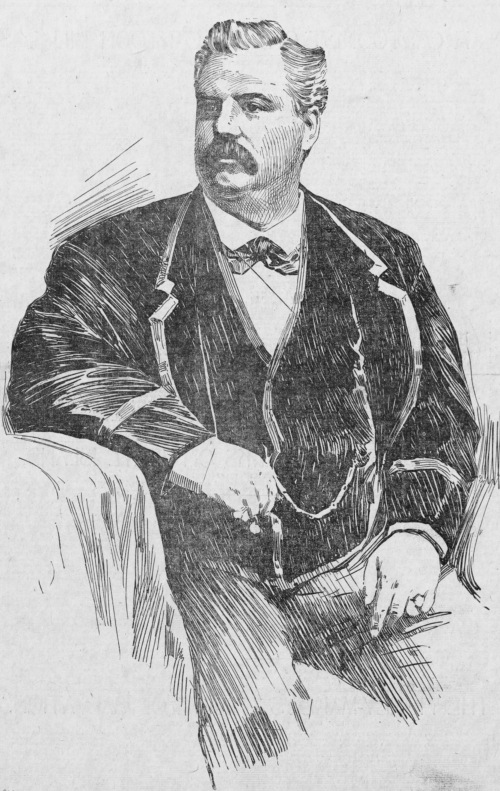 William F. Howe was the most notorious criminal lawyer of the Gilded Age. From the early 1860s through the opening of the new century Howe and his long-time partner, Abraham Hummel, defended over 1,000 defendants charged with murder or manslaughter. A “very remarkable percentage” of their clients charged with first-degree murder “enjoyed almost miraculous escapes from sentences of death through the ingenious tactics of their counsel.”[1]
William Howe’s origins are elusive. According to his obituary, he was born in Boston, the son of a minister, and grew up in England before returning to the United States.[2] Researchers have uncovered evidence suggesting that William Howe was in fact a legal clerk who was imprisoned in England in 1854 for the crime of “false representation,” i.e., submitting perjured affidavits in support of a bail application.[3] In an 1874 lawsuit against his firm Howe stated that he was a naturalized citizen of the United States.[4]
Howe began practicing law in New York City in the late 1850s and represented his first murder defendant in 1862. During the Civil War, he became known as “Habeas Corpus Howe” for getting enlistees out of military service on the ground that they were drunk when they signed their enlistment papers.[5] In 1863, Howe took on 14-year-old Abraham Hummel as his office boy. Six years later they became law partners in an office conveniently located at 89 Centre Street, across from the Tombs, New York City’s infamous jail. The pair grew their practice in part by befriending Tombs officials who were paid to refer clients their way.
Howe was a “self-consciously outrageous character,” an amateur Shakesperean who manipulated juries by using his “voice as an instrument, going up and down the scale from low whisper to angry roar.”[6]
Mr. Howe was spectacular from whatever point of view he was regarded. He was only 5 feet 7 inches high, yet he weighed nearly 250 pounds. He wore clothes that attracted attention, bright, varicolored waistcoats being one of the features of his dress. He had a penchant also for checkered trousers. When engaged in the trial of a celebrated case he often would change his clothing for every session of the court. He knew the reporters would pay attention to such things, and he had no intention of being the least conspicuous feature of the proceedings. Diamonds in clusters, horseshoes, sunbursts, and other forms adorned the person of Mr. Howe wherever it was possible to place them.[7]
Of Howe’s many famous defenses the murder trial of Ella Nelson, who fatally shot her married lover four times, is instructive. The evidence against Nelson was overwhelming and Howe encouraged her to plead guilty to manslaughter. The District Attorney’s office refused the plea, convinced it would be able to convict Nelson of at least second-degree murder. At trial, Howe argued that the shooting was accidental and depicted Nelson as a “respectable widow” entrapped into concubinage by a “base wife deserter” and “double-dyed scoundrel.”[8] During Howe’s summation, Nelson, heavily veiled in black, was weeping with her head buried in her hands. Howe suddenly wheeled around, painfully dug his long nails into her wrists and quickly pulled her arms apart so that the jury could see her stricken face, ashy-hued and “deluged with tears.”[9] As he pulled her arms apart, the startled Nelson “shrieked in unexpected pain” as Howe, referring to the gallows, roared at the jury: “Can you say, ‘I sent her to a felon’s doom?’”
Francis Wellman, a highly experienced trial lawyer and prosecutor, vividly recalled the scene:
It would be impossible to describe the effect this unearthly shriek had upon me, steeled as I was to the manufactured defense that Howe was attempting to foister upon the jury. It was as if someone had suddenly put a lump of ice down my back. The jury seemed completely petrified by it, and I saw the case was over from that moment.[10]
Howe’s histrionics apparently impressed the jury, which acquitted Nelson. “There were numerous cases of a similar character in which Mr. Howe brought about the acquittal or conviction for a lesser offense of men and women against whom the tide of evidence seemed overwhelming.”[11] Indeed, Howe enjoyed hopeless cases, which allowed him to “mak[e] closing arguments of such spirit and profound lack of logic that the jury could hardly fail to be moved.”[12] Howe also invoked the insanity defense, sometimes successfully, in a number of high-profile murder cases.[13]
Many of Howe’s tactics, including dramatic courtroom stunts and character assassination of victims, would be unethical today, but Howe and Hummel did not stop there. In the early 1870s, their law firm was named in the New York City Bar Association’s investigation of the Tweed Ring judges, including Albert Cardozo, who accepted bribes to free hundreds of the firm’s clients from prison. Remarkably, the pair, especially Howe, largely evaded accountability throughout their careers.[14]
Howe & Hummel were a product of their time. In the wake of the Civil War, a professional criminal class sprung up out of the chaos of New York City’s massive immigration and urbanization, and it flourished within a broader nexus of rampant municipal and police corruption,[15] aided by the lack of a professional police department and effective investigative practices.[16] The legal profession, also, had yet to organize and formulate the more exacting bar admission qualifications and ethical practice standards that exist today.[17] Indeed, the New York City Bar Association was founded in 1870 principally to address the above-noted judicial bribery scandal.
To be fair, there was more to Howe’s success than his showmanship and lack of scruples. Along with Abe Hummel, who played more of a behind-the-scenes legal role in the criminal practice, Howe’s ability to detect and exploit legal errors and statutory loopholes (People v. Rosenzweig) allowed many of his clients to go free or win new trials on appeal.[18] Francis Wellman, a frequent opponent, liked and admired Howe, calling him “a genius in just the kind of work he had chosen for himself,” and a first-rate “verdict-getter” who had “schooled [Wellman] in the legal arts.”[19]
In 1873, Howe successfully defended sisters Virginia Woodhull and Tennie C. Claflin from federal obscenity and state libel charges arising from their publication of a weekly newsletter which Woodhull, a suffragist and “free love” advocate, used to publicly disclose Rev. Henry Beecher Ward’s affair with the wife his protégé, Theodore Tilton.[20] The firm’s divorce practice was “equally famous,” and Hummel was a “sort of general counsel to the theatrical profession in every kind of case,”[21] with a client list that included P.T. Barnum, Buffalo Bill Cody, boxer John L. Sullivan, Mark Twain and actress Lillian Russell, among other celebrities of the day. Hummel specialized in lucrative “breach of promise” suits brought by young actresses and other women involved in romantic relationships with wealthy, upper class men, often married, who would pay substantial settlements to avoid the public embarrassment of a lawsuit.
As “an audacious self-promoter, manipulating the press at every opportunity, determined to get acquittals either through corrupt influence or by professional skill, or perhaps more often the case–a bit of both,”[22] William Howe “designed the template for a certain kind of lawyering,” presaging in style and image the modern-day high-profile celebrity attorneys of flashy wardrobe and outlandish oratory.[23]
William Howe died in his Bronx home in September 1902. Hummel continued to practice law until 1907, when he was finally disbarred.
[1] “William F. Howe, Dean of Criminal Bar, Dead,” New York Times, Sept. 3, 1902.
[2] Id.
[3] “Proceedings of the Old Bailey”. The Old Bailey Proceedings Online Project. 2009; see also James Lardner and Thomas Reppetto, NYPD: A City and Its Police, Henry Holt & Co., 2000, at 96.
[4] Cait Murphy, Scoundrels in Law, Smithsonian Books, 2010, at 3.
[5] Id., at 4.
[6] Id., at xv.
[7] New York Times, Sept. 3, 1902.
[8] Murphy, at 107.
[9] New York Times, Sept. 3, 1902
[10] Murphy, at 108-09, quoting Francis L. Wellman, Gentlemen of the Jury; Reminiscences of Thirty Years at the Bar, Macmillan Co., 1924, at 105.
[11] New York Times, Sept. 3, 1902
[12] Murphy, at xvi.
[13] Id., at 8.
[14] Hummel was disbarred in the early 1870s before being reinstated three years later “through an application made by several prominent lawyers, who said that Hummel was a young man who had been led astray by an older one.” See “A. H. Hummel Suspended by Appellate Division,” New York Times, July 13, 1906.
[15] “Decadence of New York’s Criminal Bar; Death of Mr. Howe, the Last of a Long Line of Distinguished Criminal Lawyers,” New York Times, Sept. 7, 1902.
[16] Id.
[17] Murphy, at xxi-xxii.
[18] Id., at 27.
[19] Id., at xx.
[20] Id., at 32-44.
[21] New York Times, Sept. 3, 1902.
[22] “Howe and Hummel: Modern Day Criminal Lawyers,” The Shelf, Harvard University, available at THE SHELF.
[23] Murphy, at 266-67.