
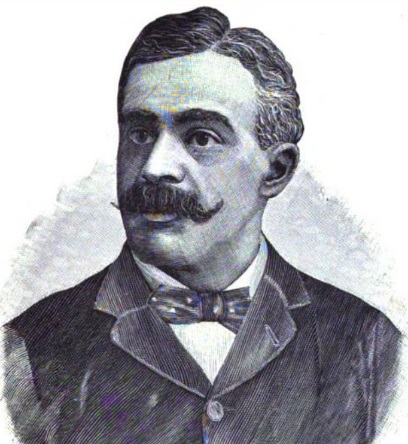
1844-1930
James C. Matthews, the first Black Judge in New York State, was born in New Haven, Connecticut in 1844. When Matthews was a child, his father, a barber, moved the family to Albany “where the schools were famed for their excellence, and had no color line.”[1] That distinction apparently changed some time after their arrival in Albany. Matthews, however, was able to remain in white schools thanks to the intervention of influential citizens and a professor who “plead for him, saying that he was so very bright and he did not want to lose him.”[2] In 1860, Matthews was one of only three students to win a scholarship to attend the prestigious Albany Academy from which he reportedly graduated with honors in 1864.
When both of his parents died in 1861, a pair of Quaker Abolitionists, Lydia Mott and Phebe Jones, stepped in to help raise the teenage Matthews.[3] In his later teens, Matthews was adopted by Francis Van Vranken, a Black barber with a large family. One of Matthews’s mentors, a wealthy Black merchant named William Dietz took the young man under his wing and introduced him to the National Convention of Colored Men.
After completing his education, Matthews worked as a bookkeeper at a hotel before deciding to study law with a local attorney, Jacob Werner. In 1868, Matthews enrolled in Albany Law School and in 1870 became the first Black person in the state to graduate from law school. Matthews was admitted to the New York bar in 1871 and opened a law practice in Albany.
In 1872, following passage of the 15th Amendment granting Black men the right to vote, Matthews voted for Ulysses Grant and the Republican Party. Within a short time, however, he switched his political allegiance to the Democratic Party and became an active supporter of Governor Samuel J. Tilden and, later, New York Governor and President Grover Cleveland.
In 1872, Matthews participated in a lawsuit against Albany’s Republican-controlled school board on behalf of his old mentor, William Dietz, who wanted his children to attend non-segregated schools. When the lawsuit was unsuccessful, the Black community responded with a vigorous lobbying campaign that ultimately led to the desegregation of Albany’s public schools in 1873.[4] As the integration of public schools gained momentum across the state, Matthews took up the cause of Black teachers who lost their jobs with the closure of Black schools. In 1884, he lobbied for a bill to protect the rights of Black teachers, which was eventually signed into law by then-Governor Grover Cleveland.
In 1885, President Cleveland nominated Matthews to succeed Frederick Douglass as Recorder of Deeds in Washington, D.C. As this was a recess appointment, Matthews served only a few months before the Republican-majority Senate returned to session and blocked his nomination. At a time when the promise of Reconstruction had begun to sour and federal patronage for Blacks had become a rarity, Matthews attracted the attention of the Black community for earning the patronage of a Democratic President. Republican opposition to Matthews put the GOP, which needed Black votes to win northern elections, in an awkward position. The era’s Black press, almost entirely Republican in outlook, looked askance at Black Democrats, but it still came to Matthews’s defense when it became clear that he was being opposed mainly for his political affiliation.[5]
. . . in this country any man had a right to think as he pleased; . . . the Republicans were not the keepers of the Negro conscience, nor should they be the suppressor of any man’s opinion. Men who had been life-long Republicans and who were still stalwart in their convictions and who were political antagonists of Mr. Matthews, nevertheless came to his rescue, believing that he was honest, sincere in his convictions and was entitled to the protection of his race; and that it was their bounden duty to see that he was not crushed because he chose to be a Democrat.[6]
Notwithstanding the Black community’s support, the appointment was formally rejected.
In 1895, Matthews became the first Black judge in New York State history when he was elected Judge of Albany’s Recorder’s Court, the city’s primary criminal court. He was endorsed for the position by the New York Times, which described him as a “bright and sharp man,” who “intellectually and as a lawyer . . . rises head and shoulders above many of his white brethren in the same profession.”[7] At the time, Matthews was the only Black person in the nation to hold such a high judicial post.[8] He lost his bid for reelection in 1899, the first time an incumbent judge had been challenged in 20 years.[9]
Matthews continued to practice law in Albany for another quarter century, handling criminal, divorce, insurance, mortgage and personal estate cases. He was a respected lawyer who was especially admired for his strong oratorical skills.
Matthews, justly remembered as a trailblazing lawyer and judge who broke down racial barriers and fought for Black civil rights and equality, died in Albany on November 1, 1930.
[1] Rev. William J. Simmons, Men of Mark: Eminent, Progressive and Rising, Geo. M. Rewell & Co., 1887, at 964-77.
[2] Id. at 964.
[3] “James Cambell Matthews (Class of 1870),” Albany Law School, available at James Campbell Matthews | Albany Law School. The two women were close personal friends of Frederick Douglass who had previously entrusted two of his daughters to their care for four years in the 1840s. See “James C. Matthews—First Elected African American Judge . . . From Albany!,” Friends of Albany History, Jan. 23, 2018, available at James C. Matthews – First Elected African American Judge … from Albany! – Friends of Albany History
[4] David A. Weinstein, People Ex Rel. King v. Gallagher and the Forgotten Legal Struggle over Racial Segregation in New York State Public Schools, CUNY Law Rev., Vol. 28, Iss. 1, Winter 2025, at 10; see also People ex rel. Dietz v. Easton, 13 Abb. Pr. (n.s.) 159 (N.Y.S. 3d 1872).
[5] Simmons at 972.
[6] Id. at 966.
[7] “A Negro Democrat,” New York Times, Oct. 29, 1895.
[8] “James Campbell Matthews, New York State Unified Court System, Third Judicial District, available at Matthews-Poster.pdf
[9] “James Campbell Matthews,” Albany Rural Cemetery Explorer, available at www.albany.edu/arce/MatthewsXX.html