
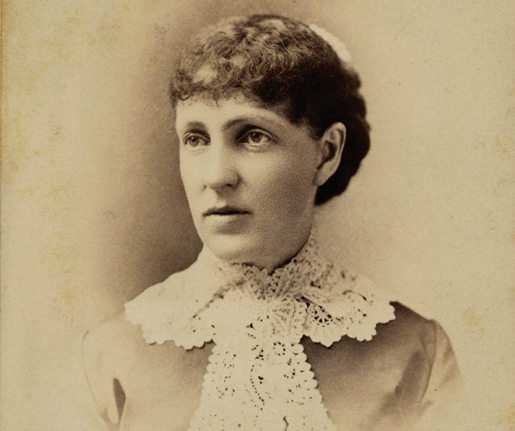
1841-1925
Early Life
Katherine “Kate” Stoneman was born in 1841 in Busti, a rural community in western New York’s Chautauqua County. Stoneman’s father was a farmer, lumberman and local justice of the peace, and her mother was a schoolteacher. Her “very liberal-minded” parents supported Stoneman’s educational ambitions. One of Stoneman’s brothers, John, was admitted to the bar in New York before moving to Iowa where he became a state senator and judge. Another brother, George, Jr., an 1842 West Point graduate and Brigadier General in command of the Union Army Cavalry, was elected Governor of California in 1883.[1] General Stoneman was famously memorialized for one of his cavalry raids in The Band’s “The Night They Drove Old Dixie Down.”[2]
In 1864, Stoneman moved to Albany to attend the State Normal School, the predecessor of the University of Albany. She supported herself by working as a copyist for Joel Tiffany, the State Reporter for the Court of Appeals. Upon graduating in 1866, Stoneman returned to the Normal School as a teacher of penmanship, drawing and geography, among the few subjects open to female educators at the college level.
Interest in Law and Women’s Suffrage
During this period, Stoneman was named executrix of a family member’s estate, an experience that further spurred her interest in the law. With the encouragement and assistance of Worthington W. Frothingham, an attorney friend of the family, she began to study law at night and on weekends.[3]
During this period Stoneman helped establish the Woman’s Suffrage Society of Albany and became a leader and active lobbyist in the crusade for voting rights. The suffrage movement won an important early victory in 1880 when the state legislature passed a bill empowering women to vote in school elections.[4] Stoneman was the first woman to cast a vote under the new law.
In 1885, after completing her legal studies under Frothingham, Stoneman became the first woman to pass the New York bar exam, including both the written and oral components.[5] The following year, she applied for admission to the bar to the General Term of the Supreme Court in Albany. As Stoneman herself recalled, the only occupations then open to women were “housekeeping, sewing, cooking, tailoring, domestic nursing, teaching in ‘dame’ schools and shop work.”[6]
Male Citizens Only
The Justices who reviewed Stoneman’s application denied it on the grounds that there were no precedents authorizing women to practice law, and the statute governing admission to the bar was limited to “male citizen[s] only.”[7] The court acknowledged that she was “well qualified for admissions,” but that “her sex was against her.”[8]
Not to be deterred, Stoneman and her suffragist allies across the state launched a strong lobbying campaign on behalf of a bill that had been introduced some months earlier by Assemblyman John I. Platt of Poughkeepsie. The bill, which removed the gender limitations on bar admission contained in section 56 of the Code of Civil Procedure, had not moved out of the judiciary committee. Stoneman’s lobbying campaign quickly dislodged the bill and within nine days it passed in both the Assembly and Senate. The amendment provided that “race or sex . . . shall constitute no cause for refusing . . . admission to practice in the courts . . . as an attorney and counselor.”[9]
First Woman Admitted to Practice
Governor David B. Hill signed the historic bill into law and Stoneman renewed her application to the General Term of Supreme Court. On May 22, 1886, the court granted Stoneman’s application and issued an order admitting the 45-year-old to the bar. She was the first woman admitted to practice in the state and among the first in the nation. Importantly, the law also eliminated racial barriers to bar admission.
Stoneman was wise to seek a legislative path. Litigation had run into a dead end in other states and the United States Supreme Court. More than a decade before Stoneman sought admission to the New York bar Myna Bradwell was denied admission to the Illinois bar after passing the state’s bar exam. Bradwell’s appeal to the Illinois Supreme Court was unavailing and the Supreme Court affirmed the denial of her application on the grounds that the practice and regulation of law was exclusively a state matter not covered under the federal constitution. Justice Joseph P. Bradley took the opportunity to publish a concurrence that was notable for asserting attitudes common for the time. In his view, “the natural and proper timidity and delicacy which belongs to the female sex evidently unfits it for many of the occupations of civil life,” including the practice of law. According to Justice Bradley, “[t]he paramount destiny and mission of women are to fulfill the benign offices of wife and mother. This is the law of the Creator.”[10]
Breaking Down Barriers
Stoneman’s pioneering efforts struck an inspiring chord nationwide. She was deluged with congratulatory telegrams from all over the country. A Kentucky newspaper congratulated her as the “first woman to break down the barriers of prejudice,” and described the elation of women who perceived Stoneman’s accomplishment as the harbinger of brighter days for oppressed women.[11] Speaking in 1887, Governor and former New York State Bar Association President David Hill, who signed into law the bill enabling Stoneman’s admission to the bar, welcomed “the fair sex in this new field of honor” and expressed the hope that its influence, “usually so potent for good,” would extend to other spheres.[12]
In 1896, at age 54, Stoneman enrolled in Albany Law School. Determined, perhaps, to prove that women could succeed in law school as well as men, she became the law school’s first female graduate in 1898.
It is unclear how extensively Stoneman ever practiced law, but her accomplishments were instrumental in opening the profession of law to women in New York and the United States. After law school Stoneman continued her college teaching career and devoted most of her energies to the suffrage and temperance movements and to advancing educational opportunities for women.
Final Years
When women in New York exercised their right to vote for the first time in 1918, Kate Stoneman was able to witness the landmark event first-hand as a poll watcher in Albany. Two years later, the 19th Amendment to the U.S. Constitution was adopted granting women the right to vote nationwide. Stoneman remarked on these revolutionary changes in her final years:
I cannot quite realize that this is the same world then and now. . . Everything seems to have changed so materially. . . It is as though the minds of the universe had been taken out to air, and had imbibed some new germs which have universally taken hold. But I enjoy it with the rest of mankind, and glory in the fact that while I cannot take an active part in things now, I am able to appreciate what the changes are, and can still respond to them.[13]
Katherine Stoneman died in Albany in 1925.
[1] Michelle Henry, “Katherine ‘Kate’ Stoneman: Raising the Bar for Women,” Judicial Notice, Iss. 12 (2017), at 15-16.
[2] Prof. Katheryn D. Katz, “Kate Stoneman: A Pioneer for Equality,” Pioneering Women Lawyers, Patricia E. Salkin, ed., American Bar Association, 2008, at 3.
[3] Id. at 16.
[4] “About Kate Stoneman: Lawyer, Pioneer, Suffragist,” Albany Law School, available at About Kate Stoneman | Albany Law School
[5] Katz, at 6.
[6] Geoffrey Williams & Carole Novick, “A Woman Who Wouldn’t Take No For An Answer,” Albany Law School Magazine, Union Univ., Spring 1992.
[7] Henry, at 17.
[8] Albany Law School, supra.
[9] Henry, at 19, fn. 6.
[10] Bradwell v. Illinois, 83 US 130, 141(1872) (Bradley, J. Concurring).
[11] Henry, at 18, quoting The Daily Evening Bulletin, May 24, 1886.
[12] Katz, at 7.
[13] Id. at 9, quoting Geraldine Muray, “Miss Stoneman, Pioneer Lawyer: First Woman in Profession Recalls Long Fight for Suffrage,” Albany Knickerbocker Pr., Feb. 19, 1919.