The Document Based Question/essay prompt You, the Juror was prepared in 2016 and the resources have not been updated since that time. For more information about recent legal developments, consult national and state newspapers, legal databases, and your librarian.
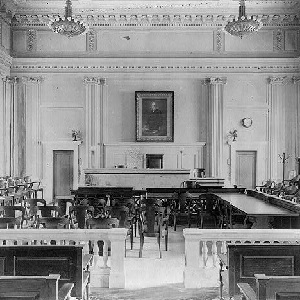
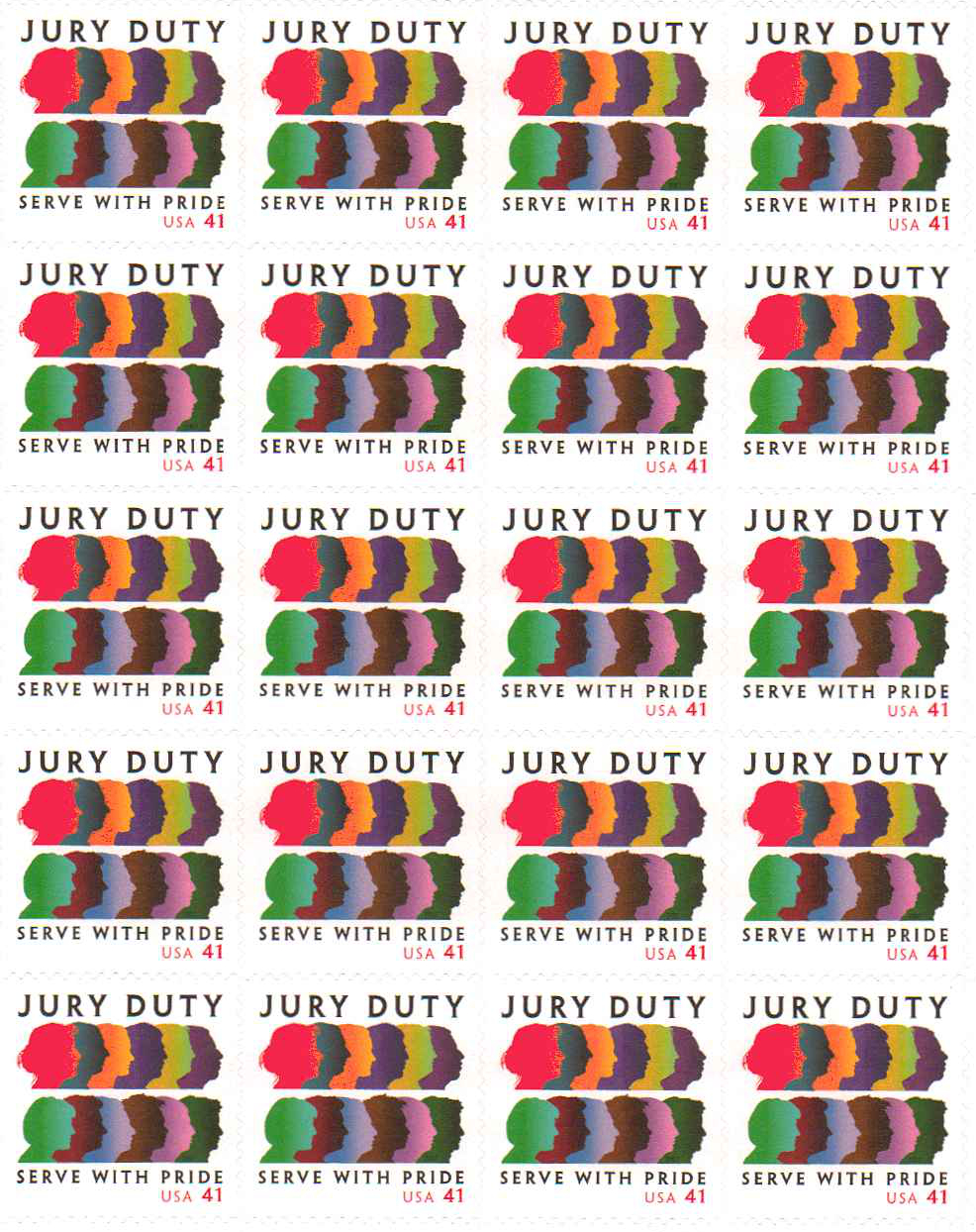
Jury service has evolved since the inception of the United States. Juries are intended to provide a fair and unbiased review of evidence during trials, but there was a time when not everyone was able to serve on them. Today we have universal jury service in both criminal and civil trials, ensuring community participation in the justice system. We ask the question, What role does jury service play in our democracy?
This activity meets the following guidelines of New York State’s Common Core Social Studies Framework (2017):
Rights, Responsibilities, and Duties of Citizenship: 12.G3c
Below is a list of the 2016 resources in a searchable table. Search by theme of resource: jury selection, race and juries, women and juries, or jury history.
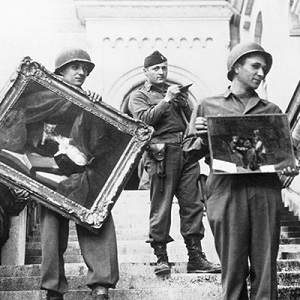
Role of the Courts in Restoring Cultural Objects to Their Owners
The Document Based Question/essay prompt Stolen Art: From the Holocaust to the Present was prepared in 2018 and the resources have not been updated since that time. For more information about recent legal developments, consult national and state newspapers, legal databases, and your librarian.
Throughout history, and particularly during World War II, cultural objects have been looted from museums and private families. In the name of justice, a global effort is underway to restore art objects to their rightful owners. We ask you to explore the role of the courts, and especially the role our NYS courts play, in reuniting families and institutions with possessions wrongly taken from them.
This activity meets the following guidelines of New York State’s Common Core Social Studies Framework (2017):
National Archives & Records Administration Documents at the National Archives helped shatter Switzerland's neutrality myth, and exposed Swiss culpability in ...
Created by Bard College Institute for Writing & Thinking
NYS Common Core Grades 11 & 12: United States History and Government Participation in Government and Civics
Justice and the New York Courts is a professional development workshop produced in partnership with the Society and Bard College Institute for Writing and Thinking. The workshop is geared to middle and high school teachers of Social Studies and English Language Arts, and aims to bring writing-rich pedagogical strategies into the classroom through the teaching of primary historical legal sources.
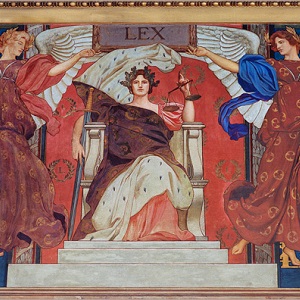
The workshops revolved around the question: What is the nature of an independent judiciary and what is its critical importance to our Federalist system of checks and balances? Texts used among others are Alexander Hamilton’s famous dissertation on the federal judiciary in The Federalist Papers (Federalist #78); the Preamble to the United States Constitution; the seminal New York 1860 slave case State of New York v. Lemmon; a contemporaneous journalistic response to this case; and recent articles addressing current debates and considerations surrounding the proper role of the judiciary.
Also included here as a PDF are the 5-12 (2016) grade common core requirements for literacy in History and Social Studies. While these requirements may evolve over time, they provide a general and helpful rubric for evaluating pedagogical strategies that promote discerning comprehension and effective communication.
This lesson plan meets the following guidelines of New York State’s Common Core Social Studies Framework (2017):
Created by Bard College Institute for Writing & Thinking
NYS Common Core Grades 11 & 12: United States History and Government Participation in Government and Civics
The purpose of this workshop is to provide tools for teachers to understand how to better help their students learn about the law. Featuring primary source documents from the era of John Locke to contemporary times, these materials include information about text rendering, collaborative reading, radical revision, process writing, and metacognitive thinking. Other tips for teachers include different types of informal writing, creating dialectical response journals, and different principles of writing.
This lesson plan meets the following guidelines of New York State’s Common Core Social Studies Framework (2017):
NYS Common Core Grades 7 & 8: History of the United States and New York
The purpose of this unit plan is to provide an introduction to the judicial branch of government and the role of the courts in American democracy. Students learn about conceptual matters of justice and the need for an independent judiciary; the structure of the court system in the United States; and how judges should be selected and how their roles should be conceived. Students also have the opportunity to view courts in action through a field trip to some of New York State’s courts while developing writing, critical thinking, and discussion skills.
This lesson plan meets the following guidelines of New York State’s Common Core Social Studies Framework (2017):
NYS Common Core Grades 11 & 12: United States History and Government Participation in Government and Civics
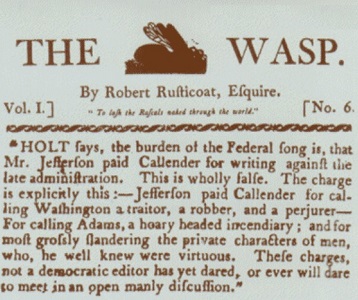
The case of People v. Croswell discusses concepts of criminal libel and sedition, in which Harry Croswell was accused of publishing defamatory statements about President Thomas Jefferson. Croswell’s defense argued that the charges were relics of an unenlightened era, where power and politics trumped reason and truth. Both in legal opinion and in the popular press, this unit, and these disputes, expose different perspectives on the relationships between truth and calumny; evidence and opinion; and national security and First Amendment rights.
This lesson plan meets the following guidelines of New York State’s Common Core Social Studies Framework (2017):
Created by Petra Riviere Adapted from Prof. Laura A. Hymson high school curriculum
NYS Common Core Grades 7 & 8: History of the United States and New York
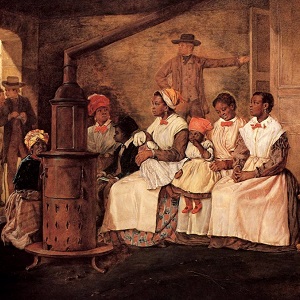
The Lemmon Slave Case provides students of U.S. history a window into the legal challenges and moral conflicts over slavery before the Civil War. This case requires a close examination of federal and state law. The New York courts freed slaves brought into the free state, while the United States Supreme Court decided Dred Scott was not free though he had traveled to a free state with his master’s family. Many curricula place a strong emphasis on the Dred Scott decision, but the Lemmon case shifts focus to New York and allows students to contemplate state’s rights implications and the interpretation of the law through a lens of human equality.
This lesson plan meets the following guidelines of New York State’s Common Core Social Studies Framework (2017):
Image Citation: Eyre Crowe, Slaves Waiting for Sale, Richmond, Virginia, 1861, via University of Virginia, The Atlantic Slave Trade and Slave Life in the Americas.
NYS Common Core Grades 11 & 12: United States History and Government Participation in Government and Civics
The Lemmon Slave Case provides students of U.S. history a window into the legal challenges and moral conflicts over slavery before the Civil War. This case requires a close examination of federal and state law. The New York courts freed slaves brought into the free state, while the United States Supreme Court decided Dred Scott was not free though he had traveled to a free state with his master’s family. Many curricula place a strong emphasis on the Dred Scott decision, but the Lemmon case shifts focus to New York and allows students to contemplate state’s rights implications and the interpretation of the law through a lens of human equality.
This lesson plan meets the following guidelines of New York State’s Common Core Social Studies Framework (2017):
Image Citation: Eyre Crowe, Slaves Waiting for Sale, Richmond, Virginia, 1861, via University of Virginia, The Atlantic Slave Trade and Slave Life in the Americas.
NYS Common Core Grades 11 & 12: United States History and Government Participation in Government and Civics
BHSEC welcomes new students each year with a Writing and Thinking Workshop in which students engage a topic in small groups and write, think and discuss the topic in depth. In 2010, the theme of this workshop was “Justice.” Students read from an anthology of sources that included some of the most read texts on the subject, starting with Plato and covering the Founding Fathers to Bob Dylan. The students then explored these ideas in their classrooms and in visits to courtrooms in New York City.
Topics include:
Foundations of Justice,
Bioethics,
Sports & Games,
Economic Justice,
Intellectual Property, Copyright & Fair Use, and
Dilemmas: Equality, Religious Freedom, Criminal Justice & Immigration.
This lesson plan meets the following guidelines of New York State’s Common Core Social Studies Framework (2017):