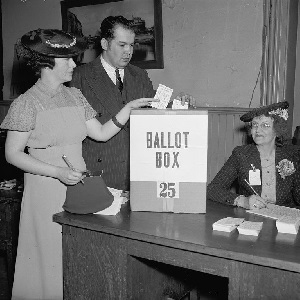
You, the Voter

The Document Based Question/essay prompt You, the Voter was prepared in 2017 and the resources have not been updated since that time. For more information about recent legal developments, consult national and state newspapers, legal databases, and your librarian.

Voting rights have evolved since the inception of the United States. Once a privilege of the elite, voting became a right of all citizens. However, recent events highlight the fact that there are still barriers to “one person, one vote.” We ask the questions, How far have we come? Is the journey over?

This activity meets the following guidelines of New York State’s Common Core Social Studies Framework (2017):

Below is a list of the 2017 resources in a searchable table. Search by theme of resource: winning the right to vote, barriers to voting, and election district boundaries.

Fear of Gridlock Coming True for New York’s Redistricting Panel

The Albany Times Union In 2014, a constitutional amendment passed that reformed the state's redistricting process -- though critics had ...

America’s Flawed Democracy: The Five Key Areas Where It is Failing

The Guardian This article examines the "five most glaring flaws exposed during the [2020] election cycle." It recognizes that some ...

Early Voting Lines are so Long, People are Fainting. That Harms Democracy

The Guardian In Georgia, some voters had to wait over two hours to cast their ballot in the heat. The ...

Drawing the Line on the Most Gerrymandered District in America

The Guardian The Supreme Court will review the long-running battle over line-drawing, but many fear that voters' voices may be ...

Securing Indian Voting Rights

Harvard Law Review This article asserts that Indians routinely face hurdles in exercising the right to vote and securing representation ...

50 Years of the Voting Rights Act: An Asian-American Perspective – Timeline & Report

Asian Americans Advancing Justice An article describing how the 1965 Voting Rights Act addressed voting discrimination against Asian-Americans, along with ...

Racial Quotas in Partisan Gerrymandering

University of Cincinnati Law Review An in-depth look at gerrymandering. Read More ...

The New Attack on Hispanic Voting

The New York Times Magazine How tactics to suppress minority voting flourished following the 2013 U.S. Supreme Court decision in Shelby ...

Native Americans Move to Frontlines in Battle Over Voting Rights

Reuters A growing number of Native Americans have become embroiled in court battles over changes to voting laws. Read More ...

Section 2 of Zero-Sums: How SCOTUS Misconstrued Voting Rights Act, Limits Minority Representation, and Pits Minorities Against Each Other

Stanford Law Review The author claims that the U.S. Supreme Court misconstrued the Voting Rights Act, limiting minority representation and ...

Protecting Voting Rights of American Indians and Alaska Natives: Video

U.S. Department of Justice Attorney General Eric Holder criticized election practices that adversely affect the ability of American Indian and ...

U.S. v. Susan B. Anthony: The Fight for Women’s Suffrage

Federal Judicial Center In the federal election in November 1872, Susan B. Anthony, a New York advocate of women's suffrage, ...

Drawing the Line: How Redistricting Turned America from Blue to Red

The New Yorker This New Yorker article examines the history of gerrymandering and David Daley's book Ratf*cked, which examines the legacy of the Redmap ...

Politicization of Voting Laws: The Impact of Voter IDs and Other Restrictions

Harvard Civil Rights - Civil Liberties Law Review This article suggests that although the U.S. Supreme Court decision in Shelby decreased the ...

Jim Crow in New York

Brennan Center for Justice This article focuses on the historical disenfranchisement of African-Americans in New York. Read More ...

A Dream Undone

The New York Times An in-depth article on the circumstances that led to the 1965 Voting Rights Act and the ...

Understanding Congressional Gerrymandering: ‘It’s Moneyball Applied to Politics’ – Audio & Transcript

NPR An interview with David Daley, author of a book about the 2010 Republican efforts to target state legislative seats ...

The House Isn’t Competitive in 2016. But Gerrymandering is on Trial

The Washington Post A short article indicating that supporters of taking politics out of redistricting got a win when the ...

What’s Behind the Voter Fraud Witch Hunt?

Brennan Center for Justice This article examines whether the voter fraud allegations that underlie the new voter identification laws are ...

A History of Voting Rights: Video

The New York Times A video on the significance of the 1965 Voting Rights Act produced in reaction to the ...

Campaign 2016 and Voting Rights: Video

C-SPAN This video focuses on the 2016 election and voting rights, including court cases on voter identification laws and the ...

Voter Identification Requirements

National Conference of State Legislatures A descriptive listing of the states with voter identification laws. Read More ...

Gerrymandering: How Drawing Jagged Lines Can Impact an Election – Video

TED-Ed From "packing" a district to "cracking" a district, learn how the shape of districts impacts political parties during election ...

The Supreme Court’s Identity Crisis on Voting Rights

The New York Times Linda Greenhouse notes that the U.S. Supreme Court decision in Shelby has cut the heart out of ...

The Fight for the Right to Vote: Video

TED-Ed This video from Technology, Entertainment and Design (TED) traces the history of the right to vote in the United ...

Judges Find Wisconsin Redistricting Unfairly Favored Republicans

The New York Times A panel of judges found Wisconsin's 2011 remapping to be unconstitutional. Read More ...

How New Voter ID Laws May Affect the 2016 Presidential Contest: Video

PBS Since the Shelby decision, States no longer to have clear changes to voting laws with the Department of Justice. This has ...


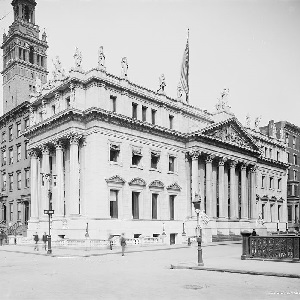
Image Citation: Library of Congress, Prints & Photographs Division, LC-DIG-hec-24529.
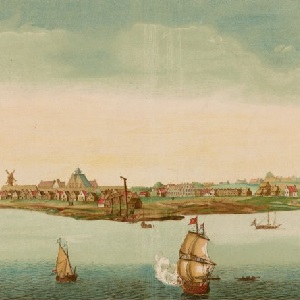
New Amsterdam, New York, and Colonial Law in the New World

in The Origins and Development of American Legal History in New York City (1609-1865)
Lesson 1

Created by Dr. Aaron Welt,  
Judith S. Kaye Teaching Fellow

NYS Common Core Grades 11 & 12:
United States History and Government
Participation in Government and Civics

This is the first in a series of five lesson plans designed to familiarize upper-level high school and college students with the early history of American law, with a specific focus on New York City. These lesson plans utilize online resources provided by the Historical Society of the New York Courts and aim to introduce students to the major events and turning points that help us understand how American law, courts, and the criminal justice system developed in early US history. The lesson plans are divided chronologically and thematically, but are meant to be instructed in conversation with one another. For each of the outlined class activities, students should write down their answers to submit to the instructor. 

This lesson plan meets the following guidelines of New York State’s Common Core Social Studies Framework (2017):

  • Colonial Foundations: 11.1c


The Historical Society’s website contains a wealth of related resources, including descriptions of cases and biographies of judges who decided the cases. 

New York Under Dutch Rule
Legal History by Era

The Eight Men (1643-1647) & The Remonstrance of Manhatas
Petition to the Dutch Parliament

The Nine Men & the 1649 Remonstrance of the Commonality of the New Netherland
Petition to the Dutch Parliament

Colonial New York Under British Rule
Legal History by Era

Crown v. William Prendergast
1766

Hon. Daniel Horsmanden
Chief Justice of the New York Supreme Court of Judicature
Presided over the case


Image Citation: The New York Public Library, The Miriam and Ira D. Wallach Division of Art, Prints and Photographs: Picture Collection

 
Revolutionary New York and the Origins of American Law
Lesson 2

Revolutionary New York and the Origins of American Law

in The Origins and Development of American Legal History in New York City (1609-1865)
Lesson 2

Created by Dr. Aaron Welt,  
Judith S. Kaye Teaching Fellow

NYS Common Core Grades 11 & 12:
United States History and Government
Participation in Government and Civics

This series of five lesson plans is designed to familiarize upper-level high school and college students with the early history of American law, with a specific focus on New York City. These lesson plans utilize online resources provided by the Historical Society of the New York Courts and aim to introduce students to the major events and turning points that help us understand how American law, courts, and the criminal justice system developed in early US history. The lesson plans are divided chronologically and thematically, but are meant to be instructed in conversation with one another. For each of the outlined class activities, students should write down their answers to submit to the instructor. 

This lesson plan meets the following guidelines of New York State’s Common Core Social Studies Framework (2017):

  • Constitutional Foundations: 11.2c, 11.2d
  • Civil Rights and Civil Liberties: 12.G2f


The Historical Society’s website contains a wealth of related resources, including descriptions of cases and biographies of judges who decided the cases. 

People v. Frothingham
1779

Alexander Hamilton
Lawyer
Called for prosecution of Frothingham

Josiah Hoffman
New York Attorney General
Counsel for prosecution

Brockholst Livingston
Lawyer and future judge
Counsel for defense

Hon. Jacob Radcliff
New York Supreme Court of Judicature Justice
Presided over the case

People v. Croswell
3 Johns. Cas. 337 (N.Y. 1804)

Ambrose Spencer
New York Attorney General
Counsel for prosecution

Hon. Morgan Lewis
Chief Justice of the New York Supreme Court of Judicature

Alexander Hamilton
Lawyer
Counsel for defense on a writ of
certiorari

People v. Croswell: Alexander Hamilton and the Transformation of the Common Law of Libel
Judicial Notice Article

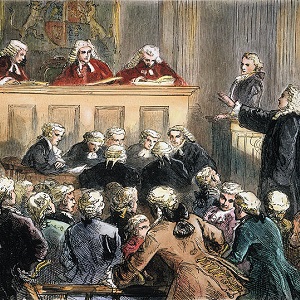
Image Citation: John Peter Zenger /N(1697-1746). American Printer And Journalist. Andrew Hamilton Defending Zenger At His Trial For Seditious Libel In New York In 1735. Wood Engraving, 19Th Century.

New Amsterdam, New York, and Colonial Law in the New World
Lesson 1
Crime and Criminal Justice in Antebellum New York City
Lesson 3

Crime and Criminal Justice in Antebellum New York City

in The Origins and Development of American Legal History in New York City (1609-1865)
Lesson 3

Created by Dr. Aaron Welt,  
Judith S. Kaye Teaching Fellow

NYS Common Core Grades 11 & 12:
United States History and Government
Participation in Government and Civics

This series of five lesson plans is designed to familiarize upper-level high school and college students with the early history of American law, with a specific focus on New York City. These lesson plans utilize online resources provided by the Historical Society of the New York Courts and aim to introduce students to the major events and turning points that help us understand how American law, courts, and the criminal justice system developed in early US history. The lesson plans are divided chronologically and thematically, but are meant to be instructed in conversation with one another. For each of the outlined class activities, students should write down their answers to submit to the instructor. 

This lesson plan meets the following guidelines of New York State’s Common Core Social Studies Framework (2017):

  • Expansion, Nationalism, and Sectionalism: 11.3a


The Historical Society’s website contains a wealth of related resources, including descriptions of cases and biographies of judges who decided the cases. 

Revolution and the Emerging State
Legal History by Era

People v. Levi Weeks

People v. Levi Weeks
1800

Alexander Hamilton
Lawyer for Defense

Aaron Burr
Lawyer for Defense

Brockholst Livingston
Lawyer for Defense

Cadwallader David Colden
Assistant Attorney General

Hon. John Lansing, Jr.
Chief Justice of the New York Supreme Court of Judicature

People v. Barrett and Ward

People v. Barrett and Ward
2 Caines 340; 1 Johns. R. 66 (N.Y. 1806)

Hon. Brockholst Livingston
Justice of the New York Supreme Court of Judicature

Hon. Daniel Tompkins
Justice of the New York Supreme Court of Judicature

Hon. Ambrose Spencer
Justice of the New York Supreme Court of Judicature

Hon. Smith Thompson
Justice of the New York Supreme Court of Judicature

Hon. James Kent
Chief Justice of the New York Supreme Court of Judicature

People v. Ruggles

People v. Ruggles
8 Johns. 290 (1811)

Hon. James Kent
Chief Justice of the New York Supreme Court of Judicature
Delivered Opinion of a Unanimous Court

People v. Christian Smith
1 American State Trials 779 (1814)
2 New-York City-Hall Recorder 77 (June 1817)

Hon. William W. Van Ness
Justice of the New York Supreme Court of Judicature

Prosecution of Dr. Smith Boughton

The Anti-Rent War Prosecution of Dr. Smith Boughton
1845

Hon. Amasa Parker
Judge of the Court of Oyer and Terminer
First Trial

Hon. John W. Edmonds
Judge of the Court of Oyer and Terminer
Second Trial

John Van Buren
New York Attorney General

Theodore Miller
County District Attorney

Ambrose L. Jordan
Lawyer for the Defense

Image Citation: The New York Public Library, The Miriam and Ira D. Wallach Division of Art, Prints and Photographs: Picture Collection.

Revolutionary New York and the Origins of American Law
Lesson 2
New York’s Courts and the People Behind Them
Lesson 4

New York’s Courts and the People Behind Them

  • Foundations of American Democracy: 12.G1d


The Historical Society’s website contains a wealth of related resources, including descriptions of cases and biographies of judges who decided the cases. 

“Duely and Constantly Kept”: A History of the New York Supreme Court, 1691-1847 and Inventory of its Records, 1797-1847
“Duely and Constantly Kept” — 2023 Update
A Joint Publication of the Historical Society of the New York Courts, New York Court of Appeals and the New York State Archives

Chief Judges Timeline
A Timeline of Chief Judges & Their Associate Judges on the New York Court of Appeals

New York Attorneys General
1847-1869

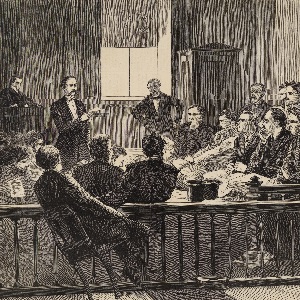
Image Citation: Winslow Homer, Jurors Listening to Counsel, Supreme Court, New City Hall, New York, from Harper’s Weekly, February 20, 1869, 1869, wood engraving on paper, image: 9 1/8 x 13 3/4 in. (23.2 x 34.9 cm), Smithsonian American Art Museum, The Ray Austrian Collection, gift of Beatrice L. Austrian, Caryl A. Austrian and James A. Austrian, 1996.63.73.

Crime and Criminal Justice in Antebellum New York City
Lesson 3
The Civil War, Race, and the Law in New York City 
Lesson 5


in The Origins and Development of American Legal History in New York City (1609-1865)
Lesson 4

Created by Dr. Aaron Welt,  
Judith S. Kaye Teaching Fellow

NYS Common Core Grades 11 & 12:
United States History and Government
Participation in Government and Civics

This series of five lesson plans is designed to familiarize upper-level high school and college students with the early history of American law, with a specific focus on New York City. These lesson plans utilize online resources provided by the Historical Society of the New York Courts and aim to introduce students to the major events and turning points that help us understand how American law, courts, and the criminal justice system developed in early US history. The lesson plans are divided chronologically and thematically, but are meant to be instructed in conversation with one another. For each of the outlined class activities, students should write down their answers to submit to the instructor. 

This lesson plan meets the following guidelines of New York State’s Common Core Social Studies Framework (2017):

  • Foundations of American Democracy: 12.G1d


The Historical Society’s website contains a wealth of related resources, including descriptions of cases and biographies of judges who decided the cases. 

“Duely and Constantly Kept”: A History of the New York Supreme Court, 1691-1847 and Inventory of its Records, 1797-1847
“Duely and Constantly Kept” — 2023 Update
A Joint Publication of the Historical Society of the New York Courts, New York Court of Appeals and the New York State Archives

Chief Judges Timeline
A Timeline of Chief Judges & Their Associate Judges on the New York Court of Appeals

New York Attorneys General
1847-1869

Image Citation: Winslow Homer, Jurors Listening to Counsel, Supreme Court, New City Hall, New York, from Harper’s Weekly, February 20, 1869, 1869, wood engraving on paper, image: 9 1/8 x 13 3/4 in. (23.2 x 34.9 cm), Smithsonian American Art Museum, The Ray Austrian Collection, gift of Beatrice L. Austrian, Caryl A. Austrian and James A. Austrian, 1996.63.73.

Crime and Criminal Justice in Antebellum New York City
Lesson 3
The Civil War, Race, and the Law in New York City 
Lesson 5


The Civil War, Race, and the Law in New York City

in The Origins and Development of American Legal History in New York City(1609-1865)
Lesson 5

Created by Dr. Aaron Welt,
Judith S Kaye Teaching Fellow

NYS Common Core Grades 11 & 12:
United States History and Government
Participation in Government and Civics

This series of five lesson plans is designed to familiarize upper-level high school and college students with the early history of American law, with a specific focus on New York City. These lesson plans utilize online resources provided by the Historical Society of the New York Courts and aim to introduce students to the major events and turning points that help us understand how American law, courts, and the criminal justice system developed in early US history. The lesson plans are divided chronologically and thematically, but are meant to be instructed in conversation with one another. For each of the outlined class activities, students should write down their answers and submit them to the instructor.

This lesson plan meets the following guidelines of New York State’s Common Core Social Studies Framework (2017):

  • Expansion, Nationalism, and Sectionalism: 11.3b, 11.3c


The Historical Society’s website contains a wealth of related resources, including descriptions of the cases and biographies of the judges who decided the cases.

The Lemmon Slave Case: The Superior Court Judgment

The Lemmon Slave Case
Judicial Notice Article

Louis Napoleon
Conductor on the Underground Railroad

Chester Arthur
Lawyer for the Enslaved People

John Jay
Lawyer for the Enslaved People

Erastus Culver
Lawyer for the Enslaved People

Henry Lapaugh
Lawyer for the Lemmons

Elijah Paine
Superior Court Judge

The Lemmon Slave Case: Appeals to the Court of Appeals

William Evarts
Lawyer for New York

Charles O’Conor
Lawyer for the Lemmons

Samuel Foot
Former Court of Appeals Judge

William Wright
Court of Appeals Judge, Affirmed

Hiram Denio
Court of Appeals Judge, Affirmed

Thomas Clerke
Court of Appeals Judge, Dissented

George Comstock
Court of Appeals Judge, Dissented

Samuel Selden
Court of Appeals Judge, Dissented

Elizabeth Jennings v. Third Avenue Railroad Co. 

Jennings v. Third Avenue Railroad Co. 
1854

Chester Arthur
Lawyer for Elizabeth Jennings

Hon. William Rockwell
Brooklyn Circuit Court Judge

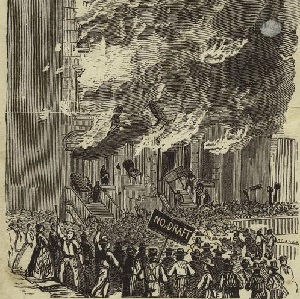
New York City Draft Riot Cases

Court Cases Related to the New York City Draft Riots
1864

Hon. John McCunn
New York City Judge

Hon. Samuel Nelson
Justice of the New York Supreme Court of Judicature

Image Citation: The New York Public Library, The Miriam and Ira D. Wallach Division of Art, Prints and Photographs: Picture Collection

New York’s Courts and the People Behind Them
Lesson 4

Writing to Read Democracy: Guided Document Analysis

in Writing to Read Democracy in New York State & The United States
Activity 1

Created by Prof. Seth Halvorson & Dr. Erica Kaufman
Bard College Institute for Writing & Thinking

NYS Common Core Grades 7 & 8:
History of the United States and New York State I & II

This document-based sequence of activities invites students to chart the dialog between the New York State Courts, the Federal Courts, and other State Courts regarding the scope of individual rights. Generally speaking, New York State Courts are more protective of individual rights than Federal Courts and more so than other State Courts as well. The central question is: How have the New York State Courts understood the scope of individual rights? 

Focusing on the New York State Constitution, this activity blends IWT’s writing to read strategies with students’ understanding of what the rights of NYS citizens are through individual and collaborative critical thinking.

This lesson plan meets the following guidelines of New York State’s Common Core Social Studies Framework (2016):

  • The Constitution in Practice: 7.5a
  • Domestic Politics and Reform: 8.9b, 8.9e


Lesson Overview PDF

IWT’s Core Writing (& Reading) Practices PDF

Document Packet PDF


Freedom of Expression in the NYS Constitution PDF


The Historical Society’s website contains a wealth of related resources related to this unit.

New York State Constitution
1777

Image Citation: Library of Congress, Prints & Photographs Division, LC-DIG-det-4a10836.

 
Writing to Read Democracy: Written Conversations & Dialectical Notebooks
Collaborative Close Reading

Lesson 2

Writing to Read Democracy: Written Conversations & Dialectical Notebooks–Collaborative Close Reading

in Writing to Read Democracy in New York State & The United States
Activity 2

Created by Prof. Seth Halvorson & Dr. Erica Kaufman
Bard College Institute for Writing & Thinking

NYS Common Core Grades 7 & 8:
History of the United States & New York State I & II

This document-based sequence of activities invites students to chart the dialog between the New York State Courts, the Federal Courts, and other State Courts regarding the scope of individual rights. Generally speaking, New York State Courts are more protective of individual rights than Federal Courts and more so than other State Courts as well. The central question is: How have the New York State Courts understood the scope of individual rights? 

Using the New York State Constitution and US Constitution, this activity blends IWT’s writing to read strategies with students’ understanding of what the rights of NYS citizens are through individual and collaborative critical thinking. The end goal of this activity is to engage in reflective process talk focused on the two documents placed in conversation.

This unit plan meets the following guidelines of New York State’s Common Core Social Studies Framework (2016):

  • The Constitution in Practice: 7.5a
  • Domestic Politics and Reform: 8.9b, 8.9e


Lesson Overview PDF

IWT’s Core Writing (& Reading) Practices PDF

Document Packet PDF


Freedom of Expression in the NYS Constitution PDF

The First and Fourth Amendments to the US Constitution PDF


The Historical Society’s website contains a wealth of related resources related to this unit.

New York State Constitution
1777

New York & Ratification of the Federal Constitution
1787

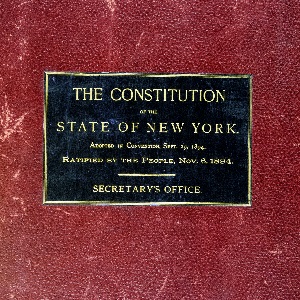
Image Citation: New York State Archives. New York (State). Secretary of State. Fourth constitution of the State of New York, 1894. A1807-78.

Writing to Read Democracy: Guided Document Analysis
Lesson 1
Writing to Read Democracy: Case Law Jigsaw
Lesson 3

Writing to Read Democracy: Case Law Jigsaw

in Writing to Read Democracy in New York State & The United States
Activity 3

Created by Prof. Seth Halvorson & Dr. Erica Kaufman
Bard College Institute for Writing & Thinking

NYS Common Core Grades 7 & 8:
History of the United States and New York State I & II

This document-based sequence of activities invites students to chart the dialog between the New York State Courts, the Federal Courts, and other State Courts regarding the scope of individual rights. Generally speaking, New York State Courts are more protective of individual rights than Federal Courts and more so than other State Courts as well. The central question is: How have the New York State Courts understood the scope of individual rights? 

Developed by psychologist Elliot Aronson, the “jigsaw” is a collaborative learning technique easily adaptable for students of all ages and levels. Students are organized into groups and given specific tasks so that each student is integral to the success (or understanding) of the entire class. What follows is a modification of the “jigsaw” that aims to foster critical reading and questioning across a range of different (and contrasting) primary documents that address New York State Shield Law and freedom of expression.

This unit plan meets the following guidelines of New York State’s Common Core Social Studies Framework (2017):

  • The Constitution in Practice: 7.5a
  • Domestic Politics and Reform: 8.9b, 8.9e


Lesson Overview PDF

IWT’s Core Writing (& Reading) Practices PDF

Document Packet PDF


Case Law Jigsaw Instructions & Activity PDF

Case 1: Shield Law Documents PDF


The Historical Society’s website contains a wealth of related resources related to this unit.

Hon. Victoria A. Graffeo
Court of Appeals Judge
Wrote the majority opinion of Holmes v. Winter

Hon. Jonathan Lippman
Court of Appeals Chief Judge
Concurred with majority opinion

Hon. Sheila Abdus-Salaam
Court of Appeals Judge
Concurred with majority opinion

Hon. Jenny Rivera
Court of Appeals Judge
Concurred with majority opinion

Hon. Robert S. Smith
Court of Appeals Judge
Dissented and affirmed in separate opinion

Hon. Eugene F. Pigott, Jr. 
Court of Appeals Judge
Dissented and concurred with Judge Smith’s opinion

Hon. Susan Phillips Read
Court of Appeals Judge
Dissented and affirmed for the reasons described in the Appellate Division’s opinion (110 AD3d 134)

Image Citation: Library of Congress, Prints & Photographs Division, Farm Security Administration/Office of War Information Black-and-White Negatives, LC-USW3-033817-C.

Writing to Read Democracy: Written Conversations & Dialectical Notebooks
Collaborative Close Reading

Lesson 2
Writing to Read Democracy: Document-Based Essay in Miniature
Lesson 4

Writing to Read Democracy: Document-Based Essay in Miniature

in Writing to Read Democracy in New York State & The United States
Activity 4

Created by Prof. Seth Halvorson & Dr. Erica Kaufman
Bard College Institute for Writing & Thinking

NYS Common Core Grades 7 & 8:
History of the United States and New York State I & II

This document-based sequence of activities invites students to chart the dialog between the New York State Courts, the Federal Courts, and other State Courts regarding the scope of individual rights. Generally speaking, New York State Courts are more protective of individual rights than Federal Courts and more so than other State Courts as well. The central question is: How have the New York State Courts understood the scope of individual rights? 

Given that the “document-based question” (DBQ) appears frequently in high school history curricula, this activity and assignment aims to help students to understand the process of writing a DBQ, from understanding the assignment and documents to writing the essay itself. Most DBQ’s involve at least five primary documents, so this activity asks students to draw on any of the documents they’ve worked with thus far, as well as an additional three documents focused on “Stop and Frisk” (nine documents total).

This unit plan meets the following guidelines of New York State’s Common Core Social Studies Framework (2016):

  • The Constitution in Practice: 7.5a
  • Domestic Politics and Reform: 8.9b, 8.9e


Lesson Overview PDF

IWT’s Core Writing (& Reading) Practices PDF

Document Packet PDF


High School Document-Based Activity Packet PDF

Middle School Document-Based Activity Packet PDF

Case 1: Shield Law Documents PDF

Case 2: “Stop and Frisk” Documents PDF


The Historical Society’s website contains a wealth of related resources related to this unit.

Hon. Victoria A. Graffeo
Court of Appeals Judge
Wrote the majority opinion of Holmes v. Winter

Hon. Jonathan Lippman
Court of Appeals Chief Judge
Concurred with majority opinion

Hon. Sheila Abdus-Salaam
Court of Appeals Judge
Concurred with majority opinion

Hon. Jenny Rivera
Court of Appeals Judge
Concurred with majority opinion

Hon. Robert S. Smith
Court of Appeals Judge
Dissented and affirmed in separate opinion

Hon. Eugene F. Pigott, Jr. 
Court of Appeals Judge
Dissented and concurred with Judge Smith’s opinion

Hon. Susan Phillips Read
Court of Appeals Judge
Dissented and affirmed for the reasons described in the Appellate Division’s opinion (110 AD3d 134)

Image Citation: The New York Public Library, Manuscripts and Archives Division, Barbara Gittings and Kay Tobin Gay History Papers and Photographs.

Writing to Read Democracy: Case Law Jigsaw
Lesson 3
Rights and the Courts: Classroom Debates about Freedom of Religion
Lesson 5
×
Product added to cart

Subtotal: $4,375.00

View cartCheckout