
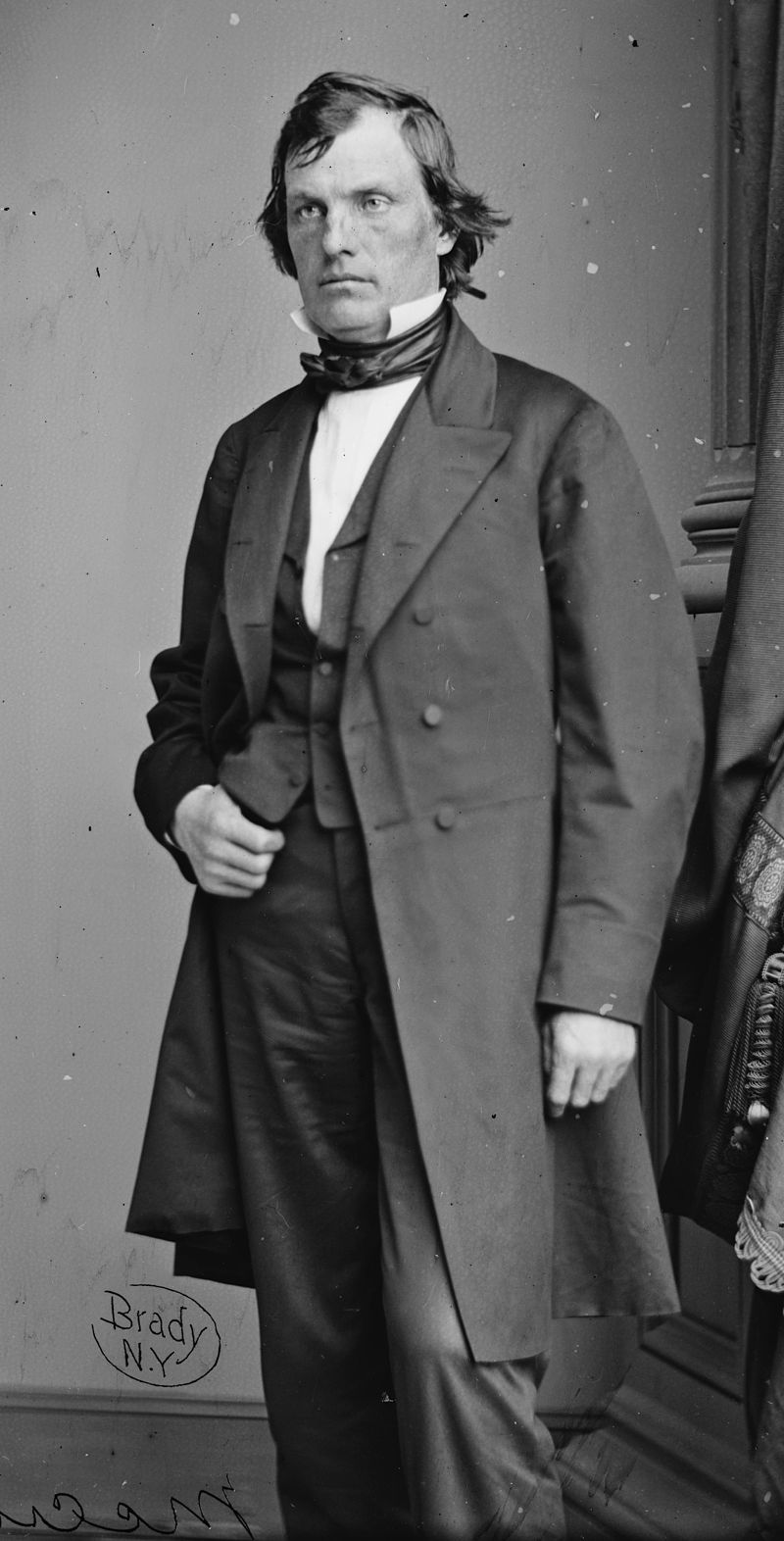
1825-1873
John H. McCunn was born in Londonderry County, Ireland, in 1825. A self-made man, he arrived in New York in 1841 at the age of 16, on board the ship Ironsides. Failing to find work in New York, McCunn moved to Philadelphia and commenced an apprenticeship, but soon returned to New York, determined to become a lawyer.
McCunn approached a fellow Irishman, the attorney Charles O’Conor, who at that time was a member of the firm of Boardman & Benedict. O’Conor, who would later play a major role in Boss Tweed‘s prosecution, arranged for McCunn to become a messenger in that law office, and afterward took an interest in the young man’s advancement. McCunn appears to have acquired a knowledge of law sufficient for admission to practice by the age of 21 and he formed a partnership with James Moncrief, specializing in commercial and real estate transactions. In 1855, he built a handsome Anglo-Italianate house at No. 411 West 22nd Street.
When his partner, Moncrief, was elected to the bench, McCunn set up a new law firm — McCunn, Swartout & Fine — and became involved with Tammany Hall. He was nominated for the office of City Judge and elected in 1860. Three years later, he left the bench to join the Sixty-Ninth Regiment as a Captain of Engineers. Subsequently, he recruited the Thirty-Seventh Regiment New-York Volunteers and was commissioned as Colonel of that regiment. McCunn left the bench at the outbreak of the Civil War to join the 69th Regiment as a Captain of Engineers. He later recruited the members of the 37th Regiment of New York Volunteers and was commissioned Colonel of that regiment. He was cited for gallantry in battle and brevetted a Brigadier-General. However, he resigned from the Army in 1863 to avoid being court-martialed for disparaging his commanding officer.
Upon returning to New York, he was elected a Judge of the Superior Court on the Tammany Hall ticket and reelected in 1870. McCunn was considered “agreeable and popular with the rougher classes of society, being always anxious to keep them favorable to him.” [1] However, as a judge he was “widely viewed as an ignorant and corrupt political hack,”[2] and “[a]s a politician, he was mistrusted, even by those with whom he labored.”[3]
In 1872, following an investigation into judicial corruption by the Association of the Bar of the City of New York, which led to Judge McCunn’s impeachment by the state Assembly, he was tried by the New York Court for the Trial of Impeachments, consisting of the Judges of the New York Court of Appeals and the members of the New York State Senate. McCunn was removed from office after his conviction for issuing numerous illegal and corrupt orders appointing individuals as receivers with whom he then conspired to defraud the parties appearing before him of money and property for his own personal gain.[4]
“On returning home from the State Capital on Wednesday night much fatigued by the heat and his journey, being also exceedingly excited mentally over the action of the Senate in finding him guilty of malconduct and malfeasance in office, and voting for his removal from the Bench, he expressed the opinion to his family ‘that he would not live through the trial he was being subjected to, and thought that he had been cruelly treated.’” Indeed, he died only days later, on July 6, 1872.
Sources
Hon. L. Bradford Prince, chairman of the Committee. Charges of the Bar Association of New York against George G. Barnard and Albert Cardozo and John H. McCunn, and testimony thereunder taken before the Judiciary Committee of the Assembly of the State of New York, 1872.
New York Times. Obituary, Judge John H. McCunn, July 7, 1872, p. 1.
[1] Obituary: Judge John H. McCunn, New York Times, July 7, 1872.
[2] Andrew L. Kaufman, The First Judge Cardozo: Albert, Father of Benjamin, Journal of Law and Religion, Vol 11, No. 1, 1994-95, at 279.
[3] New York Times, July 7, 1872
[4] Hon. L. Bradford Prince, chairman of the Committee. Charges of the Bar Association of New York against George G. Barnard and Albert Cardozo and John H. McCunn, and testimony thereunder taken before the Judiciary Committee of the Assembly of the State of New York, 1872.