
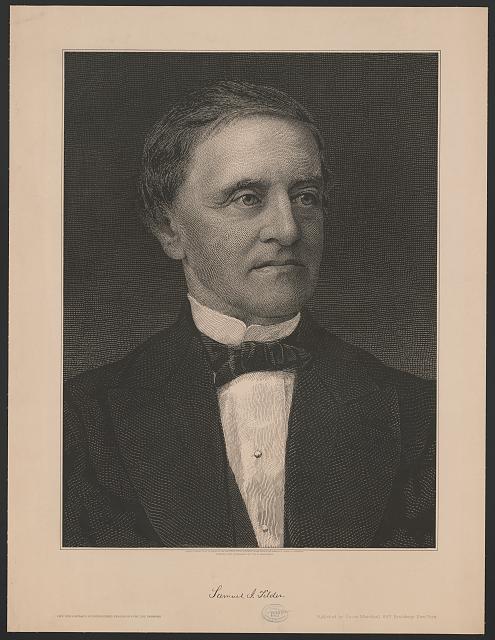
1814-1886
Early Life and Education
Samuel J. Tilden was born in 1814 in New Lebanon, Columbia County. His father, a moderately prosperous farmer and storekeeper, was a close friend of Columbia County native Martin Van Buren, who would go on to serve as Governor of New York and Vice President and President of the United States. The intellectually gifted Tilden became a protégé of Van Buren (later serving as his mentor’s investment agent and lawyer) and quickly made a name for himself in upstate Democratic circles.[1]
Tilden entered Yale College in 1833 where he was a classmate of William M. Evarts. He left after one semester due to “health issues (or, less charitably, hypochondriacal tendencies) and in part because his interest in politics distracted him from his studies.”[2] Tilden moved to New York City and enrolled in New York University where he studied law in between leaves of absence to care for his health, work in Van Buren’s successful 1836 presidential campaign and study law under John Edmonds, a future State Supreme Court Justice (1847-1853).
Early Years in Politics and Law
Tilden was admitted to the bar in 1841 and began practicing law at 13 Pine Street. He remained politically active and supported Van Buren’s unsuccessful reelection campaign in 1840. In 1843, he was appointed Corporation Counsel of New York City. Though he served only a year he gained valuable trial experience. In 1844, he was a delegate to the Democratic National Convention which nominated James K. Polk for the presidency. In 1846, he was elected to the State Assembly from Columbia County and served as a delegate to the State Constitutional Convention held that year. He also became editor of the Argus, Albany’s Democratic newspaper. During that period Tilden was aligned with the more radical “Barnburner” wing of the Democratic Party, which opposed the spread of slavery into new territories.[3] While serving in the Assembly, Tilden gained distinction for his service as Chair of a Committee that devised a compromise bill to settle the “rent war” between landlords and tenant farmers in the Hudson Valley region.
After leaving the Assembly Tilden turned down lucrative political appointments to focus on his legal practice representing large corporations, including some of the nation’s largest railroads. He became an expert in corporate reorganizations and soon became “[o]ne of the richest corporation lawyers in the nation,” with “a list of clients whose names read like a who’s who of American business.”[4] He proved equally astute as an investor, adding to his wealth.[5]
In 1857, Tilden represented the heirs of Dr. Burdell, a prosperous dentist found brutally murdered in the boarding home of Emma Cunningham, with whom Burdell had been romantically involved. After Cunningham was tried and acquitted of Burdell’s murder she claimed to have been secretly married to him and thus entitled to a one-third marital share of his estate. Tilden defeated her claim and received high praise for his meticulous research and skillful cross examination demonstrating that Burdell was out of town at the time of the purported marriage.[6]
Cold, Self-Centered and Vain
Though he was a brilliant lawyer, Tilden spoke in a flat, nasal voice and was not considered a great orator by the standards of his day. [7] He had a “round, clean-shaven face, short hair, blue eyes, and a high forehead.”[8] “Sickly since childhood” and “frequently bedridden with colds and flus, Tilden was private and reserved and tended to distance himself from casual human contact.”[9] Tilden struck many as “cold, self-centered, vain,” and much too sure of himself.[10] Others found him hard to pin down and hesitant to answer direct questions. Tilden “impressed all who knew him as the owner of a great reasoning intellect who was cautious, deliberate, slow to decide on anything, calculating, aloof, withdrawn, unexcitable, detached.”[11] A life-long bachelor, Tilden poured his energies into his law practice and political ambitions.
Anti-Lincoln Democrat
Tilden was continuously involved in state and national politics. He helped organize the Free Soil Party that nominated Martin Van Buren for president in 1848. Van Buren’s candidacy weakened the Democratic Party’s nominee, Lewis Cass, a slaveowner and state’s rights proponent, and contributed to the victory of Whig Zachary Taylor. Tilden joined Tammany Hall sometime in the 1850s and became a high-ranking member or “Sachem” in 1856. He ran unsuccessfully for State Attorney General in 1855, and for New York City Corporation Counsel in 1859. In 1860, Tilden opposed Lincoln’s candidacy on the ground that it would lead to secession and war. During the war, he circulated anti-war, anti-Lincoln tracts. Following the 1863 Draft Riots he traveled to Washington to try and persuade President Lincoln to cancel the draft.[12] In 1864, he supported George B. McClellan’s nomination as the Democratic Party’s presidential candidate.
Tilden and Tammany Hall
William M. Tweed, a chairmaker by trade, entered politics as a young man and worked his way up the ladder at Tammany Hall, the Democratic Party’s political organization in New York City. Over time he built up a ring of loyal cronies entrenched in local government and the judiciary. By the late 1860s, Tweed was the unquestioned “Boss” of Tammany Hall, the king of New York, with control over nearly every politician, judge, police captain, city contractor, and ordinary petitioner who sought to perform any kind of public labor in the city.”[13] Tweed devised an ingenious array of corrupt schemes to enrich himself and his Ring, including, most famously, construction of a new courthouse on Chambers Street in lower Manhattan originally budgeted at $250,000, but which cost the city’s taxpayers about $13 million, with the excess diverted almost entirely into the pockets of Tweed and his cronies.
Tilden’s 1866 election as Chair of the State Democratic Party coincided with Tweed’s rise to power. Tilden had a ticklish relationship with Tweed. Tilden’s political ambitions were tied up with the state Democratic party and he could not afford to make an enemy of Tweed and his powerful Tammany Hall faction. Tilden’s cautious and equivocating nature enabled him to coexist with Tweed and Tammany without being complicit in their wrongdoing. On occasion he even endured public humiliation in preference to open conflict with Tweed, as occurred during the state Democratic Convention in September 1870 when the New York Times published a politically damaging editorial calling Tilden a “Slave of the ‘Ring.’”[14]
Early Opposition to Tweed
Tilden, however, had already begun to oppose Tweed before the 1870 convention. In February 1870 Tilden and other prominent lawyers, including his old Yale classmate William Evarts, Charles O’Conor and Joseph H. Choate founded the Association of the Bar of the City of New York (the first organization of its kind in the nation) for the express purpose of investigating judicial corruption surrounding the Tweed Ring. Tilden, the Association’s first Vice President, warned that if New York City expected to remain the nation’s commercial and financial capital “it must establish an elevated character for its Bar, and a reputation throughout the country for its purity in the administration of justice.”[15]
In April 1870 Tilden had also publicly opposed Tweed’s effort to consolidate his power over the city’s governance and finances. At that time “state government in Albany still controlled much of the city’s police force and school board, the fire department, the docks, and even the city budget.”[16] Tweed reportedly bribed and otherwise persuaded state lawmakers to pass home-rule legislation transferring these powers from the state to the city. Tilden and Horace Greeley, editor of the New York Tribune and Democratic presidential candidate in 1872, were among the few influential New Yorkers who publicly opposed Tweed’s gambit. Tilden testified against the home-rule amendments in legislative hearings, arguing that they would make a small group of city officials unaccountable and non-removable.[17] The amendments passed easily, however, and Tweed gained total control over the city’s finances. Leaving Albany after his testimony, Tilden was convinced that Tweed “would close his career in jail or exile.”[18]
Tilden at the Head of the Anti-Tweed Forces
Tweed seemed unassailable for a time, but strong forces were massing against him. The New York Times, the city’s only Republican newspaper, maintained an “unremitting editorial offensive against the Ring and its boss.”[19] Meanwhile, the influential Harper’s Weekly published a series of devastating cartoons by Thomas Nast depicting a bloated-looking Tweed as the personification of greed. Indeed, Tweed feared the impact of Nast’s cartoons more than any newspaper editorial.
Finally, in July 1871, the New York Times published an exposé revealing the Tweed Ring’s massive theft of city funds. Tilden spent the rest of the summer analyzing the disclosures and considering how best to pursue a legal and public campaign against Tweed. The always cautious and exacting lawyer recognized that the newspaper reports “demonstrated that someone had robbed the city, but they failed to show who. Without a direct link connecting the crime to a specific person, he’d never be able to bring legal action against anyone.”[20] As public pressure mounted, Tilden took charge of the Committee of 70, a group of prominent citizens that came together at a Cooper Union rally in early September to investigate and prosecute the Tweed Ring.
Tilden, whose relation to Tweed up until this time had at best been equivocal, made no overt move against the boss during the summer of 1871. But by September he had become convinced that there was enough evidence to smash the Ring, and within a short time he had placed himself at the head of the anti-Tweed forces. In the ensuing months, Tilden uncovered masses of evidence against Tweed, drove the members of the Ring from the Democratic party, successfully ran as an anti-Ring candidate in 1872 for the Assembly, served as the key witness at the trials of the leading culprits, and provided the prosecution with funds, moral support, and legal advice. More than any other individual, Tilden was responsible for the overthrow of Tweedism.[21]
Following the Money
A key development occurred in early September when Justice George G. Barnard, one of the corrupt Tweed Ring judges, unexpectedly turned on his former comrades and issued an injunction that barred Tweed and his ring of municipal leaders from spending or borrowing city funds.[22] A week later, Tilden received a surprise visit from City Comptroller Richard B. “Slippery Dick” Connolly, a Ring member who wanted to retain Tilden to represent him in the coming investigations. Tilden declined to represent Connolly but convinced him to cooperate with investigators in return for leniency down the road. He also persuaded Connolly to hire a new deputy handpicked by the reformers, Andrew H. Green, Tilden’s former law partner.[23] The reformers had now wrested control of the city treasury from Tweed and placed a man inside the Comptroller’s office where they could follow the money and build a legal case against the corrupt Ring.
Tilden and Green quickly assembled a team of accountants and clerks who “began wading through oceans of data.” With Tilden himself working long hours into the night, the team buried themselves in thousands of invoices, cancelled checks and bank records in an effort to detect patterns and “reconstruct the money trail.”[24] After several weeks, Tilden produced an affidavit and spreadsheet that was “pure dynamite.”[25] The spreadsheet traced 190 different payments approved by Tweed, Connolly and Mayor Hall in 1870. In numerous columns laid said by side the spreadsheet traced deposits and transfers as they moved from bank account to bank account until they ended up in a final column representing the personal bank account of William M. Tweed. Of the $5.7 million in approved payments almost $933,000 ended up in Tweed’s personal bank account.
It was a stunning intellectual feat, one of the earliest examples of an ‘audit trail’—a fundamental compliance tool used today by financial regulators around the world. Tweed had pocketed the money; no one could doubt it. No longer could he hide behind Connolly, Hall, or anyone else. Tilden had tied him to the crime with a clear, direct chain of evidence.
Convicting Tweed
Governor Hoffman, shown the concrete evidence of Tweed’s theft, quickly authorized the State Attorney General, Marshall B. Champlain, to appoint a special prosecutor to bring the Tweed Ring to justice. At Tilden’s suggestion, Charles O’Conor, a lion of the bar and close friend, was selected as the special prosecutor. O’Conor recruited a team of assistants and Tilden hosted a meeting with them to plot strategy.[26]
On the political front, Tilden was elected to the State Assembly in November as part of a slate of reform Democrats that swept most Tammany candidates out of office. There was one remarkable exception: Tweed was reelected to the State Senate. However, finding himself publicly vilified and under constant legal attack Tweed abandoned any pretense of service.
Indeed, Tweed had been arrested in October and freed on bail of $1 million. He had been forced to resign from his city offices and Tammany Hall positions. Tweed hired a large defense team of top lawyers, including David Dudley Field, William Fullerton, Elihu Root, William O. Bartlett, John Graham and George F. Comstock. The prosecution was conducted by Wheeler H. Peckham and Lyman Tremain with minimal assistance from District Attorney Benjamin Phelps.
Tweed’s January 1873 trial ended in a hung jury. Jury tampering was suspected. Tweed’s second trial in November 1873 began with a controversial legal maneuver as his lawyers presented the trial judge, Noah Davis, with a petition requesting his disqualification on the ground of his alleged bias against Tweed. Incredulous, Davis declined to recuse himself and the trial went forward. Tilden testified again. This time Tweed was found guilty of 204 misdemeanor counts in the indictment, including larceny and forgery. Although the prosecution sought consecutive sentences that would have added up to over a hundred years in prison, Justice Davis sentenced Tweed to 12 years in prison and a $12,750 fine. At the conclusion of the trial Davis hauled Tweed’s attorneys back into court and held five of them in contempt for improperly seeking his disqualification.
Tweed’s Release and Immediate Arrest
In June 1875, the Court of Appeals reversed Tweed’s conviction and ordered his release after 19 months in jail. The Court held that the imposition of consecutive sentences was illegal and that Tweed should have been sentenced to no more than one year in jail.[27] Tweed was promptly reincarcerated in debtor’s prison, however, when he could not make the $3 million bail (the largest bail ever imposed on any person up to that time) fixed by Justice Davis in connection with the city’s pending $6.3 million civil suit seeking restitution for stolen funds.[28]
Tweed’s Escape, Capture and Death in Prison
In December 1875, Tweed escaped during a supervised home visit. He hid out in New Jersey for a time before fleeing to Cuba and then Spain where he worked for a time as a common seaman until Spanish authorities recognized him from Thomas Nast’s famous political cartoons. Tweed was arrested and returned to American authorities. By November 1876 he was back in debtor’s prison. He found that he had been tried in absentia in the civil restitution suit and a judgment entered against him for $6.3 million.
During the winter of 1876-77, Tweed offered to divulge the details and inner workings of the Tweed Ring to a special investigative committee in return for an early release from prison. The offer was put before Tilden in December 1876 when he was still Governor. Distracted by the chaos of the disputed presidential election, Tilden indicated he might consider an early release depending on the value of Tweed’s confession. Tweed’s testimony was given after Tilden left state office. State Attorney General Charles Fairchild later denied Tweed’s request on the ground that the information offered lacked value. Tweed died in prison on April 12, 1878.
Governor Tilden
Thanks to his takedown of Tweed, Tilden had “became known throughout the nation as a crusader for good government, and by 1874 he was his party’s obvious choice for the governorship.”[29] He was swept into office with a plurality of 50,000 votes, defeating the incumbent John Adams Dix, a popular Civil War hero. As Governor, Tilden followed through on the Tweed Ring prosecutions and the impeachment of the Ring judges, George G. Barnard and John H. McCunn. Another judge, Albert J. Cardozo, resigned before he could be impeached. According to Charles O’Conor, “[t]hat was all Tilden’s work and no one’s else. He went to the Legislature and forced the impeachment against every imaginable obstacle, open and covert, political and personal.”[30] Governor Tilden burnished his reform credentials by also taking down the Canal Ring, a bipartisan alliance of legislators and other officials who had embezzled monies appropriated for repairs of the Erie Canal.[31]
Tilden’s reputation and popularity as a reformer made him an obvious choice for the presidency in 1876. It was a good time to run on a reform platform as corruption scandals had rocked the Grant Administration and voters were looking for a semblance of honest government. Who better than “Sam Tilden, the honest man who’d beaten the blackest corrupt conspiracy of them all: Boss Tweed’s Tammany Hall?”[32]
The Disputed Election of 1876
Tilden won the nomination easily and chose Indiana Governor Thomas Hendricks as his running mate. His Republican opponent, Ohio Governor Rutherford B. Hayes, also ran as a reformer. At a time when candidates did not travel across the country as they do today Tilden ran a well-organized campaign from New York. He won the popular vote by three percentage points. Late on election night he appeared to be the victor. He was one electoral vote short of the presidency and needed to win just one of three remaining states — South Carolina, Florida and Louisiana — or a single disputed elector in Oregon. Hayes, of course, needed to win all of the above.
But Tilden’s position was not as strong as it seemed. The election results in the three states were not only close but hotly disputed. Moreover, the three disputed states had Republican governors who certified the results of their Republican boards of election despite the Democrats’ accusations of fraud. Republicans countered by accusing Democrats of having used violence and intimidation to turn Black men away from the polls. In Louisiana and South Carolina, where Republicans and Democrats had set up dueling state governments, the prospect of violence seemed real.[33]
Normally, electoral votes are certified by the President of the Senate, but Democrats argued that this rule did not apply where two competing sets of electoral results existed. The Democrats, who controlled the House, pointed to the Constitutional provision authorizing the House of Representatives to choose the President where no candidate receives a majority of electoral votes. Republicans insisted that the President of the Senate should still be the one to decide, but their position was complicated by the fact that the office of President of the Senate was vacant. Henry Wilson, Vice President and President of the Senate, had died a year ago without being replaced by President Grant.[34]
It was repeatedly stated on the floor of the House of Representatives, and apparently believed by the majority, that if the Republican party should proceed, through the President of the Senate, to count the votes of the disputed States, and declare them for General Hayes, the House would then proceed to elect Mr. Tilden, or to count the vote and declare him elected by the nation. There would then have been a dual presidency, a divided army and navy, a divided people, and probably a civil war.[35]
The Electoral Commission
With Congress at an impasse outgoing President Grant and congressional leaders devised a bipartisan Electoral Commission to review and settle the election results. The Commission consisted of an equal number of Republicans and Democrats and one independent, Supreme Court Justice David Davis. Davis, however, was promptly elected to the U.S. Senate in his home state of Illinois before he could participate in the Commission’s proceedings. He was replaced with Justice Joseph P. Bradley, a Republican considered to be the least partisan member of the Supreme Court. Tilden and Hayes both considered the Commission unconstitutional but reluctantly agreed to accept its decision.[36]
William Evarts represented Hayes before the Commission while Charles O’Conor represented Tilden. The Commission encountered evidence of Ku Klux Klan violence against Black voters as well as suspicious invalidation of Democratic votes by Republican canvassing boards. In the end, Justice Bradley, the deciding vote, supported the Republican results, giving the presidency to Hayes by a single electoral vote. Tilden’s supporters cried foul and there was genuine fear of mob violence by southern Whites. Seeking to avert a national crisis, power brokers from both parties negotiated a deal that effectively brought Reconstruction to an end. Southern Democrats agreed to acquiesce in the peaceful assumption of power by Hayes and made vague promises to respect Black rights. In exchange, Republicans agreed to withdraw federal troops from southern states and allow Democrats to take control of state government in South Carolina and Louisiana.
“It Will Not Do to Fight”
As the presidency slipped away, Tilden reverted to type, grasping for legal or arbitrated solutions. “He felt that a contested election was a constitutional issue whose resolution would be found in the law books. He had no stomach for a street fight.”[37] In response to supporters’ demands for aggressive public statements and mass meetings, he stated “[i]t will not do to fight. We have just emerged from one Civil War, and it will never do to engage in another Civil War.”[38] While Tilden arguably exercised commendable restraint, putting the nation’s interests ahead of personal and partisan ambitions, some have criticized his passivity.
Rather than coming to Washington or politicking behind the scenes to marshal his forces, Tilden had spent days in his law library as the outcome teetered, writing detailed legal briefs on the Constitutional issues—hoping to win the contest by words on paper rather than flesh-and-blood human contact, the stuff of politics. He’d opposed the creation of the Electoral Commission, but never communicated the fact clearly to supporters in Congress who could have blocked it.[39]
The strain of the months-long contest took a heavy toll on Tilden. He emerged with his mental faculties intact but physically old and broken, his gait shuffling, “his face pale, his voice a raw whisper.”[40]
Tilden’s Final Years, Death and Contested Will
After the election, Tilden went on a long European tour and returned home to focus on his law practice. He remained an influential figure in state politics until his death. Many supporters urged him to seek the Democratic presidential nomination in 1880 and 1884, but he never again actively pursued that objective due largely to his declining health.
Tilden died on August 4, 1886, leaving an estate valued at over $6 million, most of which he willed, along with his massive personal library, to a trust created for the purpose of founding the New York Public Library. Ironically for such an exacting lawyer, the library trust provision of his will was invalidated by the Court of Appeals.[41] The trustees were able to reach a settlement with his heirs for $2.25 million. Relying on additional contributions in the form of land from the city, money from philanthropists and books from other libraries the trustees eventually were able to build the majestic library envisioned by Samuel J. Tilden and which now stands on Manhattan’s Fifth Avenue and Forty-Second Street.
[1] Hon. Helen E. Freedman, “Samuel Jones Tilden: Lawyer, Statesman, and Victim of Fate,” Judicial Notice, Iss. 18, 2023, at 29-30.
[2] Id. at 30.
[3] Id. at 31.
[4] Ellis, Frost, Syrett & Garman, A Short History of New York State, Cornell Univ. Press, 1957, at 362.
[5] Freedman, at 32.
[6] Edmund Pearson, “The Murder of Dr. Burdell,” The New Yorker, Dec. 14, 1935; see also “An Old Crime Recalled,” New York Times, Sept. 17, 1887.
[7] Kenneth D. Ackerman, Boss Tweed, Carroll & Graf, 2005, at 41, 79.
[8] Id. at 41.
[9] Id. at 41, 44.
[10] Id. at 44-45.
[11] Gene Smith, “Whispering Sammy,” American Heritage, Vol. 45, Iss. 3, May/June 1994.
[12] Ackerman, at 44-45.
[13] Michael Tomasky, “The Boss,” The New York Review, Dec. 1, 2005.
[14] “Mr. Tilden a Slave of the ‘Ring,’” New York Times, Sept. 23, 1870; see also Ackerman, at 101-04.
[15] Edwin G. Burrows & Mike Wallace, Gotham: A History of New York City to 1898, Oxford Univ. Press, 1999, at 968.
[16] Ackerman at 78.
[17] Id. at 79.
[18] Id. at 80.
[19] Ellis, et al., at 358
[20] Ackerman, at 193.
[21] Ellis, et al., at 358-59.
[22] James Larder and Thomas Reppetto, NYPD: A City and its Police, Henry Holt & Co., 2000, at 96-97.
[23] Ackerman, at 216-17.
[24] Id. at 237.
[25] Id. at 238.
[26] Id. at 239.
[27] People ex rel. Tweed v. Liscomb 60 N.Y. 559 (1875).
[28] Ackerman at 288.
[29] Ellis, et al. at 361.
[30] James Sullivan, History of New York State: 1523-1927 Vol. 5, Lewis Historic Pub. Co., 1927, at 1764.
[31] Ellis at 363.
[32] Ackerman at 302.
[33] Freedman at 37-38.
[34] Brett Baier and Catherine Whitney, To Rescue the Republic, Custom House, 2021, at 276-77; see also Freedman at 38.
[35] Baier & Whitney, at 276, quoting Congressman James Monroe, “The Hayes-Tilden Electoral Commission: How Congress Settled the Disputed Electoral Count in the Presidential Election of 1876,” Atlantic, Oct. 1893.
[36] Freedman at 38.
[37] Baier & Whitney at 264.
[38] Id.
[39] Ackerman at 325.
[40] Id.
[41] Freedman at 40.