
60 NY 559 (1875)
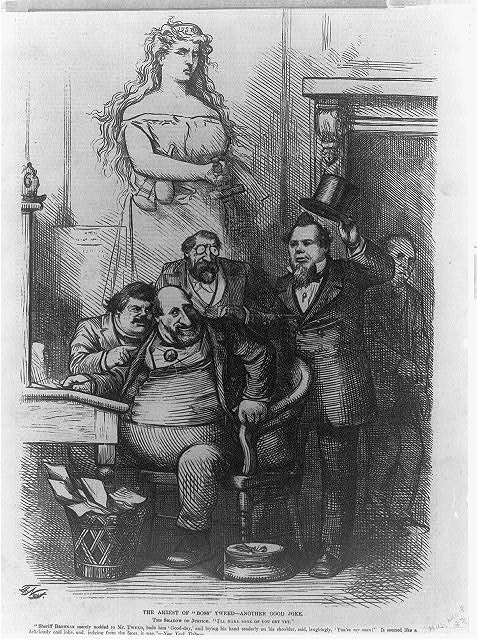
William M. “Boss” Tweed (1823-1878) was a flamboyantly corrupt public official who became the “Grand Sachem” or “Boss” of Tammany Hall, the Democratic Party’s New York City-based political machine. Beginning in the 1860s, Tweed and his loyal ring of political cronies engaged in a wide range of corrupt schemes and stole tens of millions of public dollars. The Tweed Ring’s corruption peaked during the construction of a new courthouse on Chambers Street in lower Manhattan. The facility, originally budgeted at $250,000, ultimately cost the city’s taxpayers $13 million. The excess costs were diverted to Tweed and his cohorts via a complex scheme of contractor kickbacks and bank transactions.
New York Times Exposé
Tweed’s downfall began in July 1871 when the replacement for a deceased auditor in the City Comptroller’s office discovered evidence of massive theft and disclosed it to the New York Times. The published exposé revealed the theft of millions of dollars of city funds, sparking public outrage and galvanizing forces of reform at the city and state levels. In early September 1871 a Committee of Seventy prominent citizens led a large rally at Cooper Union and began investigating and prosecuting the Tweed Ring.[1]
Committee of Seventy and Samuel Tilden
The reformers scored an early victory when Justice George G. Barnard, one of the corrupt Tweed Ring judges, unexpectedly turned on his former comrades and issued an injunction barring Tweed, Mayor A. Oakey Hall, City Comptroller Richard B. “Slippery Dick” Connolly and Park Commissioner Peter Sweeny from spending or borrowing city funds. A week later, Samuel J. Tilden, an influential lawyer and politician, received a surprise visit from Comptroller Connolly who hoped to hire Tilden to represent him in the coming investigations. Tilden declined to represent Connolly but convinced him to cooperate with investigators in return for leniency down the road. He also persuaded Connolly to hire a new deputy, Andrew H. Green, Tilden’s former law partner. In short order the reformers had wrested control of the city treasury away from Tweed and placed one of their own inside the Comptroller’s office where he could examine the city’s financial records and build a legal case against the Tweed Ring. [2]
Tilden Builds a Case
Within a few weeks, a team led by Tilden and Green had examined thousands of invoices, cancelled checks and bank records and created a spreadsheet with multiple columns that traced payments, deposits and money transfers from bank account to bank account until they ended up in a final column representing the personal bank account of William M. Tweed. Of the $5.7 million in approved payments they examined almost $933,000 ended up in Tweed’s personal bank account.[3]
Upon being shown the evidence of Tweed’s graft, Governor John Hoffman, a former Tammany man himself, authorized State Attorney General Marshal Champlain to appoint a special prosecutor to bypass District Attorney Benjamin K. Phelps and bring the Tweed Ring to justice. Charles O’Conor, a longtime leader of the bar and close friend of Tilden was selected as special prosecutor to oversee preparation of a criminal case against Tweed.[4]
Tweed Arrested
An arrest warrant was issued for Tweed on October 26, 1871. Tweed was able to make bail of $1 million, an unprecedented amount at the time, thanks to his ally and former business partner, railroad baron Jay Gould. Tweed’s 17-day trial began in early January 1873 before newly elected Supreme Court Justice Noah Davis, a highly experienced former upstate Supreme Court Justice, ex officio Judge of the Court of Appeals and Congressman. Davis, a Republican, had just moved to New York City in 1870 to practice law when President Grant appointed him United States Attorney for the Southern District of New York. In November 1872, he ran as a reform candidate for Supreme Court with the support of the Committee of Seventy.
Legal Dream Team
Tweed hired an all-star lineup of top lawyers, including David Dudley Field, William Fullerton, Elihu Root, William O. Bartlett and his son, Willard Bartlett, John Graham, J. E. Burrill, William Edelstein, and later, on appeal, George F. Comstock. The prosecution was conducted by Wheeler H. Peckham, a respected lawyer and counsel to the Committee of Seventy, and Lyman Tremain, a former district attorney, state attorney general and speaker of the state assembly.
A Hung Jury
Tweed was prosecuted under a single indictment charging him with 220 separate and distinct misdemeanors alleging neglect of duty and official misconduct in failing to properly audit the city’s liabilities. The star witness for the prosecution was Samuel Tilden and his famous spreadsheet. Tweed’s defense counsel called few witnesses and relied on the theory that he had not stolen anything. Tweed, they argued, was not an auditor capable of examining the inflated bills presented to him. The fault was with corrupt contractors and underlings like the county auditor – now deceased – who had prepared fraudulent paperwork.[5]
The jury could not reach a unanimous verdict. Indeed, the prosecution barely avoided a disastrous defeat. A single juror stubbornly held out for conviction against eleven jurors who wanted to acquit Tweed.[6] Prosecutors suspected jury tampering. Tweed commented, “It was only a political trial . . . I know they will never get a jury to convict me.” [7]
The Second Trial: Jury Selection and a Bold Opening Move
The prosecution pressed forward with a second trial. After the near disaster of the first trial, no effort was spared to select an impartial, tamper-resistant jury. Charles O’Conor engaged Henry L. Clinton, a seasoned criminal lawyer, to oversee jury selection and hired “an army of young lawyers” to investigate the background and character of every prospective juror. He also hired four Pinkerton detectives to watch the jurors and prevent tampering.[8]
In November 1873, the second trial started with a bold opening move by the defense. William Fullerton presented Justice Davis with a petition urging the judge to disqualify himself from retrying Tweed on the ground that he had previously “expressed a most unqualified and decided opinion unfavorable to the defendant upon the facts of the case.”[9] Justice Davis, taken aback, stated that some of the statements in the petition were “entirely inconsistent with truth.” He called a recess to consult “with my brethren of the district as to the proper action to be taken to sustain the dignity of the Court.”[10]
A flushed and emotional Davis returned to the bench determined to proceed with the case. “[I]ndeed, this extraordinary paper leaves me no alternative, if I have any self-respect whatever, but to go on.”[11] He reserved for a future occasion such proceedings as would vindicate the dignity of the court. Davis denied the defense’s request to address the merits of the petition. John Graham then asked for time to consult with outside counsel to consider whether “we ought not retire from the case?” Davis replied: “This case must go on.” William O. Bartlett persisted that absent a hearing to explain their position “you leave us to go through the trial resting under an imputation that we feel to be unjust.” Davis countered: “If Counsel remain under an imputation through the trial, Counsel may as well respect the fact that the Court remains under an imputation also.”[12]
Tweed Convicted and Sentenced
After the opening drama the second trial was relatively uneventful and took only four days to complete. Samuel Tilden was again the star witness for the prosecution. This time it took the jury only 45 minutes to return a verdict. They found Tweed guilty of 204 of the 220 misdemeanor counts contained in the indictment. The prosecution had researched and discussed whether Tweed could be sentenced to a separate term in prison for every count in the indictment on which he was convicted. According to Henry Clinton, they “reached the conclusion that probably the Court had that power” and decided that “the case of Tweed was a proper one to test it.”[13] The prosecution then sought consecutive sentences on 102 counts adding up to 102 years in prison.
Justice Davis agreed with the prosecution’s view that he could impose cumulative sentences. He applied a less draconian formula, however, identifying twelve groups of guilty counts for which he imposed 12 one-year sentences to be served consecutively, together with a $12,750 fine. Davis ordered that Tweed serve his time on Blackwell’s Island (today’s Roosevelt Island), “a place no less notorious than the state prison at Sing Sing.”[14]
Tweed’s Counsel Held in Contempt
At the conclusion of the second trial, Justice Davis held five of Tweed’s attorneys in contempt.[15] According to the New York Times, it was “one of the most impressive scenes ever witnessed in this City, in connection with the practice of criminal jurisprudence.” The courtroom was “filled to its utmost capacity” with “hundreds of the most prominent lawyers of this City” as Justice Davis cited five of Tweed’s attorneys for contempt, including Field, Fullerton and Graham, and fined each of them $250.[16] Referring to their written petition urging his disqualification, a “sternly dignified” Justice Davis stated:
It struck me at the moment, as it strikes me now, as an effort to induce the Judge before whom that case had been moved to leave the bench and surrender the position in which he was sitting; in short, by the combined effect of the names of a large number of eminent Counsel, intimidate the Court from the performance of the duty the law and the Constitution devolved upon him . . . Counsel thought it possibly their duty, thought it a part of their professional tactics, which a great exigency justified, to drive, if possible, from the performance of his duty, a Judge who they feared . . . And I feel it my duty now in this case—while I will do nothing harsh or unkind whatever—to make the mark so deep and broad that if it has been heretofore, as has been insinuated, the custom to drive Judges from the bench by the presentation of such documents . . . all members of the profession shall know that at least hereafter such efforts are obnoxious and open to censure and punishment.[17]
A Few Words of Advice
Citing their youth and the dominant influence of their seniors, Justice Davis did not fine Elihu Root (future Secretary of State under President Theodore Roosevelt) or Willard Bartlett (future Chief Judge of the Court of Appeals). He did offer them a few words of advice:
I ask you, young gentlemen, to remember that good faith to your client never can justly require bad faith to your own consciences; and that however good a thing it may be to be known as successful and great lawyers, it is even a better thing to be known as honest lawyers—[great applause]; and there is no incompatibility whatever in the possession of both of those characters.[18]
The Court of Appeals Reverses the Conviction
After serving one year in prison and paying a fine of $250, Tweed brought a writ of habeas corpus challenging the legality of his continued imprisonment. The Court of Oyer and Terminer dismissed the writ. The General Term of the Supreme Court in the First Judicial Department affirmed.
In June 1875, the Court of Appeals issued an unpopular but courageous decision unanimously reversing Tweed’s conviction and ordering his release from prison on the ground that Justice Davis’s imposition of consecutive sentences was illegal. Writing for the court, Judge Allen held that the maximum punishment that could have been imposed by the statutes under which Tweed was indicted was one year of imprisonment and a fine of $250. Judge Allen, no doubt anticipating that he and his colleagues would be vilified for freeing Tweed on a perceived technicality acknowledged that the public was “greatly excited” and that “great wrongs had been perpetrated.”
Far Better That the Guilty Should Escape Than the Law Be Judicially Disregarded
But courts can only administer the laws as they find them, and it is far better that the most guilty should escape, than that the law should be judicially disregarded or violated. A greater public wrong would be committed, one more lasting in its injurious effects, and dangerous to civil liberty and the sacredness of the law, by punishing a man against and without law, but under color of law and a judicial proceeding, than can result from the escape of the greatest offender, or the commission of the highest individual crimes against law.
Neither the cause of justice or of true reform can be advanced by illegal and void acts, or doubtful experiments by courts of justice, in any form, or to any extent. From some expressions of judges, and the remarks of text-writers, there was some color for the idea that several distinct offences could be tried at the same time. But there was no real or true warrant in this State for several and distinct judgments upon a single indictment in the law, and for that reason the prisoner should have been discharged upon the expiration of the imprisonment for one year and the payment of a fine of $250.”[19]
Judge Rapallo concurred and explained the policy behind the prohibition on consecutive sentences.
It is the province of courts to declare the law as they find it to be, and adjudge cases accordingly; not to change or strain the law to make it fit any particular case. . . . Laws are framed not merely to secure the punishment of those who are justly accused, but to afford a fair trial to all and guard against convictions being obtained through improper means or influences. . . . The generally accepted and recognized principle is, that a man shall be tried for only one crime at a time, and convicted only upon evidence of the commission of that crime. . . . If . . . a prisoner was arraigned for trial upon fifty separate indictments for as many different offences, to try all the indictments at the same time and before the same jury, the common sense of every layman, as well as lawyer, would revolt at the proposition; and yet it is claimed that the same result can be accomplished, in cases of misdemeanors, by uniting all the charges in the same indictment. The evils are the same in both cases. Evidence of each misdemeanor would naturally prejudice the jury against the prisoner in determining upon his guilt or innocence as to each of the others. Evidence which would be legally inadmissible as to some of them, would be necessarily admitted if competent as to some other. The prisoner might, himself, be obliged to introduce evidence to exculpate himself from some of the charges, which would have a bearing prejudicial to him (though, perhaps, illegitimately so) on the trial of the others. The result at which the law aims, of making each criminal charge depend upon its own merits would be frustrated.[20]
The Court of Appeals Criticized
Charles O’Conor, the “titan of the New York bar” appointed to lead the team of special prosecutors charged with bringing Boss Tweed to justice furiously “led a virulent attack on the court.”[21] However, Theron G. Strong, a prominent lawyer who wrote a book reflecting on the changes in the legal profession during his long legal career later put the Tweed decision in historical perspective.
It was certainly an unpopular decision, and Judge Allen had to bear the brunt of it, but after popular clamor subsided, and the public and the profession were able to take a calm and dispassionate view of the case, it became apparent that by the action of the Court of Appeals the ends of justice had been subserved and popular rights protected.[22]
Tweed Promptly Rearrested, Escapes, Dies in Prison
Tweed, meanwhile, was promptly rearrested and reincarcerated in debtor’s prison when he could not make the $3 million bail (the largest bail ever imposed on any person up to that time) fixed by Justice Davis in connection with the city’s pending $6.3 million civil suit seeking restitution for stolen funds.[23] After escaping from the less secure Ludlow Street jail in December 1875, Tweed was arrested in Spain a year later and returned to debtor’s prison. In the interim, he had been tried in absentia in the civil restitution suit and a judgment entered against him for $6.3 million. Tweed, now destitute, had no chance of making restitution. He died in prison on April 12, 1878.
[1] Hon. Helen E. Freedman, “Samuel Jones Tilden: Lawyer, Statesman, and Victim of Fate,” Judicial Notice, Iss. 18, 2023.
[2] Kenneth D. Ackerman, Boss Tweed, Carroll & Graf, 2005, at 216-17.
[3] Id. at 236-38.
[4] Id. at 239.
[5] Id. at 265.
[6] Id. at 266.
[7] Id.
[8] H. L. Clinton, Celebrated Trials, Harper & Bros., 1897, at 444; see also Ackerman at 273.
[9] Clinton at 445.
[10] Id. at 446-47.
[11] Id. at 447-48.
[12] Id. at 448-49.
[13] Id. at 465.
[14] Ackerman at 277.
[15] “The Contempt Case,” New York Times, Nov. 25, 1873.
[16] “Contempt of Court,” New York Times, Nov. 30, 1873.
[17] Clinton at 467.
[18] Id.
[19] People ex rel. Tweed v. Liscomb 60 N.Y. 559, 593 (1875).
[20] Id. at 594-95.
[21] Rosenblatt, ed., The Judges of the New York Court of Appeals, at xviii.
[22] “Theron G. Strong on the Bar’s Changes in Forty Years,” New York Times, April 12, 1914.
[23] Ackerman at 288.