
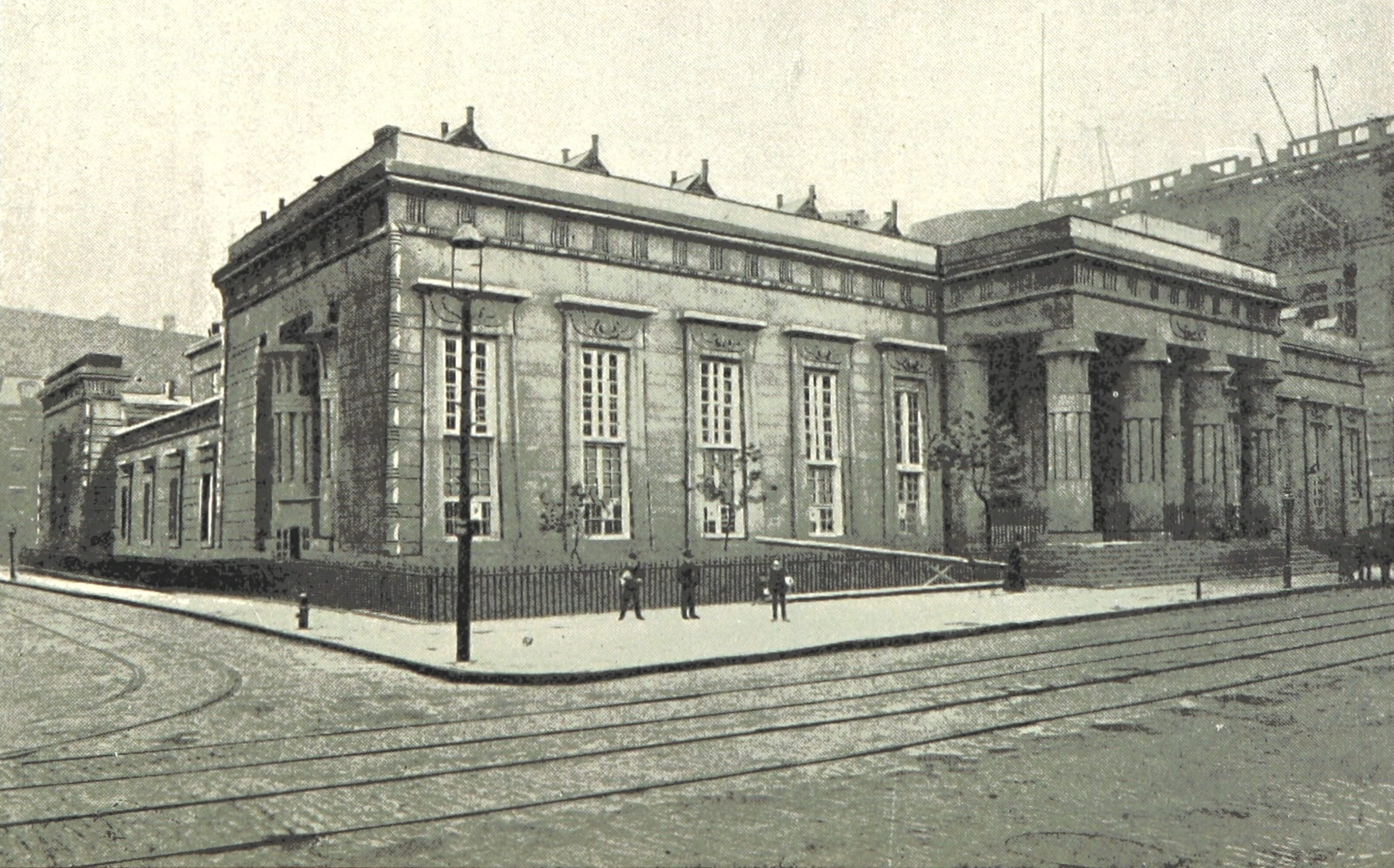
Origins of “The Tombs”
In 1838 construction was completed on a massive granite building housing the Court of Special Sessions, the Police Court and a new prison. Located on the west side of Centre Street between Leonard and Franklin Streets, the facility, designed in the briefly popular Egyptian Revival architectural style, became known as “The Tombs,” accurately reflecting the drawings of Egyptian mausoleums made by John Stevens, an engineer and philanthropist who had toured the Holy Land in 1830.[1]
The Tombs was ill-advisedly constructed on the site of the Collect Pond, a colonial era source of drinking water that was drained and filled in 1813 after it became badly polluted. “[O]nly months after the Tombs opened, the building began to sink, causing cracks in the foundation through which water leaked, forming pools on the floor.” [2] These conditions contributed to the prison’s notoriously dank and unhealthy atmosphere.
Charles Dickens Shocked and Disgusted
The Tombs was used primarily to confine persons accused of crimes until they were tried and sentenced or freed. Originally designed to house 200 inmates at a time, the prison routinely held double that number by the 1880s.[3] Charles Dickens visited the Tombs not long after it opened in 1842. He was shocked and disgusted by the experience.
What! do you thrust your common offenders against the police discipline of the town, into such holes as these? Do men and women, against whom no crime is proved, lie here all night in perfect darkness, surrounded by the noisome vapours which encircle that flagging lamp you light us with, and breathing this filthy and offensive stench! Why, such indecent and disgusting dungeons as these cells, would bring disgrace upon the most despotic empire in the world![4]
The Layout of the Tombs
The men’s prison occupied four tiers of cells:
The bottom tier opened upon the main floor and each of the three above it opened upon its own iron gallery, one above the other. Two keepers were posted on duty in each gallery to guard the prisoners. The cells, intended for two inmates, often held three. Each tier had its particular purposes. Some ground-floor cells housed convicts under sentence. The second tier was devoted to those charged with murder, arson, and similar serious crimes. The third tier accommodated prisoners charged with burglary, grand larceny, and the like. The fourth tier was assigned to those charged with light offences. The ground floor cells were the largest, while fourth tier cells were the smallest.[5]
The woman’s prison consisted of 50 cells on the Leonard Street side of the Tombs, overseen by a chief matron. In the 1880s, a portion of the building originally used as a police station-house was converted into a single large room known as “the Bummers’ Hall.”
There were confined tramps, vagrants, public drunks and disorderly persons. Many would have been arrested the previous afternoon and evening. These were kept until the morning after their arrest. Then they were brought before the courts. Those sentenced to confinement for 10 days or less remained there.[6]
The Centre Street side of the building contained the offices and residence of the Warden, the Police Court, the Court of Special Sessions, the Boys Prison and six comfortable cells overlooking the street generally reserved for wealthy or politically connected defendants. Executions by hanging were conducted regularly in the courtyard of the Tombs, and a raised, open walkway connecting the women’s and men’s sections over which the condemned men walked to the gallows was nicknamed the “Bridge of Sighs.”
Everything Was for Sale in the Tombs
The Tombs was undoubtedly awful. Located adjacent to the Five Points, the city’s most impoverished, crime-ridden neighborhood, it was “bleak and damp,” afflicting its occupants with “rheumatism and tuberculosis.” But for those with resources, it could be “surprisingly convivial.”[7]
Everything was for sale in the Tombs—from conjugal visits to clean sheets to cigars and booze. The latter was not strictly allowed, but prisoners managed, one by having a flask of whiskey incarcerated in the belly of a chicken. Vendors moved among the prison tiers hawking their goods in exactly the same way a sidewalk vendor would outside. [8]
Inmates were supposed to be locked in their cells day and night, except for a one-hour daily exercise period, but security grew lax over the years due to corruption and poor management, leading to numerous escapes. In 1872, a prisoner awaiting execution, William Sharkey, walked out of the overcrowded jail dressed as a woman and was never recaptured. An investigation revealed that prisoners had been free to wander about the building at will and mix freely with the many visitors and vendors who came and went throughout the day.
The Tombs’s politically appointed employees ran a lucrative black market with cigars, tobacco, fruit and other products readily available at twice their normal value. For the right price, many of these officials were willing to look the other way in the presence of illegal activities. Howe & Hummel, the most famous criminal defense lawyers of their day, with offices conveniently located on Centre Street, developed excellent relationships with the prison’s officials, enabling them to enter the building at will. They also arranged to kick back a percentage of their legal fees to Tombs employees who sent paying clients their way.[9]
In keeping with the Gilded Age’s extremes of wealth of poverty, the poorest inmates lived on a “starvation diet” of “dinners of bread and tea, breakfasts of bread and coffee, and a bowl of soup for lunch,”[10] while inmates with money were allowed to purchase food from outside and have it delivered or brought to them by family and friends.[11] Similarly, while the typical cell had a cement floor, an iron bed and a chamber pot, those who could afford to do so were allowed to bring in furniture, carpets and many of the comforts of home.[12] At one point, Edward “Ned” Stokes, who spent several years in the Tombs undergoing three trials for the 1872 murder of robber baron James Fisk, Jr., was attended by a personal servant who fetched him food from local restaurants. Boss Tweed spent time in the Tombs after his conviction in 1873. He was given one of the large cells in the front of the building, “heated and furnished with a bed, chairs, and a green carpet.” Tweed arranged to have his meals delivered from a local restaurant rather than risk the prison’s food.
The Second Tombs
In 1902, the first Tombs building was replaced by a new edifice constructed on the same site. Although the massive, gray building had a different “chateau-like appearance,” it too was nicknamed the “The Tombs.”[13] The second Tombs also had a “Bridge of Sighs,” a raised, covered passageway over Franklin Street which connected the prison to the Criminal Courts building.”[14]
In 1941, the second Tombs prison was dismantled and its 700 inmates transferred to the newly-constructed nearby Criminal Courts building. These were the last of the half-million men and women charged with felonies and misdemeanors, from murderers down to peddlers, who had been led across the second Bridge of Sighs over its 39 years of existence.[15] The site of the Tombs exists today as Collect Pond Park, named for the body of water that was drained to build the courthouse and prison.[16]
The Tombs Angel: Rebecca Salome Foster
 Many occupants of the Tombs came from impoverished backgrounds and densely populated enclaves like the neighboring Five Points, “renowned for jam-packed, filthy tenements, garbage-covered streets, prostitution, gambling, violence, drunkenness, and abject poverty.”[17] During the Gilded Age, there were very few, if any, government funded social services programs or other systems in place to address the struggles and miseries of the urban poor, including those caught up in the criminal justice system. Some religious institutions, such as the Catholic Sisters of Charity, regularly visited the Women’s and Boys’ Prisons. While their mission was mainly spiritual they often nursed the sick and offered alternatives to prison for wayward girls and women.[18]
Rebecca Salome Elliot, born in Alabama in 1848, married Civil War General John A. Foster in 1865 and returned with him to New York City where he practiced law after the war. Mrs. Foster, a member of the Calvary Episcopal Church, experienced a spiritual crisis following the death of two of her children which motivated her to lead a life of service on behalf of the city’s outcasts and immigrant poor.[19] In 1884, when her laundress’s young son was arrested for theft, Mr. Foster agreed to defend him. When he fell ill he sent his wife with a note seeking an adjournment, but when she arrived the case was already on. Mrs. Foster “made a powerful plea on behalf of the boy” and the impressed judge not only released the boy but asked Mrs. Foster to look into the case of a young homeless girl who had been arrested that day for solicitation.[20] Foster investigated the case, reported to the judge and had the girl paroled into her custody, after which she paid for the girl’s return to her original home.
Mrs. Foster began appearing in court on a regular basis, investigating the circumstances of vulnerable defendants, especially young women and immigrants who lacked a criminal past. Relying on religious supporters at first and later wealthy philanthropists, she began extending financial, housing and employment assistance to defendants she considered capable of rehabilitation.
Not long after her work started, Mrs. Foster began the almost-daily practice of going to the Tombs early in the morning and inquiring of the staff about newly-incarcerated persons, especially young women. She would identify those defendants who seemed to her promising candidates for her assistance and would visit with them. She would develop a plan of assistance and, rather than waiting for a judge to ask for her help, she would often attend court at the scheduled appearance and initiate an application to the judge that she be allowed to provide assistance, including in appropriate cases taking the defendant into her custody upon release or suspension of sentence.[21]
Mrs. Foster not only undertook this work at a time when “very few women of her station were leaving the comfort of their parlors,”[22] but she did so on behalf of the wretched and despised and in a place where “[f]oul sewage smells permeated the lower floors,” and “disease, lice, rats, and filth thrived in the dampness.”[23] Not surprisingly, the beneficiaries of her kindness began referring to her as “the Tombs Angel.”
In 1901, one of the religious organizations that supported Mrs. Foster made a report of her activities for the prior year.
Mrs. Foster . . . made 1,171 visits; helped 419 prisoners and 81 prisoners’ families, sent 83 people to their homes in various parts of the country; and paid the traveling expenses to Germany of two girls, to Italy of a woman and child, to Ireland of two girls, and to France and Bermuda of one each. She had distributed 230 pairs of shoes. . . she had paid out $463.98 for the traveling expenses of former prisoners, $736.21 for food, $281 for rents, $181.90 for ice in prisons, $152.38 for lodgings, and $60.75 for coal and wood.[24]
At a time when there was no right of counsel for indigent criminal defendants and what few legal aid organizations existed could meet only a fraction of the need, “Mrs. Foster did whatever she could to find attorneys for defendants in serious cases,” including using her “persuasive powers to prevail upon attorneys to take on cases pro bono.”[25] In the summer of 1896 alone, she procured representation for 133 women and 84 men. Her most famous recruit may have been Samuel Seabury, who would go on to fame as a respected appellate jurist and crusading reformer of Tammany Hall.
It is notable that Mrs. Foster walked the streets of Five Points, the city’s most dangerous neighborhood, “on a daily basis and entered its tenements, saloons, and other establishments, more often than not alone, demonstrating clearly that she was a person of considerable courage, determination, and dedication.”[26] Mrs. Foster tragically died in a fire in 1902. Having escaped from her sixth-floor residence she reentered the building to assist an elderly neighbor and was overcome by smoke and flames.
In 1904, a monument to Mrs. Foster was installed in the Criminal Courts building. Unfortunately, the monument was lost when the building was dismantled and replaced in 1941. A surviving portion of the monument, a marble relief sculpture of an angel, was rediscovered in 1983. After proper restoration it was installed in the entrance lobby of the New York County Courthouse. Located at 60 Centre Street, a short distance from the site of the Tombs, it is a worthy tribute to a remarkable woman — “a one-person combination of social services agency, probation officer, and legal aid society working on behalf of the courts and the accused and convicted, as well as their families, at a time when government services for the poor were either non-existent or in their infancy.”[27]
For more information about the good works of Rebecca Salome Foster, please read A Life of Service: Remembering the Tombs Angel by John F. Werner & Robert C. Meade, Jr.
[1] Julia and Albert Rosenblatt, Historic Courthouses of the State of New York: A Study in Postcards, Turner Pub. Co., 2006, at 126.
[2] John F. Werner & Robert C. Meade, Jr., “The Tombs Angel: An Exemplary Life of Service,” Judicial Notice, Iss. 16, 2021, at 22.
[3] “A Tale of the Tombs,” New York Correction History Society, available at The Tombs.
[4] Werner & Meade at 22, quoting Charles Dickens, American Notes for General Circulation, 1842, at 38.
[5] NY Correction Society, supra.
[6] Id.
[7] Cait Murphy, Scoundrels in Law, Harper-Collins Pubs., 2010, at 44.
[8] Id. at 48.
[9] Id. at 4
[10] Kenneth D. Ackerman, Boss Tweed, Carroll & Graf Pubs., 2005, at 280.
[11] NY Correction Society, supra.
[12] Murphy at 47.
[13] Id. at 48
[14] Robert Pigott, New York’s Legal Landmarks, 2nd Ed., Attorney St. Eds., 2014, at 2, 64-67.
[15] Rosenblatt at 127.
[16] Pigott at 66.
[17] Werner & Meade at 23, quoting Tyler Anbinder, Five Points, Simon & Schuster, 2001, at 1.
[18] NY Correction Society, supra.
[19] Werner & Meade at 13.
[20] Id. at 14.
[21] Id. at 17.
[22] Id.
[23] Ackerman at 280.
[24] Werner & Meade at 19.
[25] Id. at 20-21.
[26] Id. at 23.
[27] Id. at 13.