
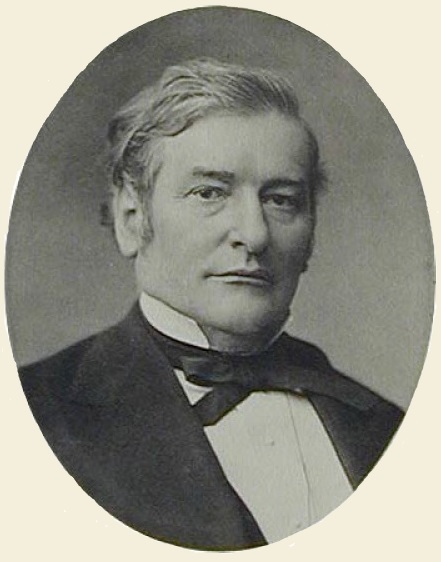
1818-1902
Noah Davis Jr., was born in Haverhill, New Hampshire, in 1818, and raised in Albion, New York. He was educated and studied law at Lima Seminary in Buffalo and was admitted to the Bar in 1841. While practicing law in Western New York he formed a partnership with Sanford E. Church, who would later serve as Chief Judge of the New York Court of Appeals from 1873 to 1880.
In 1857, Davis was appointed to a vacancy on the Supreme Court for the Eighth Judicial District. He was subsequently elected to two eight-year terms before on the court before resigning in 1868 to run successfully for Congress as a Republican.[1] In 1865, Davis served as an ex officio Judge of the Court of Appeals.[2] In 1867, he ran for a vacant seat on the United States Senate but lost a narrow election to Congressman Roscoe Conkling in the State Legislature. From 1870 to 1872 he served as the United States Attorney for the Southern District of New York by appointment of President Ulysses S. Grant. In November 1872, Davis was elected to a 14-year term on the New York State Supreme Court for the First Judicial District.
On the Supreme Court, Davis presided over the two criminal trials of William M. “Boss” Tweed in 1873. The first trial in January 1873 resulted in a hung jury, but Tweed was retried later in the year and found guilty on 204 counts. Although the prosecution sought consecutive sentences adding up to over a hundred years in jail, Judge Davis imposed 12 one-year sentences to be served consecutively, together with a $12,750 fine. After serving one year in prison, Tweed brought a writ of habeas corpus challenging the legality of his sentence and continued imprisonment. In June 1875, the Court of Appeals unanimously reversed Tweed’s conviction and ordered his release from prison on the ground that the imposition of consecutive sentences was illegal.[3] “Judge Davis and Charles O’Conor (who had prosecuted Tweed) thereupon indulged in severe strictures upon the justices of the Court of Appeals, and much feeling was exhibited.”[4]
The Tweed trials attracted the top legal talent of the day, including for the defense, David Dudley Field; William Fullerton; Elihu Root (future Secretary of State), William O. Bartlett, John Graham, and George F. Comstock. Representing the People were, among others, District Attorney Benjamin Phelps , Special Prosecutor Wheeler H. Peckham, and Lyman Tremain. Throughout the trials, Justice Davis “enlivened the serious proceedings with flashes of humor.” When the prosecution insisted on trying Tweed on all 220 counts of the indictment, Davis quipped: “More counts than in a German principality, eh?”[5]
At the conclusion of the second trial, Justice Davis held five of Tweed’s attorneys in contempt for having sought his recusal on grounds of bias against Tweed.[6] “In one of the most impressive scenes ever witnessed in this City, in connection with the practice of criminal jurisprudence,” in a courtroom “filled to its utmost capacity” with “hundreds of the most prominent lawyers of this City,” Justice Davis cited five of Tweed’s attorneys for contempt, including Field, Fullerton and Graham, upon whom he imposed a fine of $250 each.[7] Referring to their written request for recusal, Justice Davis stated:
It struck me at the moment, as it strikes me now, as an effort to induce the Judge before whom that case had been moved to leave the bench and surrender the position in which he was sitting; in short, by the combined effect of the names of a large number of eminent Counsel, intimidate the Court from the performance of the duty the law and the Constitution devolved upon him . . . Counsel thought it possibly their duty, thought it a part of their professional tactics, which a great exigency justified, to drive, if possible, from the performance of his duty, a Judge who they feared . . . And I feel it my duty now in this case—while I will do nothing harsh or unkind whatever—to make the mark so deep and broad that if it has been heretofore, as has been insinuated, the custom to drive Judges from the bench by the presentation of such documents . . . all members of the profession shall know that at least hereafter such efforts are obnoxious and open to censure and punishment.[8]
Justice Davis did not impose a fine on Root and Bartlett, citing their youth and domination by their seniors, but he reprimanded them with “these few words of advice:”
I ask you, young gentlemen, to remember that good faith to your client never can justly require bad faith to your own consciences; and that however good a thing it may be to be known as successful and great lawyers, it is even a better thing to be known as honest lawyers—[great applause]; and there is no incompatibility whatever in the possession of both of those characters.[9]
According to the New York Times, “[t]he decision of Judge Davis was worthy of his high character. There was in his manner the most marked absence of anything approaching to harshness, and while sternly dignified as befitting the administrator of justice, he preserved the utmost composure and drew from every spectator expressions of admiration and respect.”[10]
Justice Davis also presided over the third and final trial of Edward “Ned” Stokes, which resulted in his conviction of manslaughter for fatally shooting notorious Wall Street financier James Fisk, Jr.
From 1874 to 1886, Davis served as the Presiding Justice of the General Term for the First Department. In 1887, he returned to private practice in New York City.
At his retirement ceremony, Justice Davis said:
It is my nature to form strong convictions, and sometimes I express them too strongly, but neither by speech nor silence have I ever designed to injury any suitor or his counsel. In searching the record of my judicial life I can find no entry that I ever decided any cause or matter contrary to my then convictions of right.”[11]
Noah Davis died in New York City on March 20, 1902. He had been an “intimate friend” and “personal counsel” to Ulysses Grant.[12]
[1] “Ex-Justice Davis Dead,” New York Times, March 21, 1902.
[2] Pursuant to the Constitution of 1847, the Court of Appeals consisted of four judges elected to eight-year terms and four “ex officio” Judges who rotated in and out on a yearly basis. This organizational structure was ended by the Constitution of 1869. Rosenblatt, ed., The Judges of the New York Court of Appeals, Fordham Univ. Press, 2007, at xxxii.
[3] People ex rel. Tweed v. Liscomb, 60 NY 559 (1875).
[4] History of the Bench and Bar of New York Vol 2, New York History Co., 1897, at 123.
[5] New York Times, March 21, 1902.
[6] “The Contempt Case,” New York Times, Nov. 25, 1873.
[7] “Contempt of Court,” New York Times, Nov. 30, 1873.
[8] H.L. Clinton, Celebrated Trials, Harper & Bros., 1897, at 467.
[9] Id.
[10] “Contempt of Court,” New York Times, Nov. 30, 1873.
[11] History of the Bench and Bar of New York Vol 2, at 123.
[12] “Ex-Justice Davis Dead,” New York Times, March 21, 1902