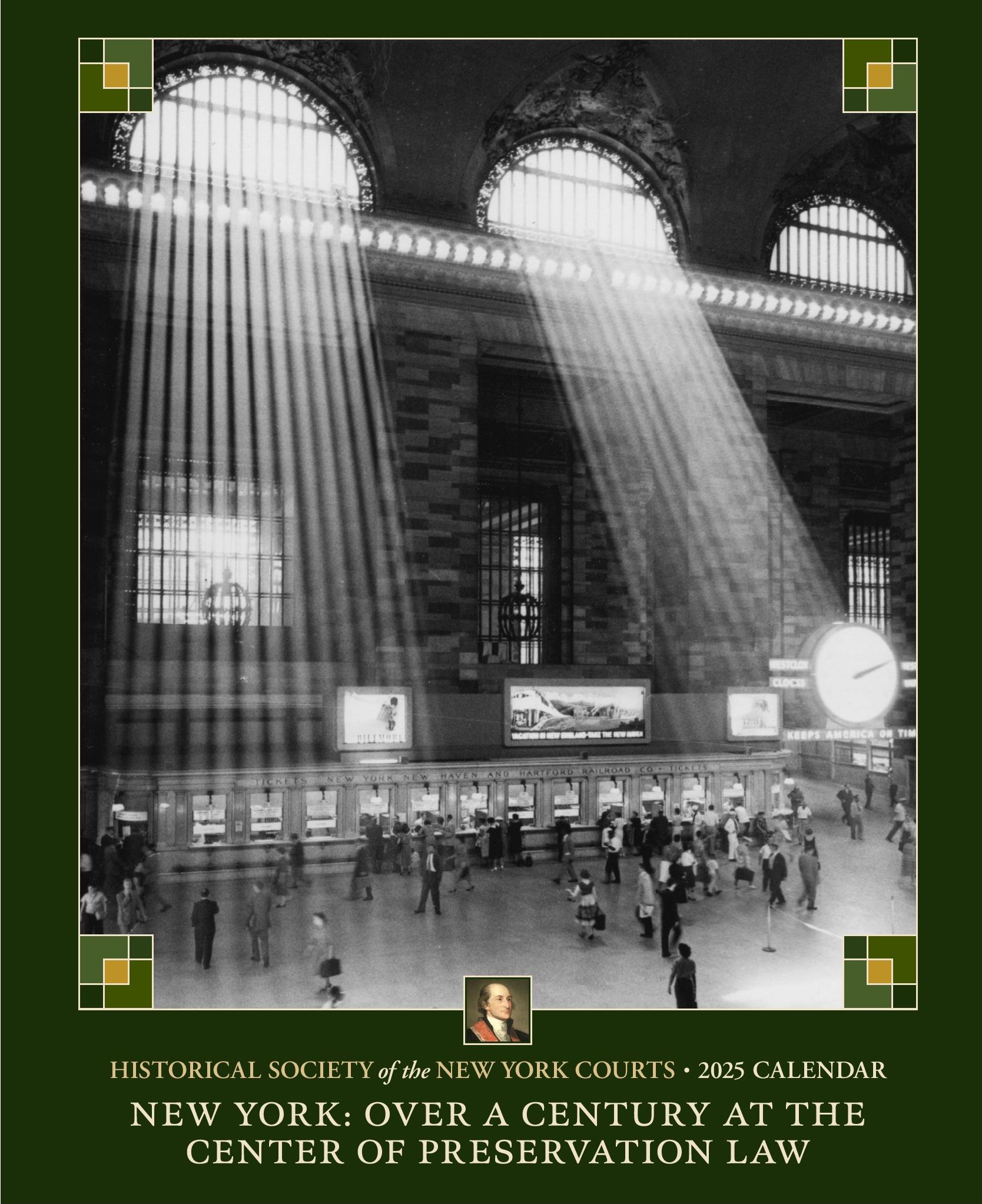
Description
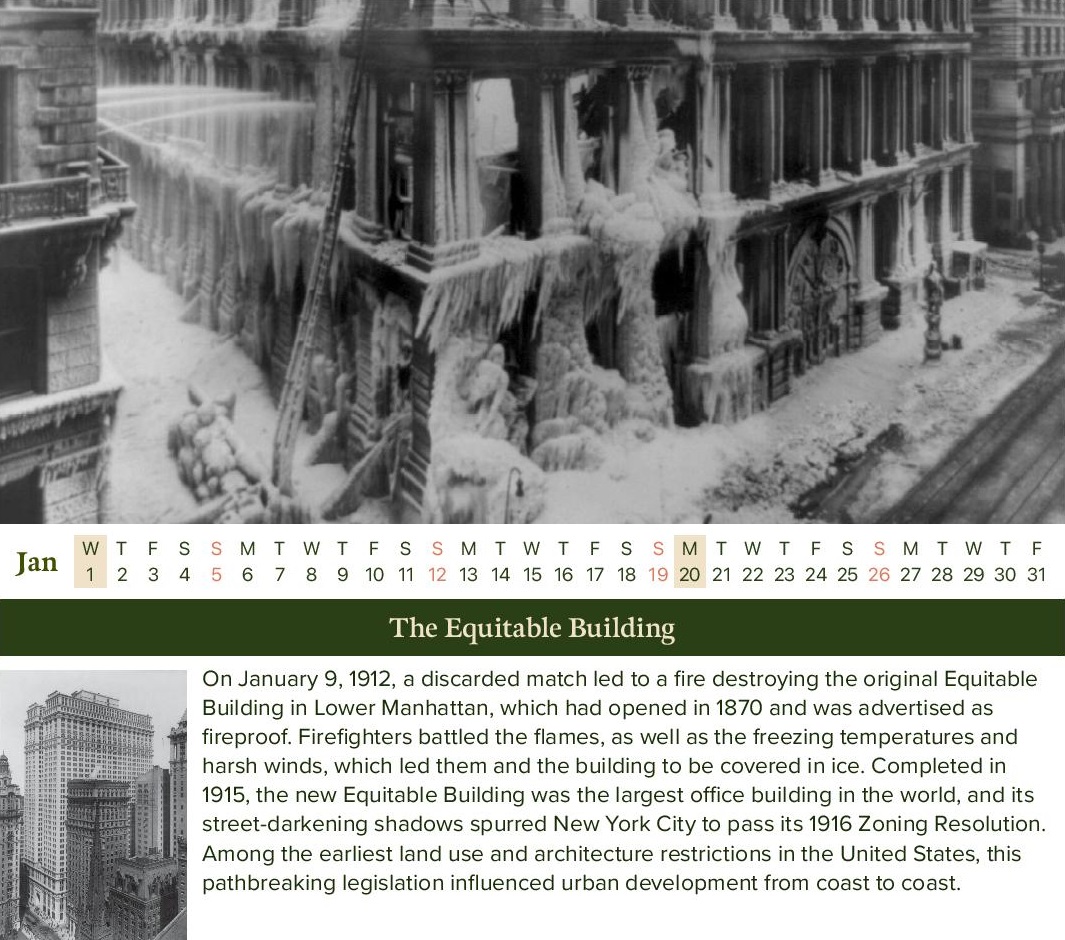
The Equitable Building
On January 9, 1912, a discarded match led to a fire destroying the original Equitable Building in Lower Manhattan, which had opened in 1870 and was advertised as fireproof. Firefighters battled the flames, as well as the freezing temperatures and harsh winds, which led them and the building to be covered in ice. Completed in 1915, the new Equitable Building was the largest office building in the world, and its street-darkening shadows spurred New York City to pass its 1916 Zoning Resolution. Among the earliest land use and architecture restrictions in the United States, this pathbreaking legislation influenced urban development from coast to coast.
Images
Photograph after a fire destroyed the original Equitable Building on January 9, 1912, New York City, c. 1912. Library of Congress, Prints & Photographs Division, LC-USZ62-99109.
Photograph of the Equitable Building, New York City, c. 1915. Library of Congress, Prints & Photographs Division, LC-USZ62-64152.
February 2025
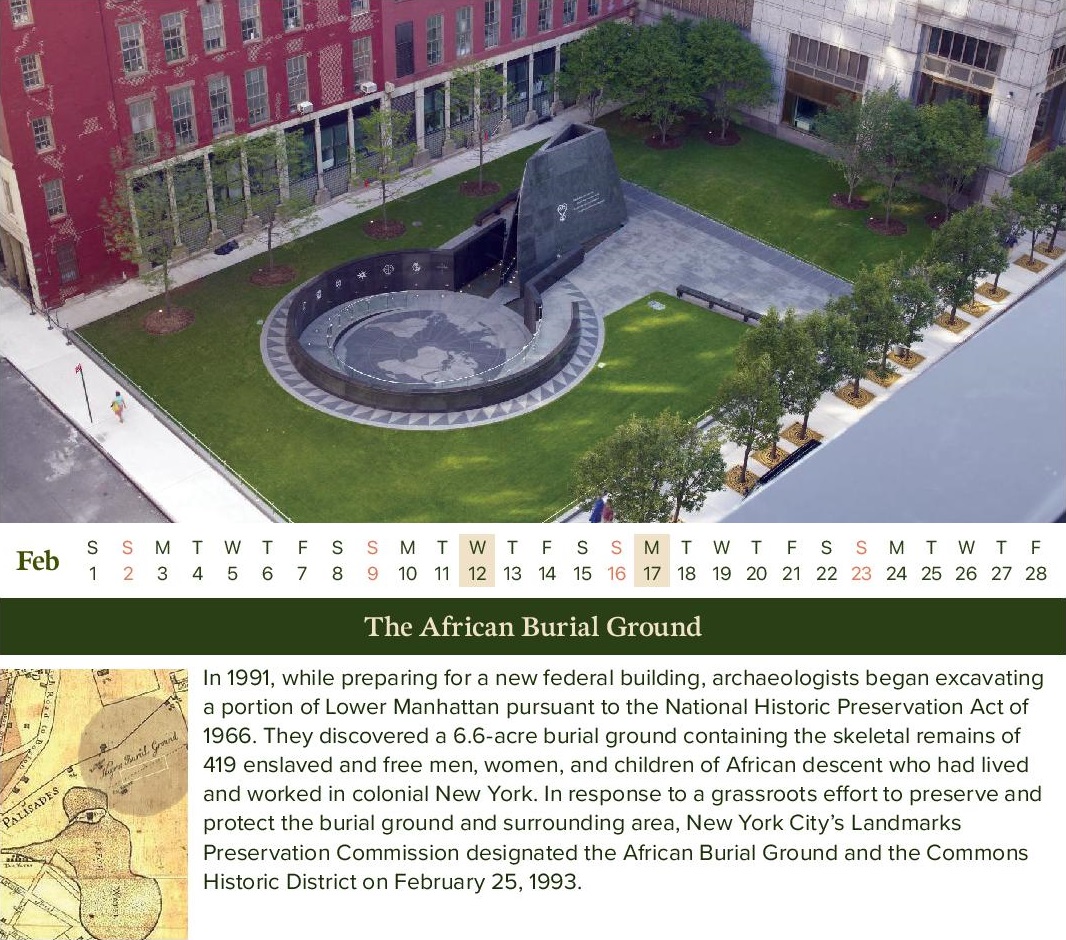
The African Burial Ground
In 1991, in preparation for a new federal building, archaeologists began excavating a portion of Lower Manhattan pursuant to the National Historic Preservation Act of 1966. They discovered a 6.6-acre burial ground containing the skeletal remains of 419 enslaved and free men, women, and children of African descent who had lived and worked in colonial New York. In response to a grassroots effort to preserve and protect the burial ground and surrounding area, New York City’s Landmarks Preservation Commission designated the African Burial Ground and the Commons Historic District on February 25, 1993.
Images
African Burial Ground National Monument, New York City, c. 2008. Library of Congress, Prints & Photographs Division, Photograph by Carol M. Highsmith, LC-DIG-highsm-03710.
Area of archaeological excavation marked by Howard University for the General Services Administration on a map by Francis Maerschalk (d. 1776). Published in The New York African Burial Ground: Unearthing the African Presence in Colonial New York by Howard University Press in Association with the General Services Administration (2009).
March 2025
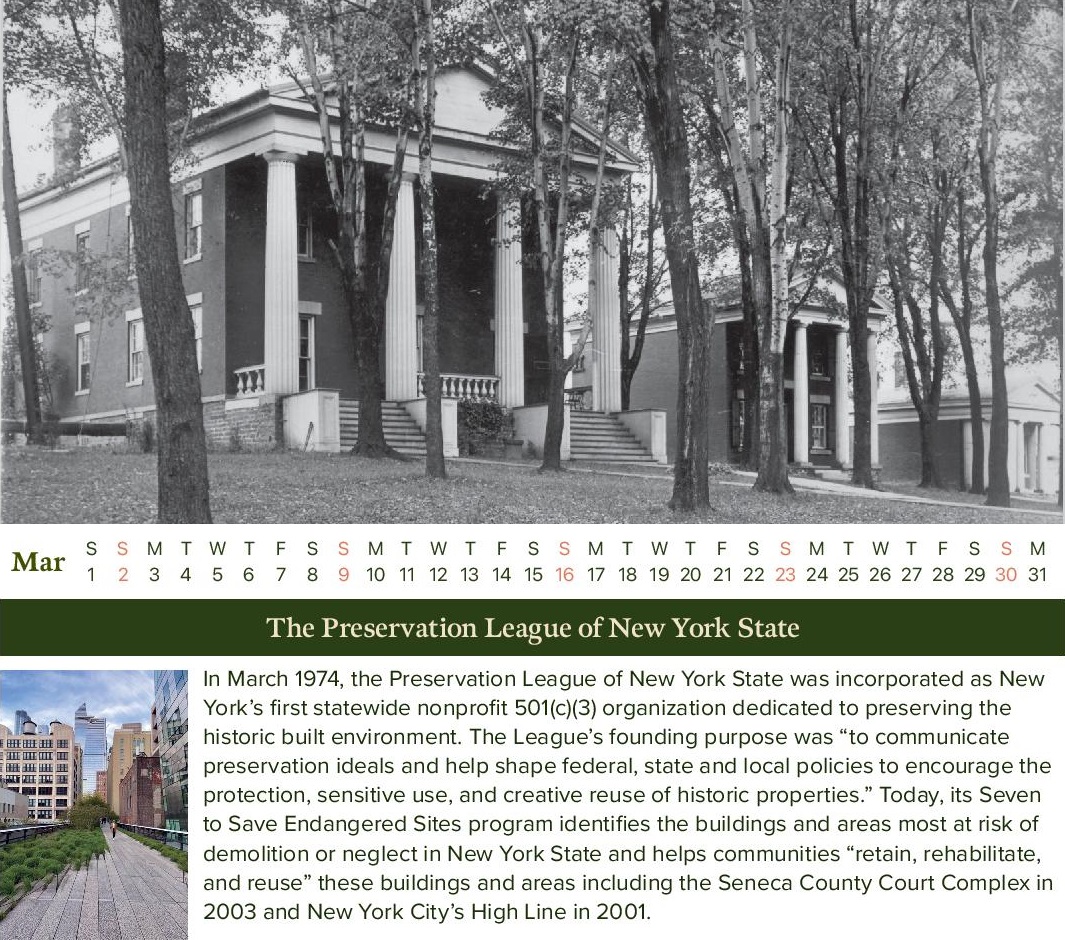
The Preservation League of New York State
In March 1974, the Preservation League of New York State was incorporated as New York’s first statewide nonprofit 501(c)(3) organization dedicated to preserving the historic built environment. The League’s purpose was “to communicate preservation ideals and help shape federal, state and local policies to encourage the protection, sensitive use, and creative reuse of historic properties.” Today, its Seven to Save Endangered Sites program identifies the buildings and areas most at risk of demolition or neglect in New York State and helps communities “retain, rehabilitate, and reuse” these buildings and areas.
Images
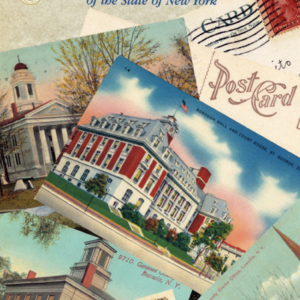
Postcard of the Seneca County Court Complex, often referred to as the “Three Bears,” which was included in the Preservation League’s Seven to Save list in 2003. Courtesy of the Historical Society of the New York Courts.
View along New York City’s High Line, a 1.45-mile-long elevated linear park, that was included in the Preservation League’s inaugural Seven to Save list in 1999, c. 2018. Library of Congress, Prints & Photographs Division, Photograph by Carol M. Highsmith, LC-DIG-highsm-51902.
April 2025
New York City’s Landmarks Law
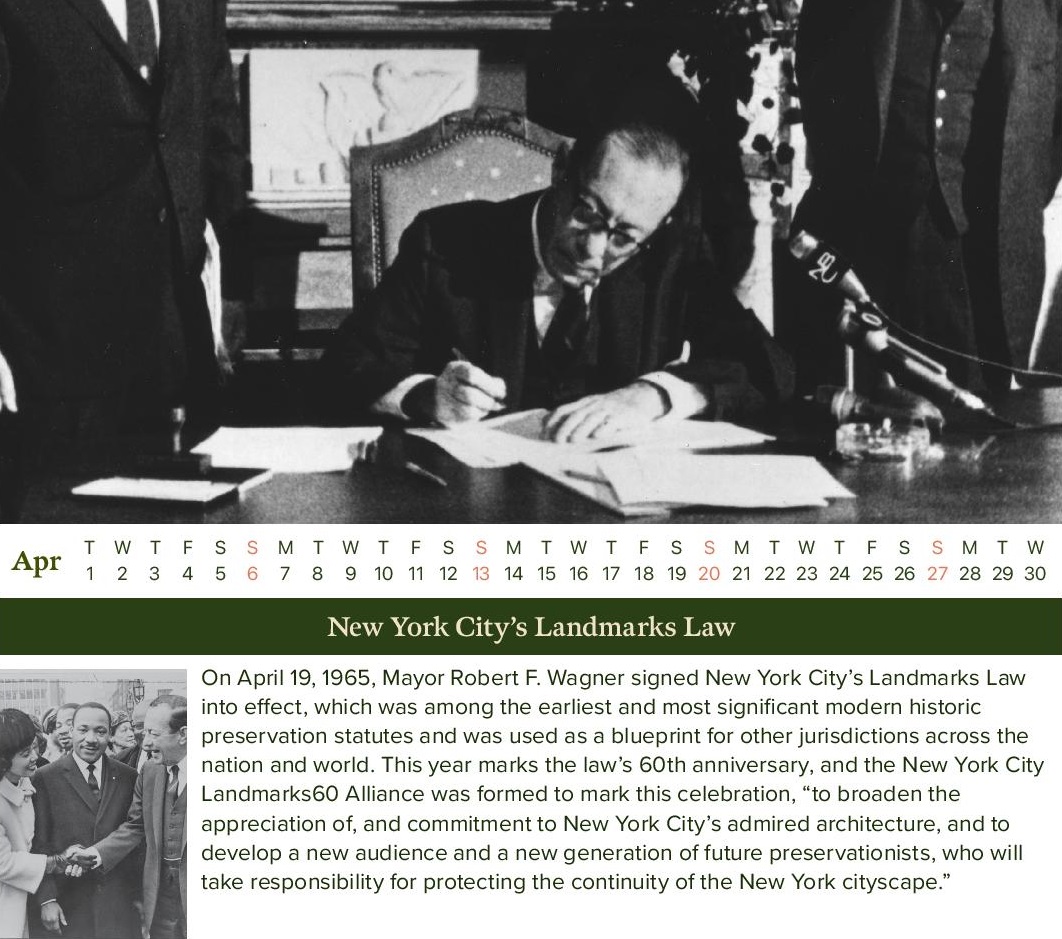
On April 19, 1965, Mayor Robert F. Wagner signed New York City’s Landmarks Law into effect, which was among the earliest and most significant modern historic preservation statutes and was used as a blueprint for other jurisdictions across the nation and world.
Images
New York City Mayor Robert F. Wagner signed New York City’s Landmarks Law on April 19, 1965. Photograph by Margot Gayle. Courtesy of the New York Preservation Archive Project.
New York City Mayor Robert F. Wagner (right) greets Dr. & Mrs. Martin Luther King, Jr. (center, left) at City Hall, c. 1964. Library of Congress, Prints & Photographs Division, Photograph by Phil Stanziola, LC-USZ62-120210.
May 2025
Author and Urbanist Jane Jacobs
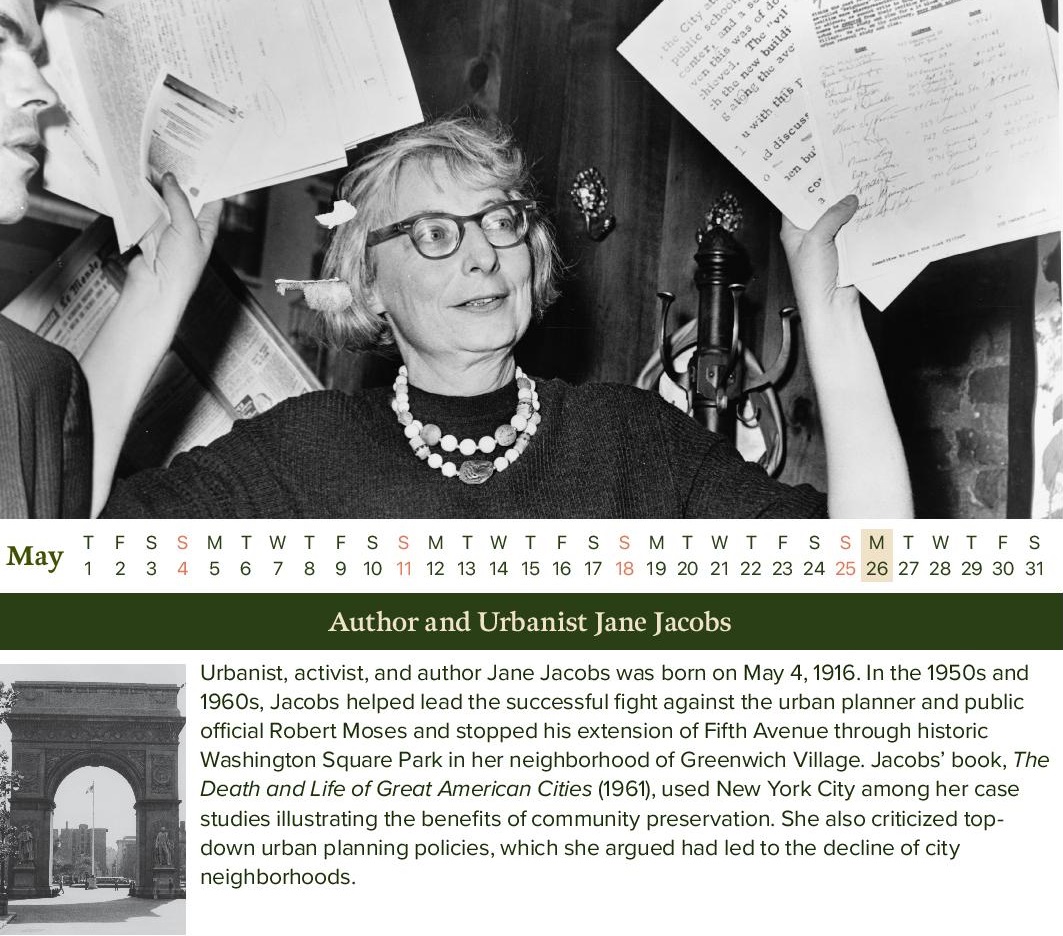
Urbanist, activist, and author Jane Jacobs was born on May 4, 1916. In the 1950s and 1960s, Jacobs helped lead the successful fight against the urban planner and public official Robert Moses and stopped his extension of Fifth Avenue through historic Washington Square Park in her neighborhood of Greenwich Village. Jacobs’ book, The Death and Life of Great American Cities (1961), used New York City among her case studies illustrating the benefits of community preservation. She also criticized top-down urban planning policies, which she argued had led to the decline of city neighborhoods.
Images
Photograph of Jane Jacobs, Chairman of the Committee to Save the West Village, holding up documentary evidence at a Press Conference, New York City, c. 1961. Library of Congress, Prints & Photographs Division, Photograph by Phil Stanziola, LC-USZ62-137838.
Photograph of Washington Square Arch at Washington Square Park in Greenwich Village, New York City, c. 1953. Jacobs was involved in the effort to preserve the park in her neighborhood of Greenwich Village. Library of Congress, Prints & Photographs Division, Anthony Angel Collection, LC-DIG-ppmsca-69726.
June 2025
Penn Central Transportation Co. v. City of New York (1978)
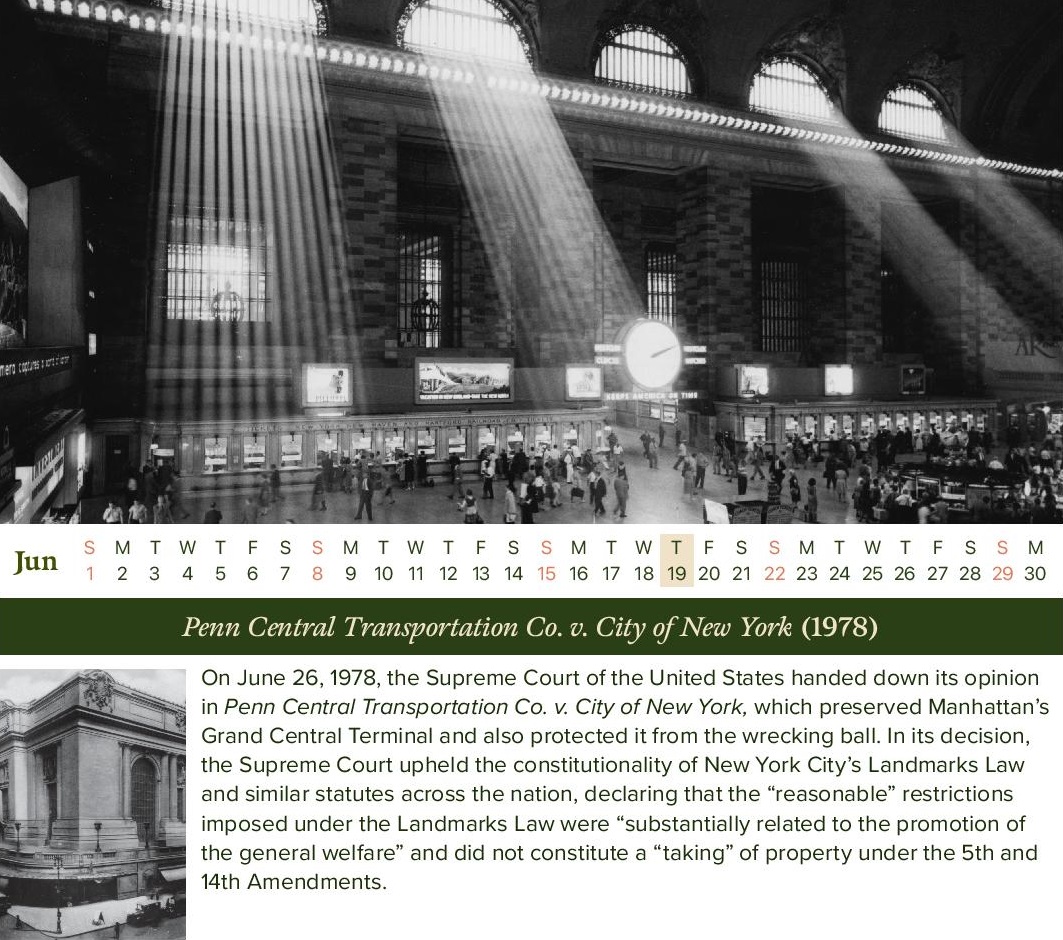
On June 26, 1978, the Supreme Court of the United States handed down its opinion in Penn Central Transportation Co. v. City of New York, which preserves Manhattan’s Grand Central Terminal and also protects it from the wrecking ball. In its decision, the Supreme Court upheld the constitutionality of New York City’s Landmarks Law and similar statutes across the nation, declaring that the “reasonable” restrictions imposed under the Landmarks Law are “substantially related to the promotion of the general welfare” and do not constitute a “taking” of property under the 5th and 14th Amendments.
Images
Photograph of Grand Central Terminal, New York City, c. 1959. Library of Congress, Prints & Photographs Division, Anthony Angel Collection, LC-DIG-ppmsca-70682.
Photograph of Grand Central Terminal, New York City, c. 1910-1940. Library of Congress, Prints & Photographs Division, LC-DIG-pcrd-1d04775.
July 2025
Robert Moses – The Power Broker
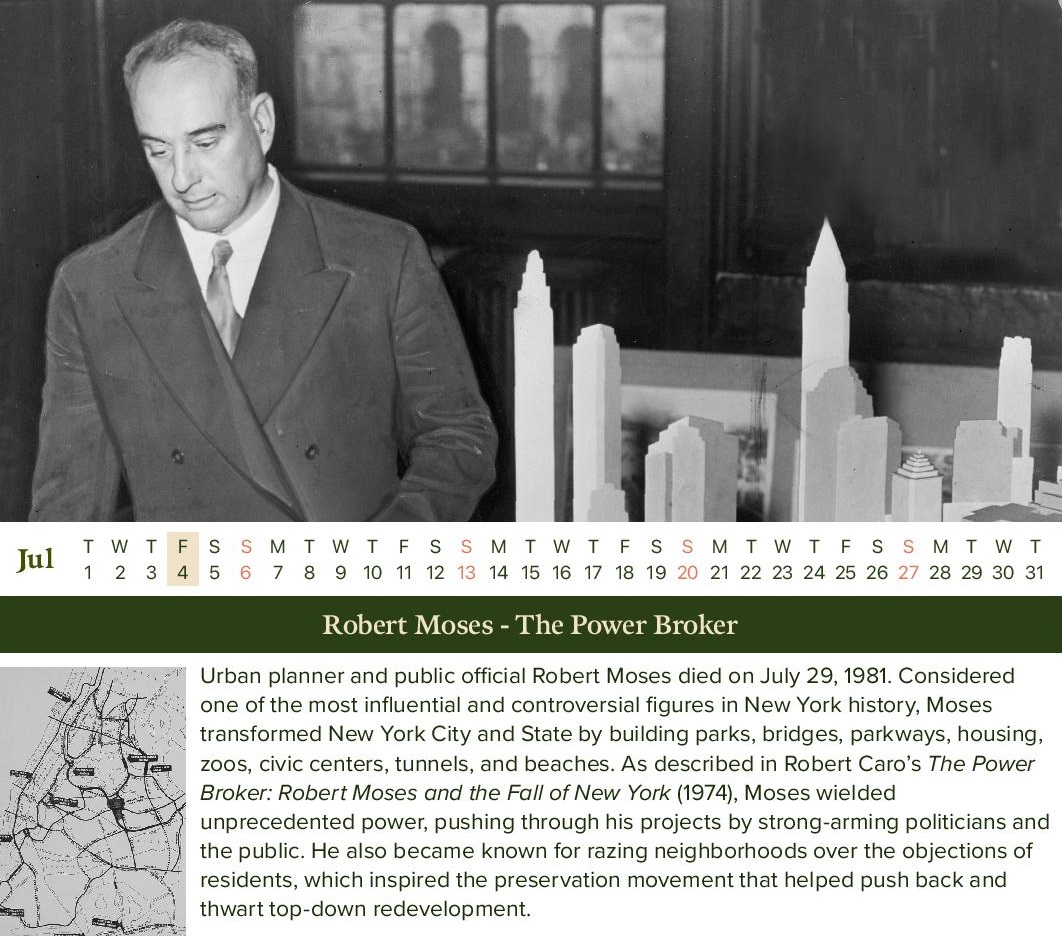
Urban planner and public official Robert Moses died on July 29, 1981. Considered one of the most influential and controversial figures in New York history, Moses transformed New York City and State by building parks, bridges, parkways, housing, zoos, civic centers, tunnels, and beaches. As described in Robert Caro’s The Power Broker: Robert Moses and the Fall of New York (1974), Moses wielded unprecedented power, pushing through his projects by strong-arming politicians and the public. He also became known for razing neighborhoods over the objections of residents, which inspired the preservation movement that helped push back and thwart top-down redevelopment.
Images
Photograph of New York City Parks Commissioner Robert Moses, New York City, c. 1939. Library of Congress, Prints & Photographs Division, NYWT&S Collection, LC-USZ62-136079.
Map of Robert Moses’ projects, including bridges and tunnels. Originally published in 30 Years of Progress, 1934-1964: Department of Parks: 300th Anniversary of the City of New York: New York World’s Fair (1964), p. 64. Digitized by Columbia University Libraries.
August 2025
The Penn Station Picket
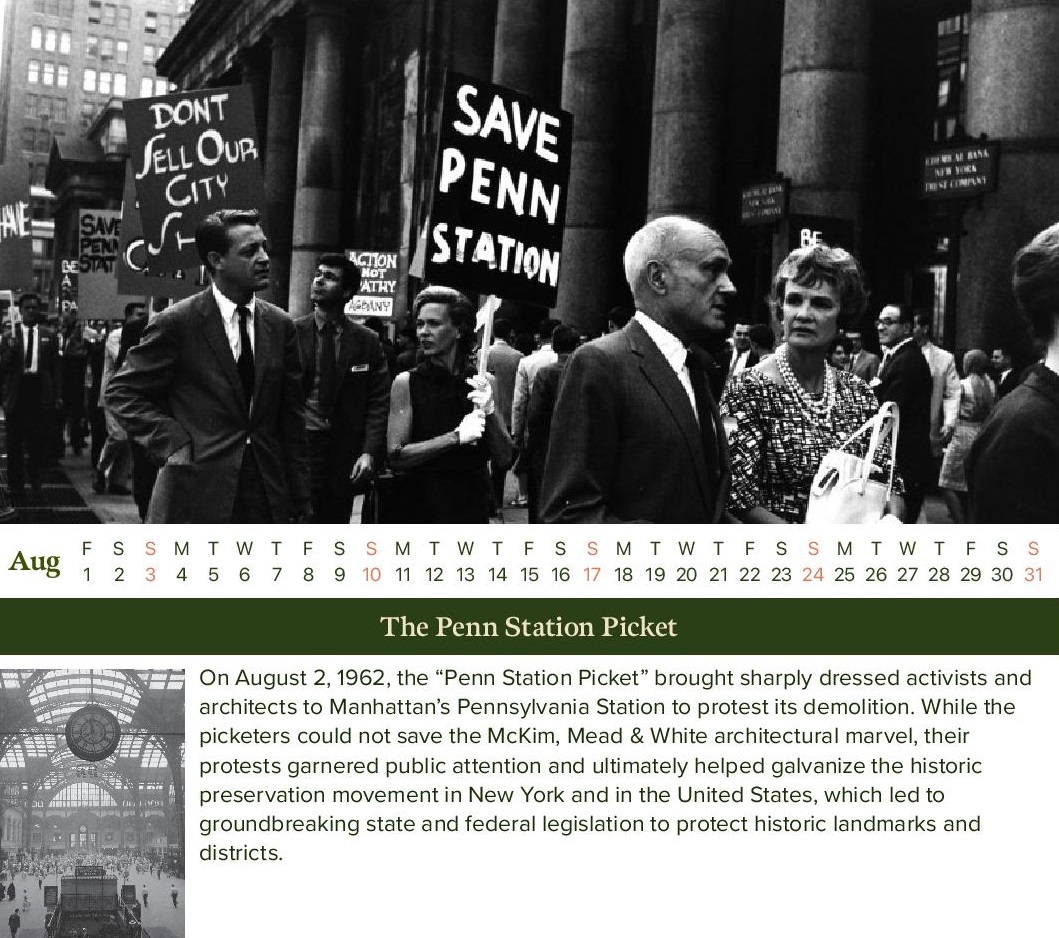
On August 2, 1962, the “Penn Station Picket” brought sharply dressed activists and architects to Manhattan’s Pennsylvania Station to protest its demolition. While the picketers could not save the McKim, Mead & White architectural marvel, their protests garnered public attention and ultimately helped galvanize the historic preservation movement in New York and in the United States, which led to groundbreaking state and federal legislation to protect historic landmarks and districts.
Images
Photograph of members of the Action Group for Better Architecture in New York City, protesting the demolition of Pennsylvania Station, c. 1962. Courtesy of the New York Preservation Archive Project and with permission of the photographer, David Hirsch.
Photograph of the main concourse inside Pennsylvania Railroad Station, c. 1942. Library of Congress, Prints & Photographs Division, FSA/OWI Collection, LC-USW3-007028-D.
September 2025
Empire State Plaza
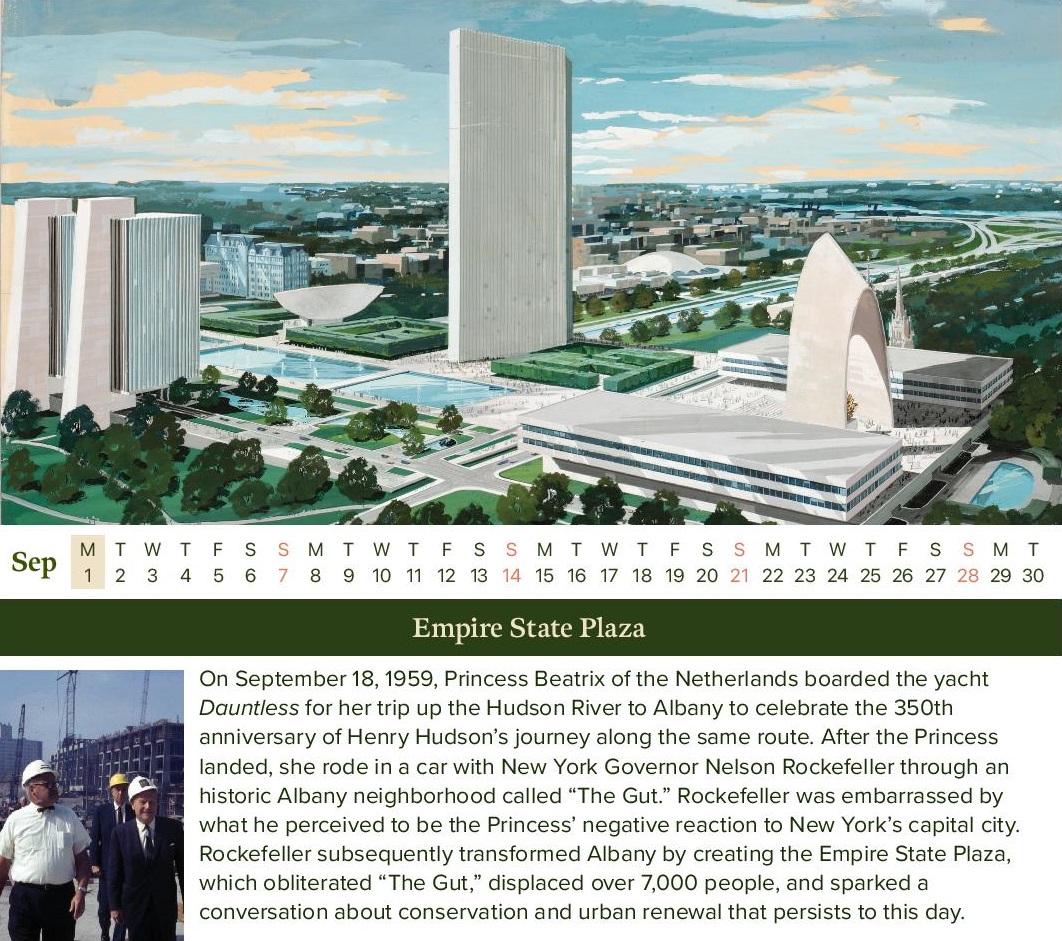
On September 18, 1959, Princess Beatrix of the Netherlands boarded the yacht Dauntless for her trip up the Hudson River to Albany to celebrate the 350th anniversary of Henry Hudson’s journey along the same route. After the Princess landed, she rode in a car with Governor Nelson Rockefeller through an historic Albany neighborhood called “The Gut.” Rockefeller was embarrassed by what he perceived to be the Princess’ negative reaction to New York’s capital city. Rockefeller subsequently transformed Albany by creating the Empire State Plaza, which obliterated “The Gut,” displaced over 7,000 people, and sparked a conversation about conservation and urban renewal that persists to this day.
Images
Architectural Rendering, Proposed View of South Mall Looking Northeast, Marcel Mutin (1910-1998), c. 1962, tempera on board, Albany Institute of History & Art Purchase, 1997.19.1.
Governor Nelson Rockefeller visiting the construction of the Agency Building 4 overhang on the South Mall, Albany, New York, c. 1968. New York State Archives, Public Information Photographs, 1910-1922, NYS_15727-98_B1_287_20183-C.
October 2025
The Seward House
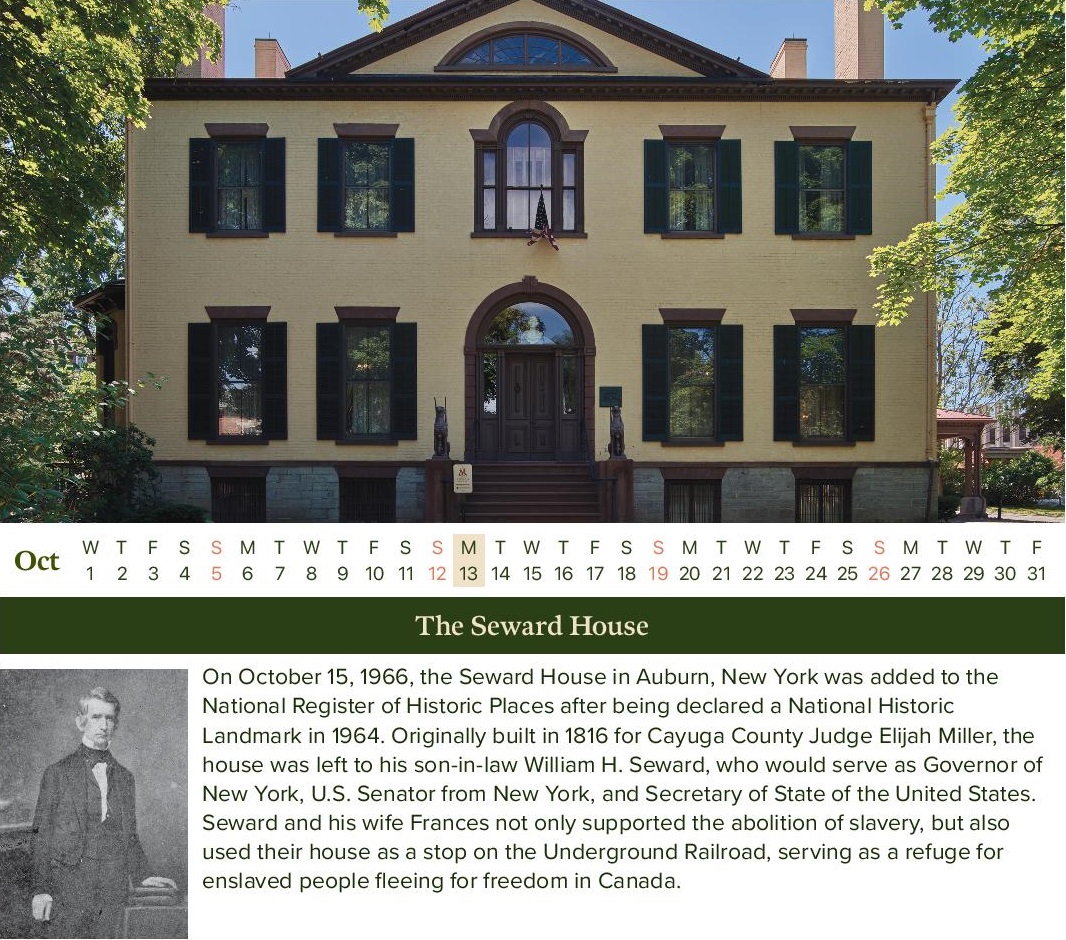
On October 15, 1966, the Seward House in Auburn, New York was added to the National Register of Historic Places after being declared a National Historic Landmark in 1964. Originally built in 1816 for Cayuga County Judge Elijah Miller, the house was left to his son-in-law William H. Seward, who was Governor of New York, U.S. Senator from New York, and Secretary of State of the United States. Seward and his wife Frances not only supported the abolition of slavery, but also used their house as a stop on the Underground Railroad, serving as a refuge for fugitive slaves on their way to Canada.
Images
The Seward House, now The William H. Seward House Museum, Auburn, New York, c. 2018. Library of Congress, Prints & Photographs Division, Photograph by Carol M. Highsmith, LC-DIG-highsm-52131.
Photograph of William H. Seward by Mathew Brady, New York, c. 1861-1876. Library of Congress, Prints & Photographs Division, LC-2021669451.
November 2025
Demolishing the Inner Loop Expressway
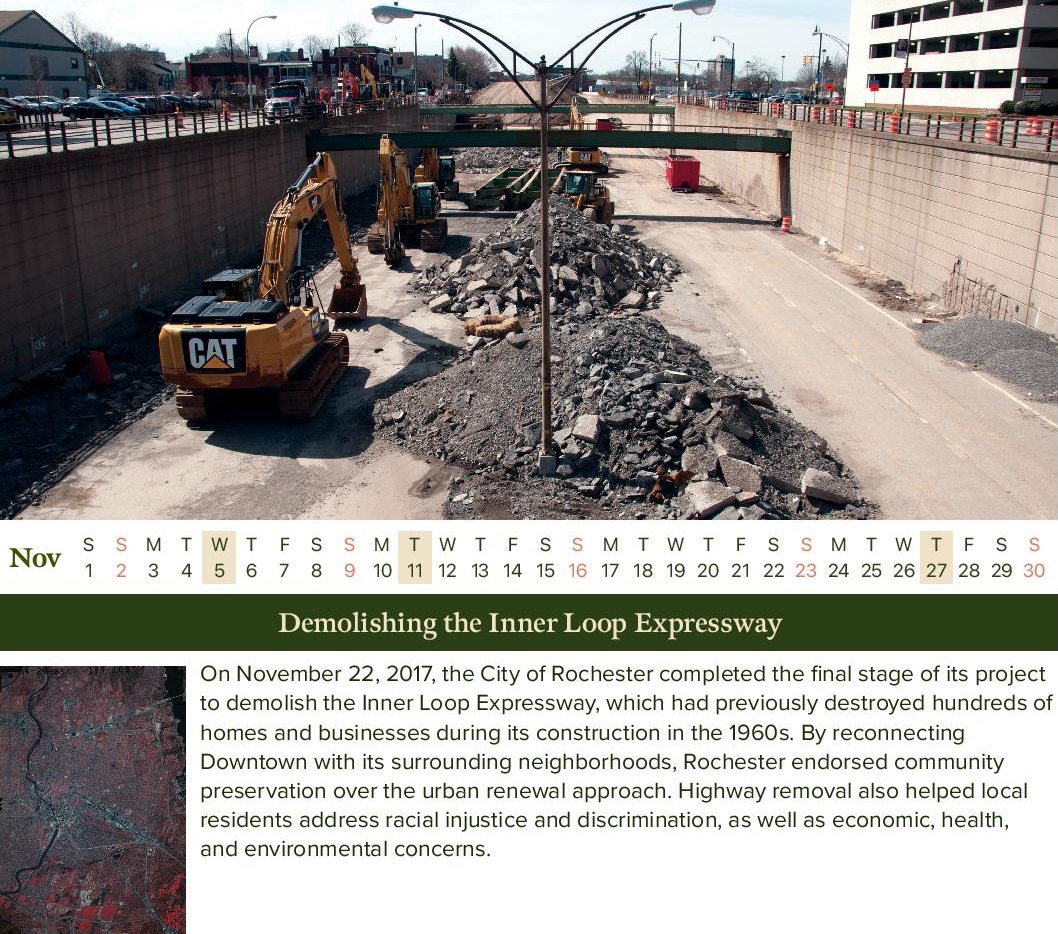
On November 22, 2017, the City of Rochester completed the final stage of its project to demolish the Inner Loop Expressway, which had previously destroyed hundreds of homes and businesses during its construction in the 1960s. By reconnecting Downtown with its surrounding neighborhoods, Rochester endorsed community preservation over the urban renewal approach. Highway removal also helped local residents address racial injustice and discrimination, as well as economic, health, and environmental concerns.
Images
Urban renewal project demolishing and filling in the Inner Loop Expressway, Rochester, New York, c. 2014. Photograph by Peter Steiner, Alamy Stock Photo.
Aerial Photograph of Rochester East, Rochester, New York, c. 1985. New York State Archives, Dept. of Transportation. Map Information Unit. Aerial photographs, [ca. 1930s-2000], NYSA_B2009-09_RochesterEast_1985_108.
December 2025
Albert S. Bard – Architect of Preservation Law
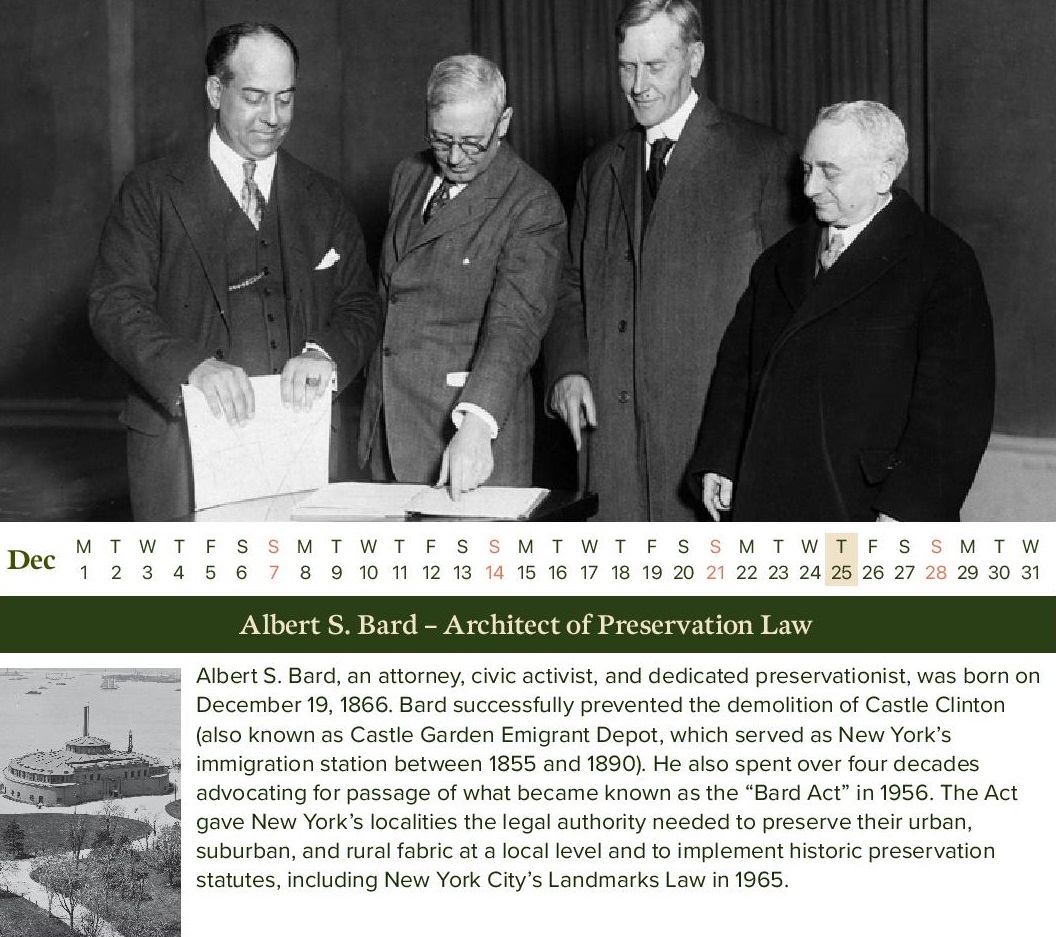
Albert S. Bard, an attorney, civic activist, and dedicated preservationist was born on December 19, 1866. Bard spent over four decades advocating for passage of what became known as the “Bard Act” in 1956. The Act gave New York’s localities the legal authority needed to preserve their urban, suburban, and rural fabric at a local level and to implement historic preservation statutes, including New York City’s Landmarks Law in 1965.
Images
Willam B. Roulstone, Albert S. Bard, Harold A. Caparn, and Albert E. Henschel (pictured left to right) at an Advisory Committee for Conservation of Parks meeting, New York, c. 1924. New York Public Library, Manuscripts and Archives Division, Digital Collections, Albert S. Bard Papers. https://digitalcollections.nypl.org/items/2132ee30-5cda-013d-fff5-0242ac110005.
Photograph of Battery and Castle Clinton (also known as Castle Garden), New York City, c. 1900. Bard successfully prevented the demolition of Castle Clinton. Library of Congress, Prints & Photographs Division, LC-DIG-det-4a08011.