
1832-1896
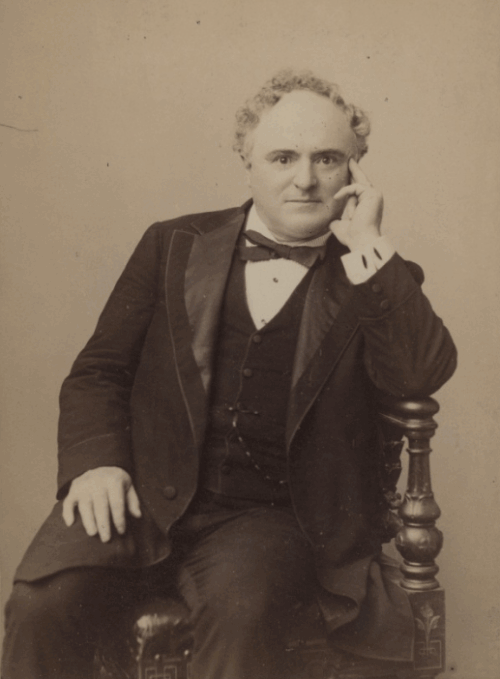 John R. Fellows was born in Troy, New York, in 1832, the son of farmers in Saratoga County. In 1850, he moved to Arkansas to study law with an uncle and was admitted to the bar of that state in 1855. At the outbreak of the Civil War Fellows enlisted in the First Regiment of Arkansas Volunteers. He rose to the rank of Colonel before being captured in July 1863 and remained a prisoner of war until the South’s surrender. Fellows retained the title of “Colonel” throughout his lifetime. After the war, he returned to the practice of law and was elected to the Arkansas State Senate in 1866.
In 1868, Fellows was a Delegate to the Democratic National Convention in New York City’s new Tammany Hall building. He gave a stirring speech that deeply impressed William M. “Boss” Tweed, who convinced Fellows to move to New York City to practice law and join the Tammany organization. Tweed secured Fellows’s appointment as an Assistant Corporation Counsel in 1868, and as an Assistant District Attorney under District Attorney Samuel Garvin in 1869. In 1873, at the end of Garvin’s term, Fellows entered private practice before returning to the District Attorney’s office in 1882 under John McKeon. In 1887, he ran for District Attorney himself on the Tammany ticket, defeating his Republican opponent and fellow Assistant District Attorney, De Lancey Nicoll.[1]
Colonel Fellows prosecuted many important cases during his career, including People v. Stokes, the famous murder of Wall Street titan James Fisk by his rival for the affections of showgirl Josie Mansfield. Fellows, assigned to the case, found himself in a “peculiar position” of having been the defendant’s friend and legal adviser. [2] He nonetheless secured a verdict of first-degree murder, but when the conviction was overturned on appeal, Fellows opted to resign rather than prosecute Stokes again. His resignation was not accepted; a different prosecutor was assigned to the case instead.
In 1887, Fellows’s close ties with Boss Tweed came back to haunt him on the eve of Election Day. On November 4, the New York Times published two notes from Fellows to Boss Tweed, both written on February 1, 1873, the day after Tweed’s first trial ended in a hung jury. In one of the notes, Fellows said that he was short of money to pay his rent and a bank note, both due that day. “I am sorry to have to avail myself of your generous offer of yesterday, but I have not received anything from the Gentlemen referred to.” The Times had his original note to Tweed with an endorsement from Tweed’s secretary indicating that he gave Fellows a check for $523 on February 1.[3]
According to the Times, if this was a loan Fellows had never repaid it. “But it was not a loan. It was, in all probability, a partial payment to Col. Fellows for valuable services that had been rendered at the most critical time in his existence – services which the public office held by Col. Fellows up to Jan. 1, 1873, had given him remarkable ability to render.”[4] The Times alluded to the possibility of jury tampering and challenged Fellows to issue a public explanation. “We hope Fellows and his friends realize that these proofs of his corrupt dealings with Tweed are absolutely fatal to him and his chances of election unless some complete and final explanation is at once made.”[5] Fellows insisted that it was a loan that he had repaid but otherwise provided no explanation. The crisis was not fatal and Fellows elected District Attorney.
In November 1890, Fellows was elected to the House of Representatives and reelected to a second term in 1892. He resigned from Congress late in 1893 when he was again elected District Attorney on the Tammany ticket.
Colonel Fellows died of stomach cancer on December 7, 1896. He was eulogized as “an interesting figure in the life of the metropolis,” a “man of engaging personality, an orator of acknowledged ability, a lawyer whose career was largely spent in public service, and a citizen . . . praised in many directions and criticised in others.”[6]
[1] “Col. John R. Fellows Dead,” New York Times, Dec. 8, 1896.
[2] History of the Bench and Bar of New York Vol. 1, New York History Co., 1897, at 324.
[3] “Fellows Paid By Tweed,” New York Times, Nov. 4, 1887; see also “It Dismays the Bosses,” New York World, Nov. 4, 1887.
[4] “Fellows Paid By Tweed,” New York Times, Nov. 4, 1887.
[5] “Mr. Fellows Must Explain This,” New York Times, Nov. 1887.
[6] “Col. John R. Fellows Dead,” New York Times, Dec. 8, 1896.