
Part Two: Murals of the First and Second Floors
Artistic Elements and Aims
by Robert C. Meade, Jr., Esq.[*]
This article discusses the murals in the vestibule, the colonnade, and the corridors of the first two floors of the courthouse, and on the ceiling of the spectacular rotunda. Photographs of the murals can be found in the accompanying Photo Gallery.
THE MURALS IN THE VESTIBULE, THE COLONNADE AND THE CORRIDORS
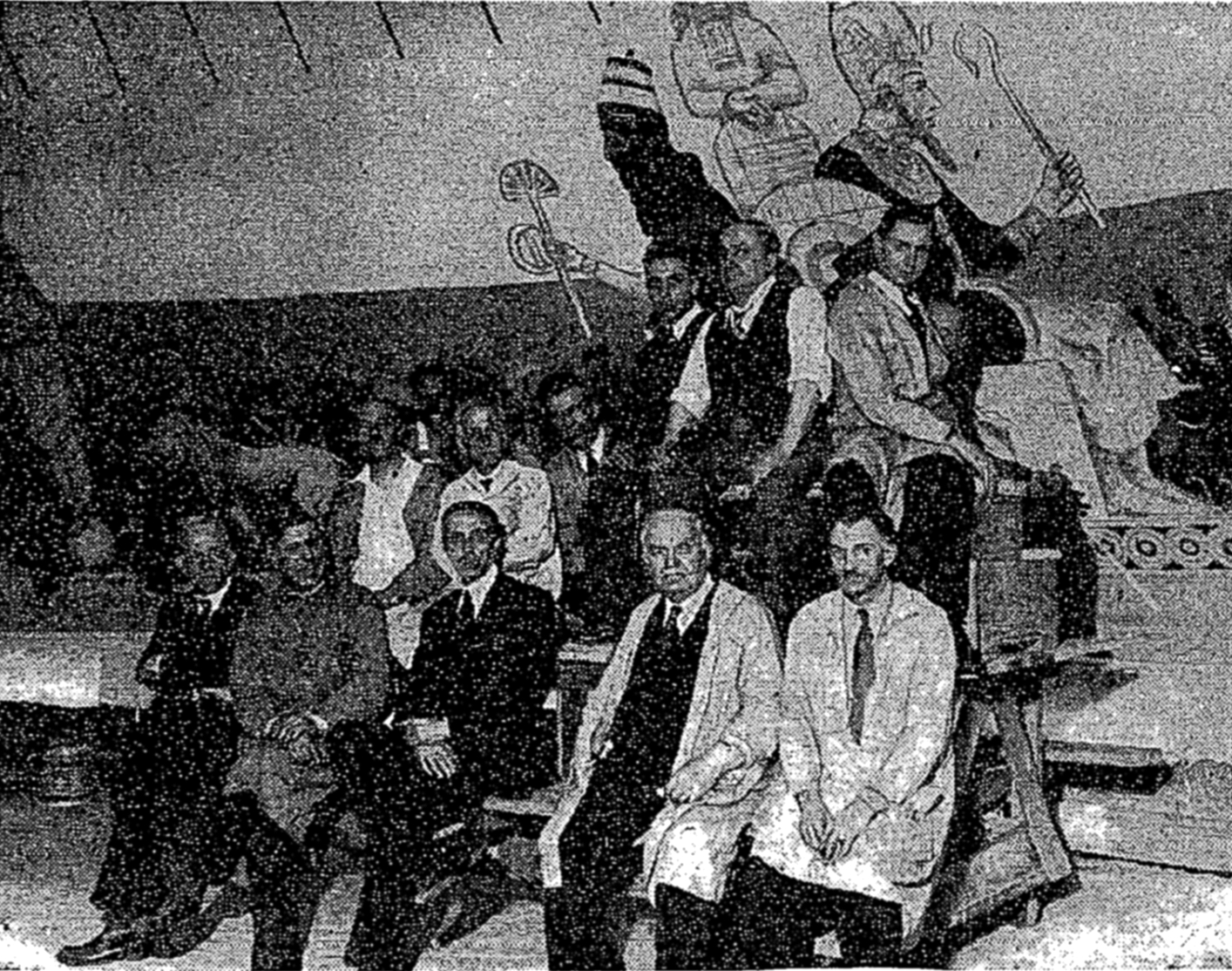
The lofty ceiling in the lobby of the New York County Courthouse consists of three domes that rest on piers of travertine stone. The murals on the ceiling present the theme of “The Administration of Justice.” The inspiration for these murals was the work of Raphael in Rome, according to Attilio Pusterla, the painter of all of the murals on the first and second floors,. The vestibule murals are painted in a Renaissance style in colors characteristic of Raphael’s work: much yellow is used, along with greens, reds, lavender, rust, and blues, and the tonal palette is quite different from that used in the rotunda.
The central dome in the vestibule provides the fulcrum for the composition on the ceiling. At the apex of this dome is a decorative design in various colors and forms. Below it and running around it are four dignified head portraits in green of a Native American, an inhabitant of New Amsterdam, which became New York City, a soldier from the Revolutionary era, and a contemporary worker in a cap and smoking a pipe. Together these figures are meant to symbolize the history of the City of New York.
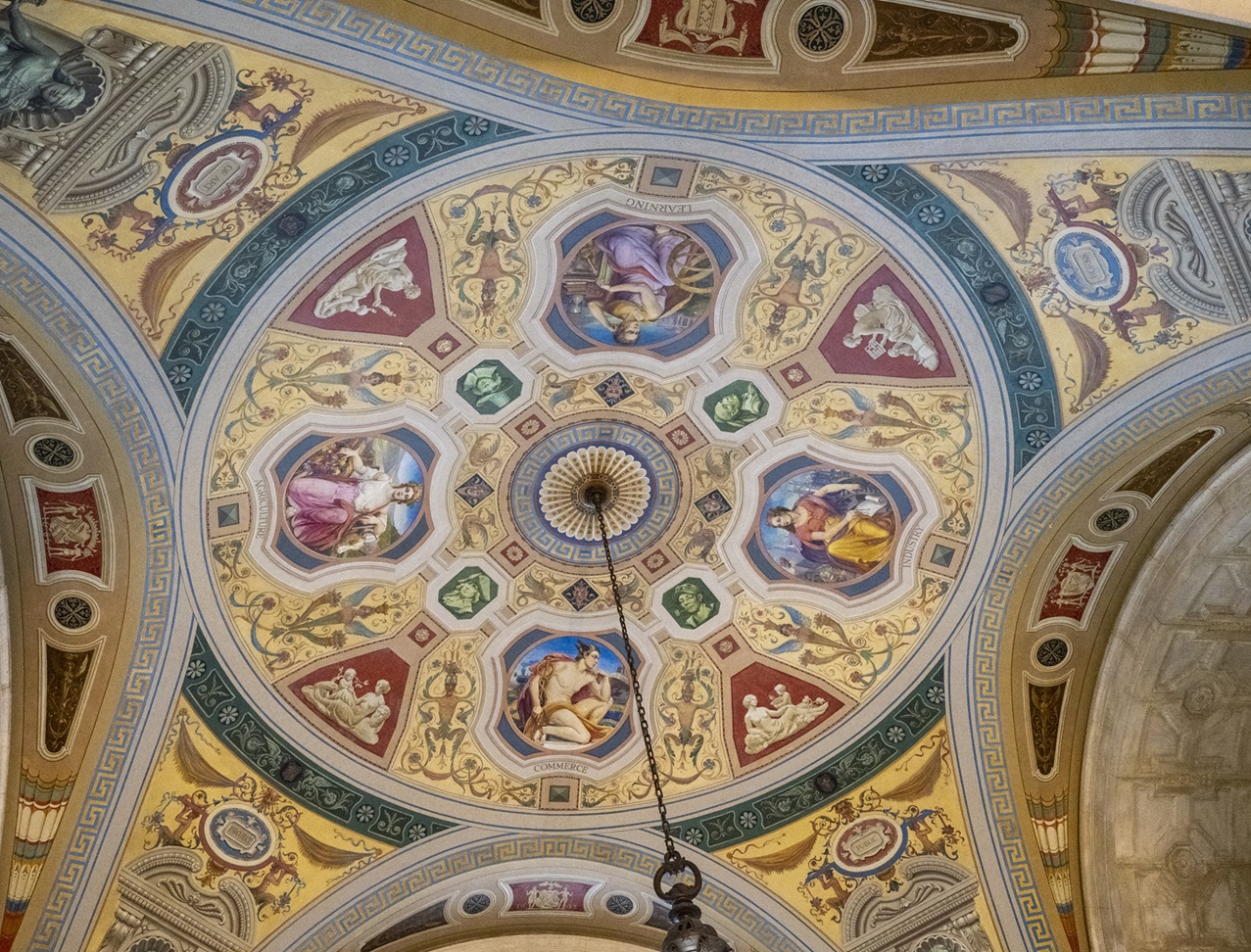
Below these and arrayed evenly around the dome’s center are the four principal figures. Within a circle and an enclosure for each are four allegorical figures, two women and two men, representing Learning, Agriculture, Commerce, and Industry. The figures are presented in classical poses with flowing robes and carrying or surrounded by objects relevant to their activities. They seem to be gods and goddesses from Greek mythology or their Roman equivalents. The figure representing Commerce is a portrait of the Greek god Hermes. As he is often depicted, he here is young and athletic, wearing winged sandals and a cap, and carrying a special staff, the caduceus. Behind him are instruments of modern commerce, a train and a steamship. The female figure representing Industry, who may be the Greek goddess Athena, has a protractor in her hand and is surrounded by modern buildings and an industrial plant. The figure representing Learning, who may be Apollo, is shown with objects associated with knowledge, such as books, an hourglass, and an academic building. The figure representing Agriculture, who may be the Greek goddess Demeter, is surrounded by agricultural products. These four spheres of action were depicted because activities within them often lead to the work that the courthouse carries out and because the justice that the courthouse assures encourages the free operation of these fields. The four figures are surrounded by elaborate decorative elements.
In the pendentives, presented as bronze sculptures in marble niches, the figures of Authority, Justice, Clemency, and Judgment are depicted, all values for which a courthouse should strive. Captions identify all eight of these figures. Above each of the figures in the pendentives is a painted form of marble plaque. The plaques contain words, which, taken together, set forth the injunction: “Protect Public Works of Art.” To which the viewer will naturally say “Amen.”
Decorations in tones of yellowish cream and blue grace the other two domes. In these are designs of the stars and stripes, the Mayflower, and Henry Hudson’s ship, the Half Moon.
At each end of the vestibule, to the north and the south, is a passage above which is a mural. There is a clock with a painted face and mechanical parts. Against a green background are figures set on each side of the clock. Over one passage is a young couple from New Amsterdam. The young woman is shown sewing at home. The young man sits outdoors smoking, with a gun in one hand and a turkey at his feet. Between the two figures is the seal of New Amsterdam.
Over the other passage is a similar scene but set in a different social context. We see a Native American man and woman. The woman is shown weaving a basket at home with a rug and clay pots nearby. The man is sitting outside smoking with a bow in his hand and a dog at his feet.
At the top of each of the passageways is a small plaque bearing the letters “WPA,” thus disclosing for the viewer the sponsor, through its Federal Art Project (along with its predecessor, the Public Works of Art Project), of the murals in the building. Since the WPA did not exist when the vestibule was painted, the plaque must have been added at a later time or perhaps the entire paintings over the two passageways were subsequent additions.
This impressive lobby is well lit by large windows on the western exterior of the building. Enormous bronze lanterns, the work of Tiffany Studios, which is believed to have done all the light fixtures in the building, are suspended from the ceiling on long chains.
The murals in the vestibule are well-balanced, the figures and decorative elements are rich and very well-painted. In July of 1934, an art critic noted that the then-brand-new mural was a harmonious addition to the building and that the figures in the work were “done expertly and with pleasing freshness of tone.” The colors of the vestibule murals remain bright and warm to this day, over 90 years after they were painted. The murals mix the style of the Renaissance and the modern in seamless and interesting ways. These murals make a powerful impact.
The colonnade of the main corridor slopes gently down from the entrance lobby to the main hall of the building. On each side of the colonnade are four large, beautiful columns of striated marble and piers of travertine. The ceiling is vaulted and has a shallow dome in the center. The ceiling is painted in a Renaissance-like style in hues of yellow, green, and red, with differentiation in color from the scheme used in the vestibule. Windows on both sides of the colonnade admit light from the “light courts” (open spaces inside the building) that are a main architectural feature of the courthouse. An enormous and impressive bronze lantern, again a Tiffany work, hangs on a long chain from the center of the space.
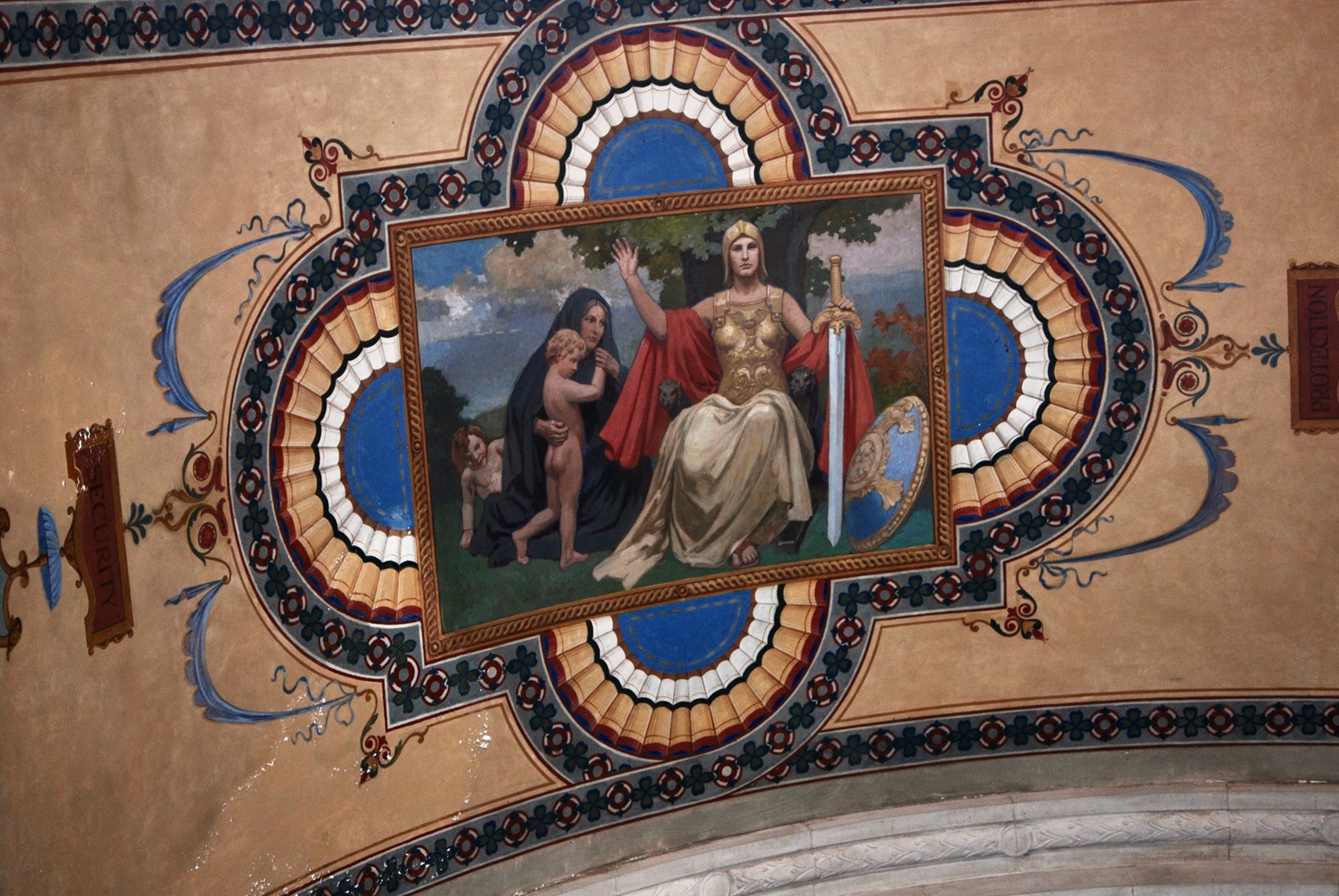
The themes of the design on the ceiling of the colonnade are “protection and security,” “army and navy,” and “truth and error.” On each side of the colonnade are head portraits of Presidents Grover Cleveland and Theodore Roosevelt, who were both New Yorkers and Governors of New York. Their initials are adjacent so as to help the viewer identify them.
The barrel-vaulted ceiling contains two panels of allegorical figures. In one, against a tan background there is a design of four scallop shells colored with a strong blue, white, tan, and brown. At each end of the composition is a painted plaque. Within one is the word “Security” and within the other the word “Protection.” The dominant figure in the composition is a woman seated in a woodland setting who is dressed in a gold helmet and armor and flowing robes and holding a large sword with a shield nearby. This figure, who might be the Greek goddess Aletheia, in fulfillment of the theme gives protection and security to a woman and her child.
The composition on the other barrel vault parallels the one just described, but with a different allegorical subject at its center. Here again there are two plaques at each end of the design, one containing the word “Error” and the other “Truth.” At the center of the composition is an allegorical or mythological female figure, possibly the Greek goddess Soteria, who is dressed in classical robes and wearing a winged headdress. She places a protective hand on the shoulder of a naked woman. This woman holds a mirror in her hand. Over the right shoulder of the main figure is a naked man with his back to the viewer. The goddess seems to sweep this man away with her right hand and he skulks away in shame. The goddess protects truth, in the form of the woman. The mirror is a symbol that has had multiple meanings in art, including duality, but one thing a mirror clearly does is to present the truth, reflecting back to the viewer whatever reality is present. The man, on the other hand, is error. The goddess is protecting truth and punishing and discarding error and dishonesty.
Over the entrance way to the rotunda is an elaborate bronze screen or grille.
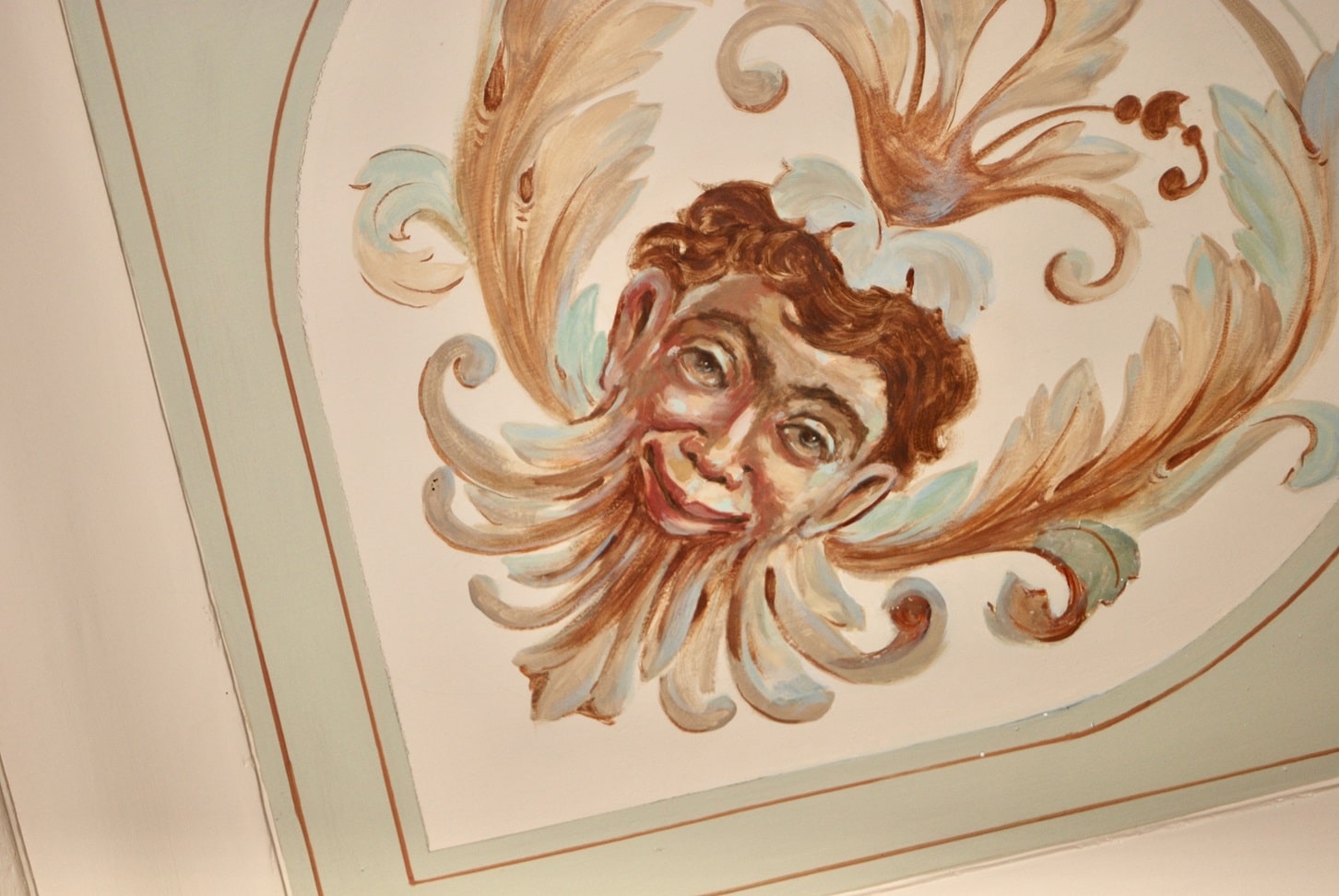
The corridors on the first and second floors were also painted by Pusterla and his assistants. These murals are decorative rather than representational figures and images such as are found in the vestibule and the colonnade and on the rotunda ceiling. Pusterla and his assistants painted very simply the ceilings of the circular corridors that wind around the outside of the rotunda proper on the first floor and around the balcony on the second floor. They also painted decorations on the walls and ceilings of the five radiating corridors that run from the rotunda to the circumference of the building on each of the two floors. The example here and others like it were painted on ceilings and others were painted on walls. There are elaborate painted medallions under large lanterns that hang from the ceilings. The schemes in the various corridors differ from one another.
THE ROTUNDA CEILING
The rotunda, the centerpiece of architect Guy Lowell’s design, is stunning. Six pairs of marble columns in Corinthian style and six travertine piers, two stories tall, circle the space. The beautiful floor is composed of marble in white, tan, and darker tones. A central design, which resembles a sun, is surrounded by several bands with circles in the largest of the bands. The signs of the zodiac are inset in bronze in low relief in this band. Marble decorates the walls that run around the outside of the rotunda proper on both floors. As the Landmarks Preservation Commission put it: “The spectacular rotunda, in essence the recreation of a splendid Roman hall, reflects the classical spirit that so strongly influenced American architecture during the early twentieth century” and that inspired Guy Lowell in his work on the courthouse.
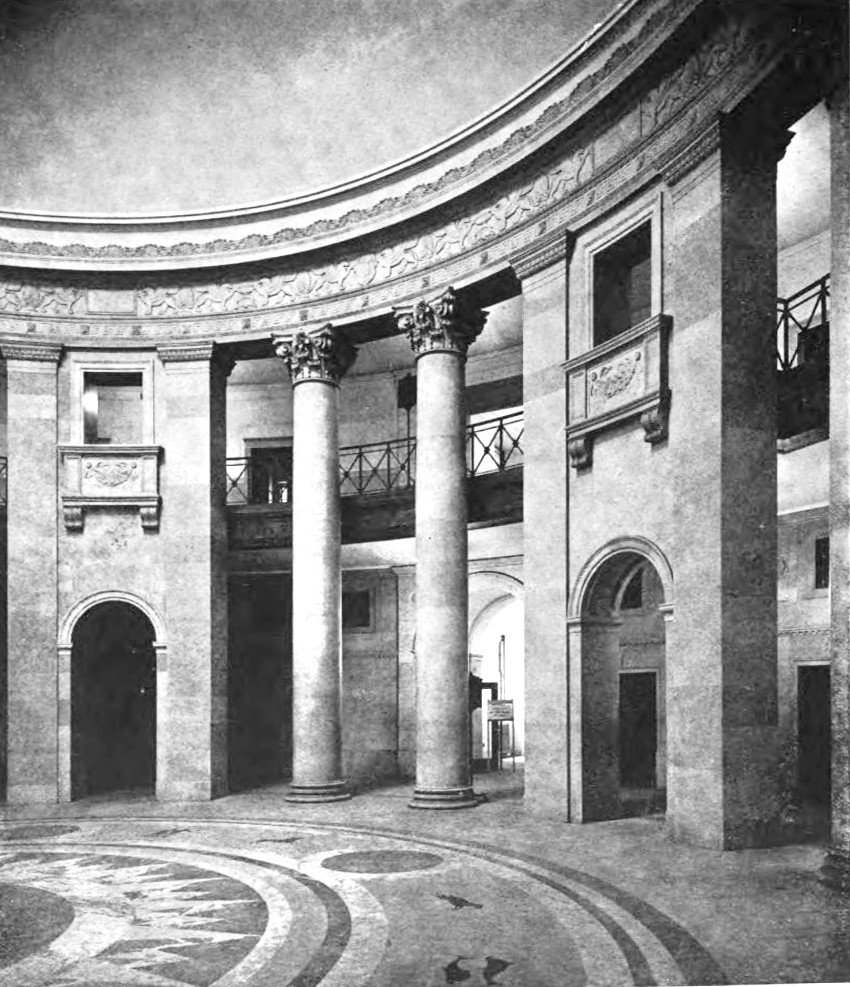
The ceiling of the main hall is immense, 200 feet in circumference and 75 feet tall and the dome is 30 feet high. Looking at the space and imagining it entirely undecorated, as it was from the opening of the courthouse in 1927 through 1935, gives one a sense of the scope of the challenge that faced Mr. Pusterla. At its most basic, the task was to carry out a daunting physical undertaking, that of filling up the large space with paint by hand in the fresco secco technique while working on scaffolding far up from the floor. The physical labor must have been especially difficult for Pusterla as he was, at the time he worked on the rotunda, 73 years of age.
Very challenging artistically was the task of creating designs that would have artistic value and power, which demanded great skill and care in planning the composition. Pusterla confronted the difficulty that has faced frescoists, such as Michelangelo and Tiepolo, who have had to paint scenes on lofty ceilings — that of achieving largeness and carrying power so that the viewer looking upward from far below can readily perceive and be affected by all aspects of the painting.
Pusterla also had to conquer difficulties on the score of perspective caused by the vaulted and domed surfaces of the vestibule, the colonnaded corridor, and the rotunda ceiling. Those curved surfaces and the fact that they were located high in the air called upon the painter to create optical illusions, foreshortening that would trick the eyes of the viewers below.
Developing a sophisticated and impressive composition on paper in a studio is a far different thing than executing the design on the surface of a huge ceiling such as that of the rotunda. Merely creating a competent design suited to the curved spaces of the domed ceiling required skill and understanding of the technical aspects of mural painting. The vast empty space would have to be divided into zones and each of the 12 events covered by the mural would have to be properly situated at even distances one from the other and at the same height and with the same width; the various figures in the scheme would have to be correctly and evenly placed and have the same dimensions as each other like figure in the assigned place in the scheme; and the preliminary and final divisions of the space would have to take careful account of the curved space being worked on to achieve balance and uniformity.
The rotunda mural Mr. Pusterla proposed and executed is a fresco expressing a single theme through a group of related elements. The mural is entitled “The Law Through the Ages.” It depicts a group of important incidents in the development of the law from ancient times through the founding of the United States and its second founding at the time of the Civil War.
We do not know how Pusterla decided upon the theme of the rotunda mural or chose the elements to illuminate it; probably he developed these things in his consultations with Guy Lowell before 1927. The theme is one naturally suited to the most important space in a large courthouse. It is a representation of growth, of progress in the evolution of legal principles from primitive times, when the law was just emerging and was unsophisticated, down to the relatively recent past.
At the apex of the mural there is a band of blue, with decorative designs in tan set inside, that runs around the circumference of the ceiling. Just below this band is another band of colored designs in gold, red, and blue. Connected to this band are six painted designs in the form of faux pendentives, which serve the function of creating partitions of the main part of the mural into six sections, as discussed further in a moment. On the blue band, over the center of each pendentive, there appears a painted plaque that seems to be affixed to the wall and within each plaque is the name of a figure in the history of the law. Below each plaque and inside a pendentive is a painted illusion of a piece of marble and on it is a painted marble head of the figure named. The figures depicted in this portion of the mural are six of the great legal figures in history: the lawgivers Hammurabi, Moses, Solon, and Justinian; Sir William Blackstone, an English jurist and scholar known for the immensely important treatise Commentaries on the Laws of England; and Chief Justice John Marshall, the greatest interpreter of the United States Constitution.
In the center between each two pendentives a circle or shield hangs down. There are six of these, each placed over the middle of the main sections described shortly. Within this element appears a thing or things that relate to the section below it. I describe these elements below. Flowing down from each area between the pendentives are gold stars and rays pointing downwards against an intensely blue sky.
The main sections of the mural are in the bottom portion, below the features just described. In order that each of the six sections of the mural may have its own identity, each section is partitioned from the others by bands of color flowing down from the pendentives, each of which creates a kind of arch. Yet the sections are also harmoniously linked together by the consistent use of the arches and by a continuous band that runs across the whole of the painting, a sort of painted frieze, in dark blue tones. This frieze appears just above the action of the main sections. It consists of a continuous grouping of persons, sometimes with horses, wagons, and the like, densely packed together. These persons are smaller than the figures that appear in the main sections.
Mr. Pusterla drew attention to the fact that the some 300 figures in the mural are painted in two different ways: those in front in the main sections are “painted in strong colors, while those further back [are] painted less boldly, thus giving a fine sense of perspective.” Those in the frieze are all painted in tones of dark blue. He described his aim in creating the frieze:
Over the main mural, in a hazy, cloudlike effect, will be seen humanity on the march, in scenes suggestive of each historical period – – the Exodus, over the Hebraic group; Caesar’s legions, over the Roman group; the Continental armies and the settlement of the West, over the United States panel. The entire effect will be that of a panorama, where the whole host of humanity marches around in a circle, with the blue sky overhead drawing the great masses of bright colors in a unified entity.
The figures in the frieze are very numerous and close together, and yet are created through the use of only three tones of blue. The overall impression the figures present is, as a result, hazy, as intended. Even so, however, it is remarkable how well Mr. Pusterla carved out the individuals who make up the marching mass of humanity. One can easily discern men and women, who are soldiers and who are ordinary persons, the animals in the march, and the characteristics of the persons that reveal the historical epoch in which they lived.
Below the sky in each section are the protagonists of the design, the great historical figures who advanced the cause of the law. These figures are much larger than all the others in the mural, thus conveying, along with their positions in the composition, their centrality to the scheme of the painting. In each section, two such figures (with one exception) are seated back-to-back at the center of the section, so that the mural presents its theme through 12 historical episodes. Below the frieze and ranged below, at the feet of, the principal historical figures are groups of other figures, larger, more colorfully painted and more defined than those in the frieze. These figures surround the even larger historical protagonists and were associated with them in or affected by aspects of their work. For instance, George Washington is surrounded by individuals who participated with him in the founding of the country.
Below the mural proper runs a band of marble within which are affixed words in illuminated gold capital letters that identify the period of the action depicted within each of the sections, i.e., “Assyrian,” “Egyptian,” “Hebraic,” “Persian,” “Greek,” “Roman,” “Byzantine,” “Frankish,” “English,” “Colonial,” and “United States of America.” There are ten names applicable to ten episodes, plus the “United States of America,” covering two of the 12 episodes.
From this description of the design of the ceiling, one might be inclined to think that there is much happening there. But the placement of the groups, the spacing of the elements of the design, the differing sizes of the various figures, the frieze and its coloration, the differences in the use of color and other marks of differentiation among the elements of the scheme have been so carried out by the painter as to make for a composition that is not cluttered or confusing, but balanced and effective.
The episodes depicted in the mural are highly stylized and idealized presentations of imagined historical scenes, which represent actual events or processes, and some episodes derived from the Bible, that drove or contributed to the growth of the law over the centuries.
The ceiling is topped by a large clerestory composed of eight stained glass windows separated by Ionic columns and capped by other windows. From here is suspended a magnificent bronze chandelier.
A description of the 12 episodes set out in the rotunda painting and an explanation of their importance to the development of law in the world through the centuries follow.
[*] Robert C. Meade, Jr., Esq., a member of the New York Bar, served, among other things, as First Deputy Chief Clerk of the Supreme Court, Civil Branch, New York County.
THE PROGRAM OF THE ROTUNDA CEILING
The First Section
The Assyrian
The first section shows Hammurabi (1792-1750 B.C.), a king of the Babylonian empire in Mesopotamia. In this scene, it appears that a woman has been caught in some suspected offense and has been brought before the king by a soldier while a crowd observes. The king sits in a chair carved into a design of a lamassu, a winged lion with a bearded human head that was a divine guardian in Assyrian culture.
Hammurabi is best known to history for having promulgated the Code of Hammurabi, one of the first written codes of law. Though harsh by today’s standards, the Code also limited retribution, promoted peaceful resolution of disputes, set forth one of the earliest instances of the idea that the accused is presumed innocent, and sought to prevent the oppression of the weak by the strong. The Code was thus a watershed. It was written in the daily language of Babylon, on a stone pillar, which was placed on public view and so was accessible to any literate person. This act of promulgation conveyed to the whole community both what the laws were and the expectation that all persons were to adhere to them.
In the lower left corner of this section of the mural, we see a lion, a symbol of Babylon. As we will see, one of the motifs of the mural is the placement of symbols in the corners of each part of each section. Near the lion, at the bottom of the line that creates the arch that separates this section from an adjacent one, there is a painted sculpture of a woman. A figure of this sort appears at the bottom of each of the arches in the mural.
The Egyptian
The second seated figure is the Pharaoh of Egypt. Nearby his chair is a chess board, which appears since it has been thought by some over the centuries that chess originated in ancient Egypt (the board game senet was definitely played there). Two soldiers at the Pharaoh’s feet are beating someone, while farther back in the crowd two other soldiers are controlling a prisoner who is fettered and blindfolded. The victims are Jews who are intended to represent the Jewish community generally, which was at the mercy of the Egyptians. We see Moses imploring the ruler to free his people. Ultimately, the Bible recounts, the Jews were liberated, but only after a series of plagues had descended upon Egypt. Pharaoh frees the Jews, but repents of having done so and sends his soldiers after them. The Jews escape when the Red Sea parts and the Egyptian soldiers are drowned.
This portion of the mural is intended to celebrate liberation from slavery. A sculpture of a sphinx, a symbol of Egypt, is shown in the lower right corner. At the bottom of the arch nearby is a painted sculpture of a woman wearing an Egyptian headdress. Between the two seated figures is a painted sculpture of a pharaoh.
The Second Section
The Hebrew
The second section, on the left, presents King Solomon as he deals with the case of the two women and the child. We see the child being held by an officer who brandishes a sword and is about to slay the child in accordance with the King’s initial direction. We also see the two women at the ruler’s feet, one of them entreating him more earnestly than the other. The story is recorded because it shows that justice should be founded upon the application of wisdom. The lion, traditional symbol of Israel, is shown in the lower left.
The Persian
On the right we see Cyrus the Great (ca. 590-ca. 529 B.C.), the first Emperor of Persia. Cyrus built a formidable empire, but was, by the standards of his time, an enlightened ruler. He respected the customs and religious beliefs of the lands he conquered, was open to applying administrative and other practices of other peoples, and was willing to appoint persons other than Persians to positions of responsibility if he deemed them to be able. After his conquest of Babylon, Cyrus decreed that the Jews, who had been deported to Babylon by a prior ruler, were thenceforth free to return to Jerusalem and some 40,000 of them did so in a “Second Exodus.” But he went further, declaring that the temple in Jerusalem would be rebuilt at his expense and that plundered treasure would be returned. The value of magnanimity in the application of power and law is what the mural celebrates here.
In this scene, three soldiers bow deeply before the king, while members of the crowd appear to be saluting him. In the lower right a winged griffin is shown, a symbol of Persia. Immediately next to the king is a large lion baring his teeth menacingly, brightly colored and strongly painted. At the foot of the nearby arch is a painted sculpture of a woman. Between and behind the two seated figures is a menorah.
The Third Section
The Greek
Seated on the left-hand side of this section is Solon, an Athenian statesman (ca. 630-ca. 560 B.C.). During a time of social unrest, Solon, as chief archon of Athens, was empowered to draw up laws and pursued sweeping constitutional, economic, and moral reforms. He repealed most of the very harsh laws then extant, including that providing for slavery for debt, and issued an amnesty. He reformed criminal procedure to minimize vengeance and to make justice a concern for the whole community. To address social tensions, he implemented a constitution that divided all male citizens into four census categories, in accordance with their property, which gave political input to all groups and allowed for upward mobility. He created the concept of an impersonal state, as opposed to arbitrary leadership by an aristocracy, and gave benefits to all sectors of society, thereby ensuring that the laws would not be rejected.
Solon’s laws were inscribed on wooden tablets that were placed in the agora for all to see.
In subsequent centuries it was asserted in Athens that Solon, though not himself a democrat, was the father of democracy. His reforms also created a political and social system that benefitted from individual initiative and change. Solon’s work can be seen as an early effort in the direction of a democratic form of government and in the humanization of law.
We see in the foreground an official reading to the citizenry from a paper setting forth or discussing Solon’s reforms. A symbol associated with Greek culture and myth, also a griffin, is shown in this panel.
The Roman
On the right is Marcus Tullius Cicero (106-43 B.C.), statesman and orator of the late Roman Republic. Cicero was not born to the aristocracy. He trained to become a lawyer and was a junior magistrate, serving in Sicily in 75 B.C. This position also gave him a seat as a senator for life. Back in Rome he prosecuted a case against Verres, a corrupt governor, and his arguments became well known. Cicero became a praetor in 66 B.C., an office in which he exercised judicial duties in Rome. In 64 B.C., he was elected consul, the highest office in the Republic, the first time in years that a non-aristocrat had ascended to that position. He defeated Catiline for the post, having criticized him to great effect. Cataline sought the consulship again in 63 B.C., without success. He then engaged in a complicated plot to overthrow the Republic. The plot failed. Cicero gave a famous group of orations denouncing Cataline, defending the Republic, and urging him to leave Rome. Cicero was supported by the Senate. Cataline was forced to flee and the conspiracy was defeated.
Later, Cicero advocated on behalf of the Republic and republican values as Rome slid into dictatorship. Invited to join Caesar’s alliance with Pompey and Crassus later called the “First Triumvirate,” Cicero declined out of concern that the arrangement would undermine the Republic. At considerable personal risk, he subsequently gave a series of notable orations, the Phillipics, against Marc Antony in the Senate.
Cicero was above all a forceful defender of the Republic. He articulated republican ideals that had a powerful impact on Western culture in the centuries that followed. His influence was felt during the Renaissance and the Enlightenment, as he was a means by which Roman and republican values were given a rebirth in Europe. In the United States in the decades prior to the revolution, Cicero’s republicanism exercised profound cultural, political, and legal influence. His support for republicanism and adherence to law is why he is the protagonist in this part of the mural.
In the mural we see Cicero presiding in the Senate as Cataline is accused of betrayal of the Republic. Before Cicero is a crowd of citizens, Roman soldiers, and senators. On the far-right side appears a glowering Cataline. In the lower right there is a painted statue bearing the letters “S.P.Q.R.” (abbreviation for the words “the Senate and the People of Rome” in Latin) and showing Romulus, Remus and the wolf, the symbols of the founding of Rome. Here, as throughout, there are painted sculptures between the two main figures in this section and at the end of the nearby arch.
The Fourth Section
The Byzantine
In the left-hand side of the fourth section two figures are seated, the Byzantine Emperor Justinian and his wife Theodora. In the sixth century A.D., Justinian, aiming to promote unity in a fractious empire, directed that a study be made of the constitutions and laws of the previous Roman emperors and compiled a code of laws. In the centuries that followed, the Code of Justinian had great influence upon the development of law in the western world. The heritage of Roman law was forgotten for a time after the fall of the Western Roman Empire, but it was recalled in the Middle Ages as surviving manuscripts of the Code were rediscovered, copied, and studied in a systematic way, and the Code became the basic source of Roman law in the culture of the West. All subsequent systems of law in the West borrowed from it, including the English common law, which in turn, of course, became the principal source of law in the United States. This productive development in the history of law is commemorated here.
In the crowd below the two protagonists we see richly-dressed men presenting scrolls that contain the laws of the Code. Standing prominently near the Emperor is a soldier holding a shield that bears the chi-rho, a symbol of Christ, arranged as a monogram, composed of the first two letters, X and P, of the name of Christ in Greek superimposed one on the other. This monogram was used as a symbol of Christianity in its early centuries. Justinian’s seal is in the lower left-hand corner of this part of the mural.
The Frankish
Charlemagne, King of the Franks and Holy Roman Emperor, is seated on the other side of this section. In the crowd we see religious figures, as well as soldiers and some well-dressed men. One of the religious figures might be Pope Leo III, who crowned Charlemagne Holy Roman Emperor in the old St. Peter’s Basilica in Rome (800 A.D.). Some in the crowd bow before Charlemagne.
Charlemagne united most of western Europe under one authority for the first time since the classical era of the Roman Empire. This gave western Europe an identity as the “second Rome,” separate from the Byzantine empire and greater than the positions of the individual peoples who made up the parts of the new entity, and from this much was to grow over succeeding centuries. On his seal Charlemagne had inscribed the words “the renewal of the Roman empire.” The Holy Roman Empire lasted for a thousand years and under it, the western way of life, culture, and institutions flourished. Beyond this achievement, what set Charlemagne apart from his predecessors was his deep interest in pursuing and promoting intellectual activities. His 47-year reign became a period of noteworthy cultural and intellectual growth and artistic development. Charlemagne promoted books, learning, and libraries and he provided extensive support for monastic schools and centers for book-copying. Many manuscripts were copied and preserved for the future, the most important being the Bible, works of the early Christian period, and the works of antiquity, including much of the classical writing that had survived to that time. The copying centers generated a beautiful new form of script, the Carolingian, that, apart from its beauty, improved upon its predecessor by making writing clearer and much more legible. Charlemagne thus played a major role in spurring a renewal of interest in classical antiquity and the preservation of the classical heritage and its transmission in later years.
All of these and other advances under Charlemagne helped to build an indispensable foundation for reason and law in western Europe in succeeding centuries. Charlemagne’s impact was recognized in his own lifetime, as he was called the “Father of Europe,” a name used to this day.
In the lower right-hand corner of this portion of the mural we see an insignia associated with Charlemagne. In the customary position between and behind the two principal figures in this section of the mural is a painted sculpture of the pope.
The Fifth Section
The English
On the left portion of this section appears the seated figure of King John of England, who receives the Magna Carta (1215 A.D.). This document, the product of significant unrest on the part of leading barons, was forced upon the king and was issued by him and the barons. In it, King John dealt with grievances about his rule and restrictions on the powers of the king were set forth. With Magna Carta, the law assumed preeminence in Great Britain and the concept of formal legal rights that could not be denied by the political realm was established.
The charter provided that taxes could not be exacted without the “general consent of the realm” and that fines must be calibrated in accordance with the severity of the offense. The most important of the charter’s provisions for the advancement of individual rights was the 39th clause, which gave to all free men the right to justice and due process of law.
Magna Carta was recognized in Great Britain as a foundational document of liberty and its influence resonated down the centuries. Its formal expression of protection for individual rights and due process of law were highly influential in the American colonies and in the formation of the Constitution of the United States, and in many other countries. Due process is one of the most basic and important elements of our constitutional and legal systems. The mural celebrates Magna Carta as a symbol and manifestation of the ideals of the rule of law and the rights of the individual.
In the mural, we see the knights assembled at Runnymede in Surrey as they present the document to King John, who does not appear to be happy at the event. The coat of arms of the King is in the lower left-hand corner.
The Colonial
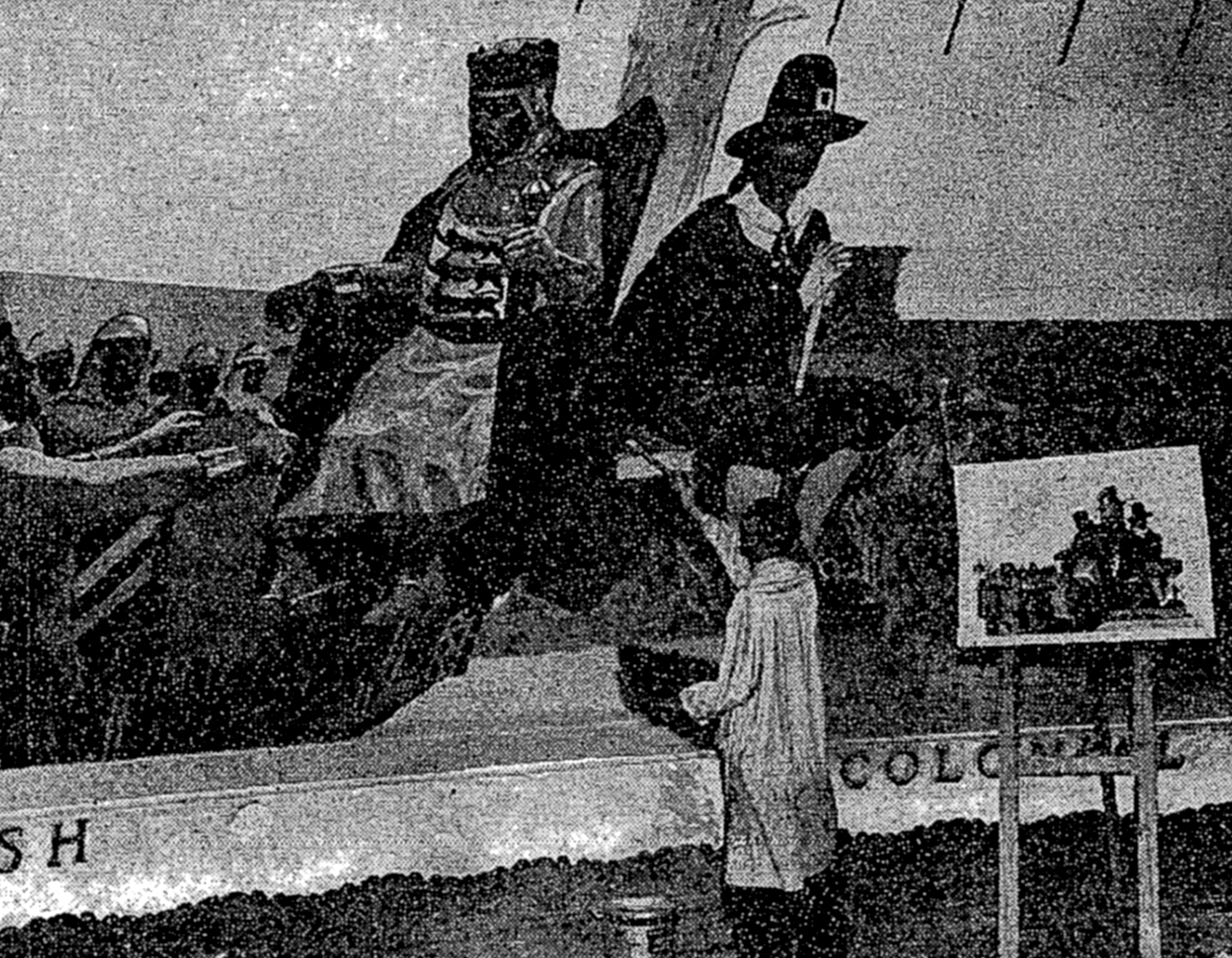
On the right-hand portion of this section of the mural is a portrait of a seated Puritan leader, someone such as, perhaps, William Bradford, or John Winthrop. Bradford was an Englishman who, after years in Holland, was one of the original settlers of the Plymouth Colony in 1620, and was elected by the colonists governor of the colony, in which capacity he served on and off for over 30 years. Winthrop was a lawyer who led a large expedition to America in 1630 to establish what he called “a Citty upon a Hill,” what became the Massachusetts Bay Colony. Winthrop was elected governor of his settlement four times.
Despite their severity in religious matters (we see in this section a man in the stocks), the Puritans were symbols of religious freedom. The colonists at Plymouth were Separatists who first went to Holland and then crossed the ocean to escape religious persecution under King James I. John Winthrop and his followers, dissatisfied with the Church of England, sought to establish in the New World an ideal spiritual and secular community that would freely live the true Anglican religion as they understood it. Further, the colonies were to be and were self-governing and largely independent of Britain. In the “Mayflower Compact,” one of the foundational documents in American history, the Plymouth colonists committed to resolve issues in the colony by voting. The royal charter of the Massachusetts Bay Company was transferred to the colony along with the government and members of the company, which ensured independence from royal government in Britain. The colony was governed through the votes of church members and officials elected by them. The Puritans, then, stand for religious freedom and freedom more generally and the ideal of democratic government. These are the values that the mural commemorates in this section.
In the lower right-hand corner of the section is a turkey, a bird indigenous to North America that is, of course, linked in the public mind to the colonists of New England. At the bottom of the arch is a painted sculpture of a Native American woman.
The Sixth Section
United States of America
On the left-hand side of this last section is a skillful portrait of President George Washington. Dressed in civilian attire, having surrendered his military commission at the conclusion of the war, he is serving as the presiding officer at the Constitutional Convention at the Pennsylvania State House in Philadelphia in 1787, where the Constitution was drafted. We see members of the Convention and other founders arrayed before Washington and engaged in discussion and debate. Among the figures assembled are Benjamin Franklin and Alexander Hamilton, who is seated at a desk writing, and perhaps James Madison and John Adams. Hamilton and Madison were two of the three authors (the other being the New Yorker John Jay) of The Federalist Papers, which work argued effectively for ratification of the Constitution and has ever since served as a fundamental source for understanding the intentions of the Framers.
In the lower left-hand corner is a bison, which is identified with American history. The American bison is the more numerous of the two extant species and is native to North America.
In this part of the section, the muralist honors the ideals of the constitutional framework of the United States in which the rights of the citizens are protected by the fundamental law and the laws and policies of the country are debated and decided upon, not by a monarch like King John, but by the people themselves through their chosen representatives. It is also a system in which the leader of the country serves but a limited time in office, a precedent established by Washington, whose willingness to surrender power had earned from King George III, his political and military adversary, the encomium that he was “the greatest man in the world.” Imperfect though it was, the Constitution and its enshrining of democratic government and the natural rights of the individual, the principle of equality of all men set forth in the Declaration of Independence, and the principle that a more perfect union that would establish justice and promote the general welfare would be the task of and decided upon by “We the People” were profound innovations of worldwide importance, both for the cause of decent government in the world and for the progress of the rule of law. In the words of a great historian, “[i]t was the Revolution, more than any other single event, that made America into the most liberal, democratic, and modern nation in the world.”
On the right-hand portion of this section the mural addresses the great failure of American law, justice, and the American democratic system. Here we see President Abraham Lincoln in his typical attire, with his famous hat and shawl on a nearby table, writing the Emancipation Proclamation, which he issued on January 1, 1863. In a preliminary Emancipation Proclamation of September 22, 1862, he had announced that, on the following January 1st, all persons held as slaves in the rebellious states “shall be then, thenceforward, and forever free ….” This action freed millions of enslaved persons and opened the way so that, once the war was won, slavery could be abolished by the 13th Amendment to the Constitution and the 14th and 15th Amendments could be enacted. In the usual position below the figure of Lincoln we see enslaved persons representing the enslaved population generally, who wait anxiously for the completion of the Proclamation, although, as we know from the Juneteenth national holiday, in reality many were unaware of its issuance for a long time. Also present are some Union soldiers, other figures, and, in the lower right-hand corner, Frederick Douglass, a towering advocate for the abolition of slavery and freedom for all. In the customary position, we see a bald eagle, a symbol of America.
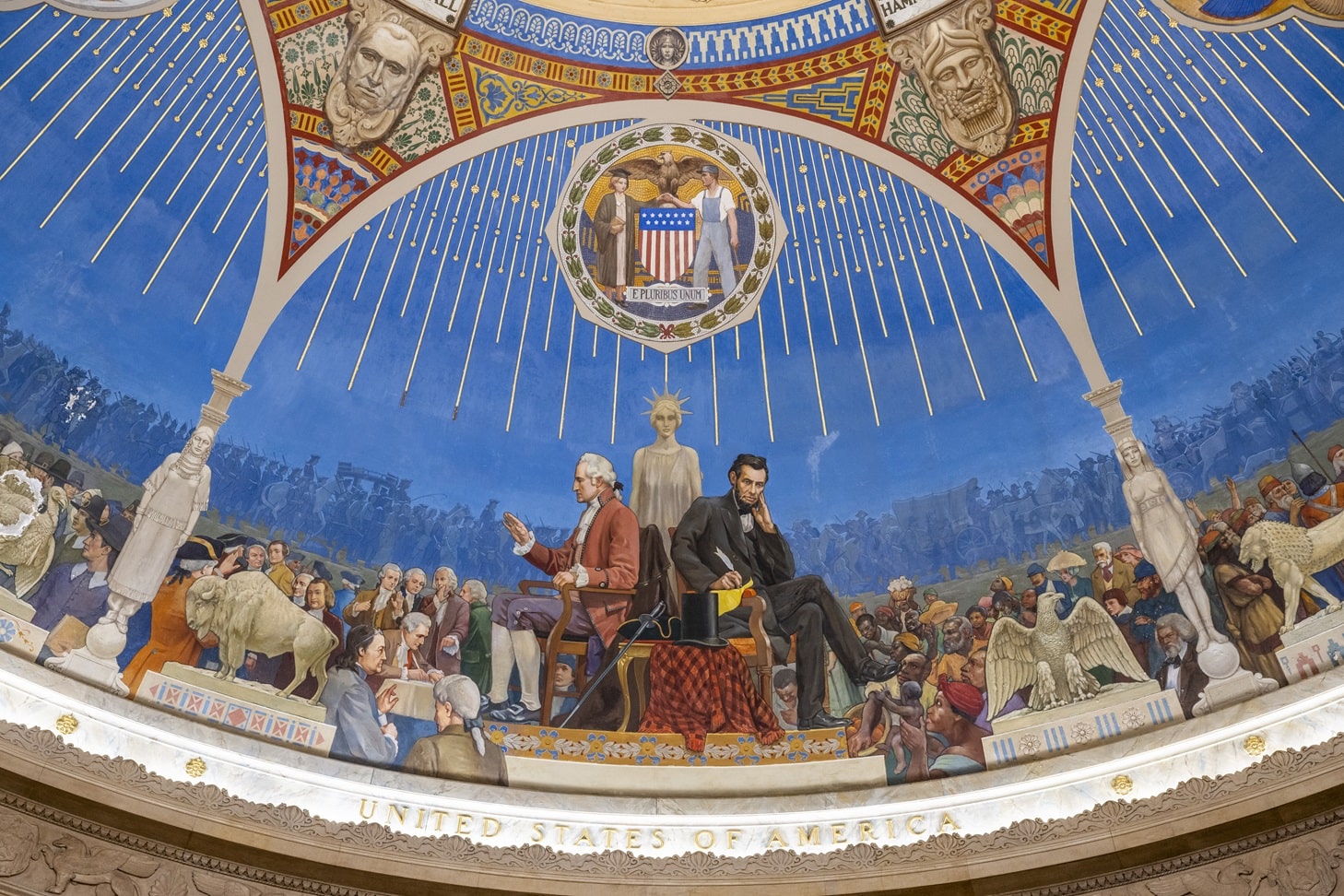
The Proclamation was a central element in the second American founding. It represented a great advance for the rule of law and the cause of justice in the democracy of the United States. The mural is a depiction of that moment of progress. But, as we know, that founding could not remedy the “bondman’s two hundred and fifty years of unrequited toil,” in the words of Lincoln’s Second Inaugural. Nor was the “new birth of freedom,” as he put it at Gettysburg, to be achieved for a long time, despite the amendments that followed the war. So, as the mural commemorates the advances of the law through history, it also calls upon the Supreme Court of New York State, all the courts, and the legal system as a whole at all times energetically to do what they can to achieve a system of law that truly attains its aims for the benefit of every person.
Behind Washington and Lincoln stands the figure of liberty.
Finally, there are the shields or circles in the upper portion of the mural that are positioned over the center of each of the six sections.
The “Assyrian” and “Egyptian” section: A shield contains a figure of an ancient Egyptian, snakes, and two wedjat eyes (“Eye of Horus”), symbols from ancient Egyptian religion that represented well-being, healing and protection.
The “Hebraic” and “Persian” section: A circle contains tablets with the Ten Commandments written thereon in Hebrew and the Star of David.
The “Greek” and “Roman” section: A shield contains pictures and the names in Greek of Hermes (with his symbols), Hera, Zeus, and Poseidon (with a chariot).
The “Byzantine” and “Frankish” section: In the center of a circle are what may be an image of a coin from the time of Justinian and saints on either side. At the top in the center is the chi-rho symbol.
The “English” and “Colonial” section: Inside a shield at the bottom is a portrait of Martin Luther (1483-1546) with his name underneath. Above his shoulders on either side are coats of arms of Pope Pius IV (1559-1565), derived from the Medici, of whom this pope was one, and the King of England. All three are linked to the Protestant Reformation. Luther, of course, was a seminal figure in the Reformation. Pius IV concluded the Council of Trent, which was important to the Counter-Reformation. The King of England became the leader of the Church of England.
The “United States” section: Inside a circle is a mosaic background and at the apex an eagle. Below that is a shield of the stars and stripes. On either side of this shield are a contemporary man and woman. They hold hands as though each is helping the other. The man is a workman dressed in overalls and a cap and the woman is dressed in an academic cap and robe and holds a book in her hand. They may symbolize labor and learning and/or be illustrations of the social progress and achievements that are possible for men and women under a system of law and democratic government. Beneath them a plaque bears the words “E Pluribus Unum,” “Out of Many, One,” the traditional motto of the United States, which appears on the Great Seal and is an aspiration which the Founders sought to make into a reality through the Constitution.
Further Reading
For a history of the murals, see our companion article:
THE MURALS OF THE NEW YORK COUNTY COURTHOUSE
PART ONE: HISTORY
For information on the murals of the upper floors, see our companion article:
A comprehensive and annotated study of the murals is also available online: