
Part Three: Murals of the Upper Floors
Artistic Elements and Aims
by Robert C. Meade, Jr., Esq.[*]
Thirty-two murals, most of them oils on canvas, unlike the murals on the first and second floors (frescoes), were installed in 1937 and, in a few cases, in 1938 in the New York County Courthouse, in the Ceremonial Courtroom (Room 300), the Jury Assembly Room (Rooms 448 and 452), and a conference room on the Seventh Floor. Photographs of the murals can be found in the accompanying Photo Gallery.
THE CEREMONIAL COURTROOM
There are three full-scale murals in the Ceremonial Courtroom: a large painting (about 21 feet wide and 11 feet high) behind the judge’s bench and, on the rear wall, two smaller, but still substantial murals (about 10 feet wide and 11 feet high). Tones of cream, red, and green are used in these works. The colors are notably more muted than those on the first floor (although a cleaning may be in order). These murals are realistic and devoid of allegory. They were the work of Andrew T. Schwartz, assisted by his colleague, Winthrop D. Turney, and two others, Nino Polimeni and Jules Ruppert. All of these murals are signed in the lower right-hand corner.
The largest mural takes up much of the wall behind the bench, but not all of it. On the left of the painting is a painted box. There are also four narrow decorative canvas panels in brown on this wall depicting fish and other animals, urns, floral arrangements, garlands, lions’ heads, and other elements. These panels also appear on all of the other walls in the room, for a total of 18 such panels. To the right of the main painting, over an entrance door for the judge, jury, and staff, is one of the subsidiary murals, another painted box displaying a seal.
On the rear wall, opposite to the main painting, are a clock, the other two principal paintings, which are the dominant features on the wall, some of the decorative panels, and, to the far right as one faces this wall, a window. At the other end of this wall, there is another staff door and over it another subsidiary mural of a painted seal.
The clock on the rear wall of the room consists of brass elements for the hours and minutes and brass arms (one is currently missing) within a large painted design that makes up the third of the three subsidiary murals in the courtroom. It appears that the painted design surrounding the clock is a fresco. Further, it appears that the other two subsidiary murals, those of the two seals, are frescoes as well. All three may have been the work of Attilio Pusterla.
The courtroom is very richly decorated with wood. There is an elaborate wooden entrance door and wooden wainscoting throughout.
The theme of all of these murals is the development of law and justice in the earliest decades of the colony that would become New York State. Understanding the murals requires a brief foray into the history of the colony in the 17th century. New York began as the Dutch colony of New Netherland. This colony covered an immense territory between the English centers of New England and Virginia, extending from Cape Cod to Albany, New York to Delaware, land that today is part of six states. The claim of the Dutch derived from the travels of Henry Hudson, who, in 1609, seeking a passage to India, sailed in the Half Moon from what is now Delaware up the river that is named after him. Various exploratory and trading activities occurred in the years that followed. In 1624, four years after the founding of the Plymouth colony in Massachusetts and six years before the creation of the Massachusetts Bay Colony, the territory of New Netherland became a province of the Dutch Republic. That same year, a ship, the New Netherland, chartered by the Dutch West India Company and carrying Flemish and Walloon families, arrived in the harbor of Manhattan and soon established settlements at Fort Orange (Albany) and on today’s Governor’s Island and later, as Fort Amsterdam, in lower Manhattan. Famously, the land of Manhattan was purchased in 1626 by Peter Minuit, one of the Walloon immigrants, then Director of New Netherland, from a group of Native Americans. So was founded New Amsterdam, the principal settlement of the territory of New Netherland, the center of the fur trade, which became the first chartered city in the 13 colonies, the antecedent of the City of New York. The province within which New Amsterdam was situated was variously called at the time Manhattoes or Mannados or the like, from an Indian name.
One of the murals on the rear wall depicts a meeting of the first law court of New Netherland in the City Hall of New Amsterdam (which appears in one of the murals in Room 448). This is, in other words, an image of one of the earliest instances of the administration of justice through courts of law in the history of New York and, indeed, the United States, illustrating our legal tradition in operation in its earliest years.
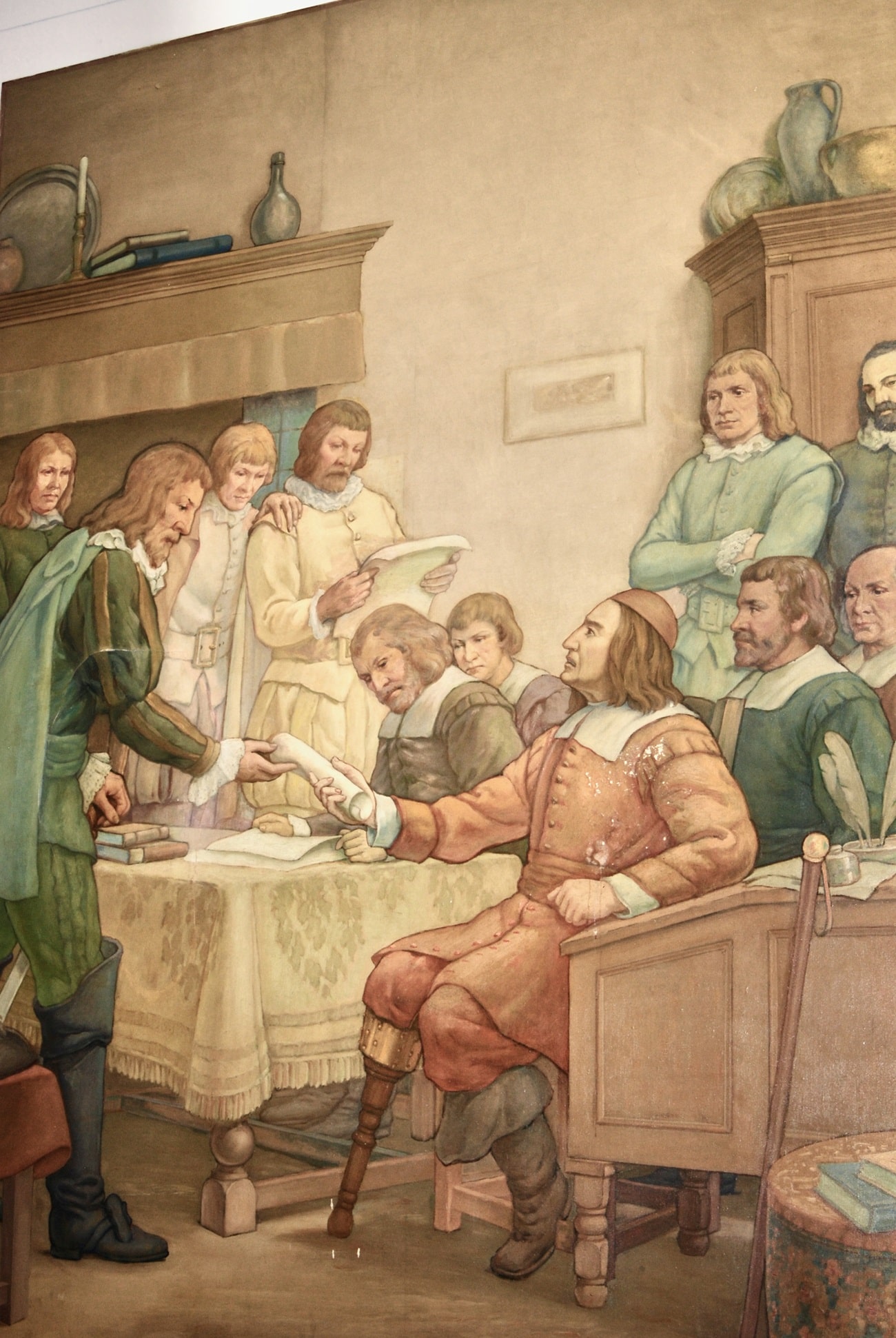
The other mural adjacent to the clock shows a milestone that had a profound and enduring impact upon the later history of New York State and the entire United States – – the transfer of the territory of New Netherland from the Dutch to the English in 1664. Had the Dutch been able to retain and strengthen New Netherland, the entire history of the United States might have been different, but the territory was not always well-governed by its Directors. Had the Dutch government been more successful, it might have been the case, for example, that the legal system of the country, or portions of it, would have been anchored in Dutch law, not English common law and the recognized rights and freedoms of Englishmen, which were critical to the kind of society America eventually became. The Dutch, though, were known for their tolerance, including in matters of religion, rights of citizenship and civil liberties, and New Netherland was open to various cultural influences. The Dutch also exhibited notable energy in commercial affairs and an orderly commercial and social life. The influence of all these things during the decades of Dutch control and their aftereffects in ensuing decades contributed positively to the political, social, and economic life of the colony that would become New York. The Dutch interest in commercial activity was passed on to subsequent inhabitants and is a characteristic of New Yorkers, as well as Americans generally. Reminders of Dutch domination of New Netherland and New Amsterdam and Dutch political, social, and cultural influences are all around us today in many place names (the Bowery, for instance, derives from a Dutch word, bouweries, for farms and Harlem (Haarlem), Brooklyn (Breuckelen) and Long Island (Lange Eylandt) were originally named by the Dutch) and in the names of successful Dutch families that are well-known to us, such as the Van Burens, the Van Rensselaers, and the Roosevelts, two of which families gave us three Presidents of the United States. Even the street patterns in lower Manhattan remain largely intact from those created by the Dutch of New Amsterdam.
English governments viewed New Netherland as an intrusion in English America. There were tensions between the Dutch and the English in the Old World as well. Between 1652 and 1674, the Dutch and the English fought three wars. The surrender of New Netherland took place because of these conflicts. In 1664, the last Dutch Director General of New Netherland (1647-64), Peter Stuyvesant, peacefully surrendered the colony to the English after a small English fleet had appeared in the harbor of New Amsterdam. Articles of Capitulation set out the terms of the transfer and, significantly for the rights of the people of the future, were generous and broad-minded, protecting the property rights of the inhabitants and providing for civil rights and freedom of worship in the colony. In this mural, we see Stuyvesant handing the Articles to a representative of the English. We recognize Stuyvesant from his wooden leg, which he is known to have lost in battle before he arrived in New Netherland.
The last and the largest of the murals in the courtroom, that located behind the judge’s bench, portrays a meeting of the first General Assembly of New York in October 1683, convened by the Governor, Thomas Dongan, which approved a Charter of Liberties and Privileges for the colony. The issuance of the Charter, a kind of Magna Carta for New York, was a consequential event in the constitutional history of New York State and in the history of the United States. The document established a right of suffrage and a system of government for New York in which popular representatives participated as members of the Assembly. Taking inspiration from Magna Carta, the Charter provided protection for the rights and freedoms of the people, including due process, taxation only upon the approval of the assembly, and trial by jury. A facsimile of the Charter and a transcript and summary of its provisions have been made publicly available by the Historical Society of the New York Courts.
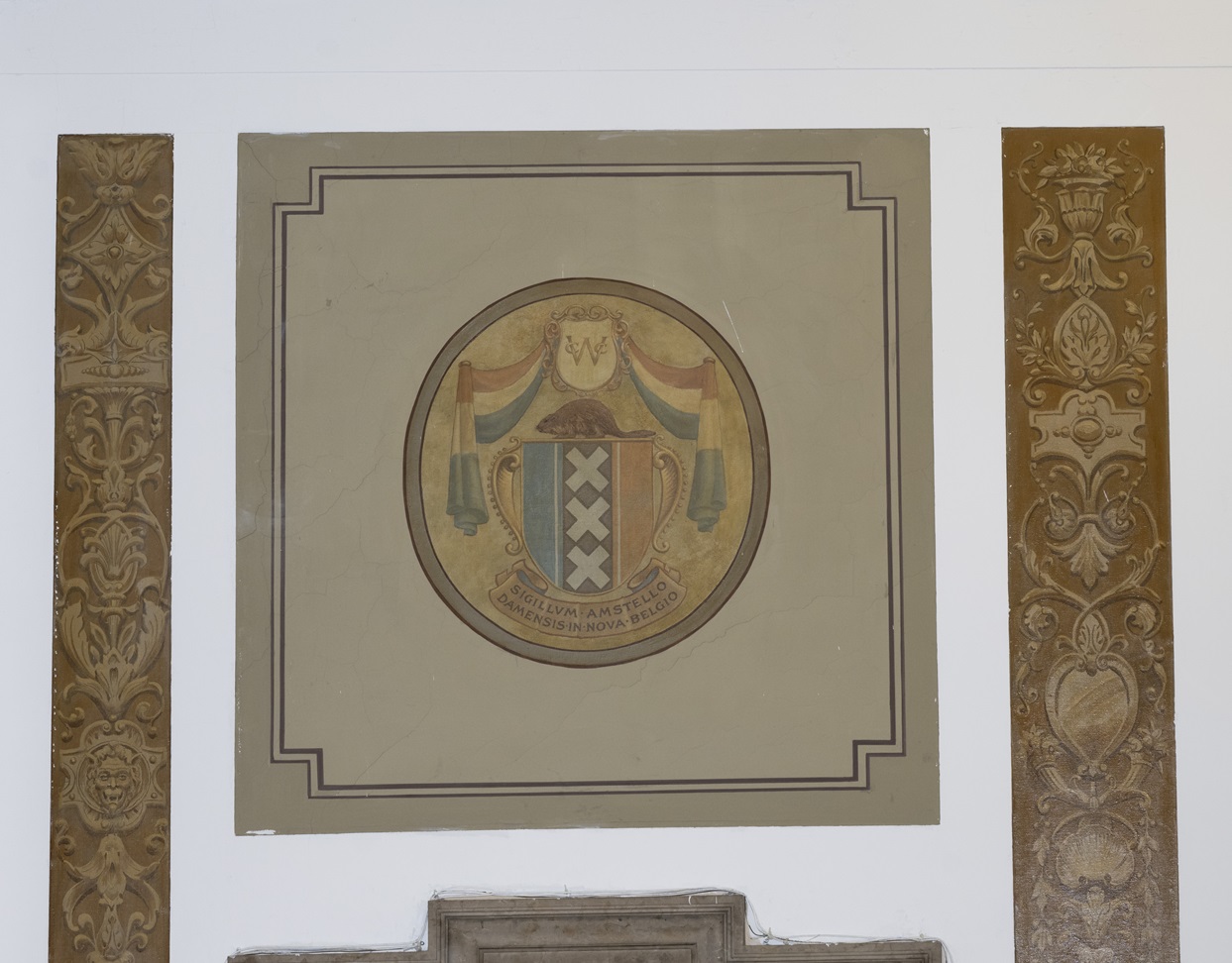
The seal on the rear wall, which was based upon that of Old Amsterdam, reads in Latin “Seal of Amsterdam in New Netherland.” Reflecting commercial realities of the time, the seal also includes a beaver and, at the top, the initials of the West India Company. This seal dates from 1654, when it was presented to Director General Stuyvesant.
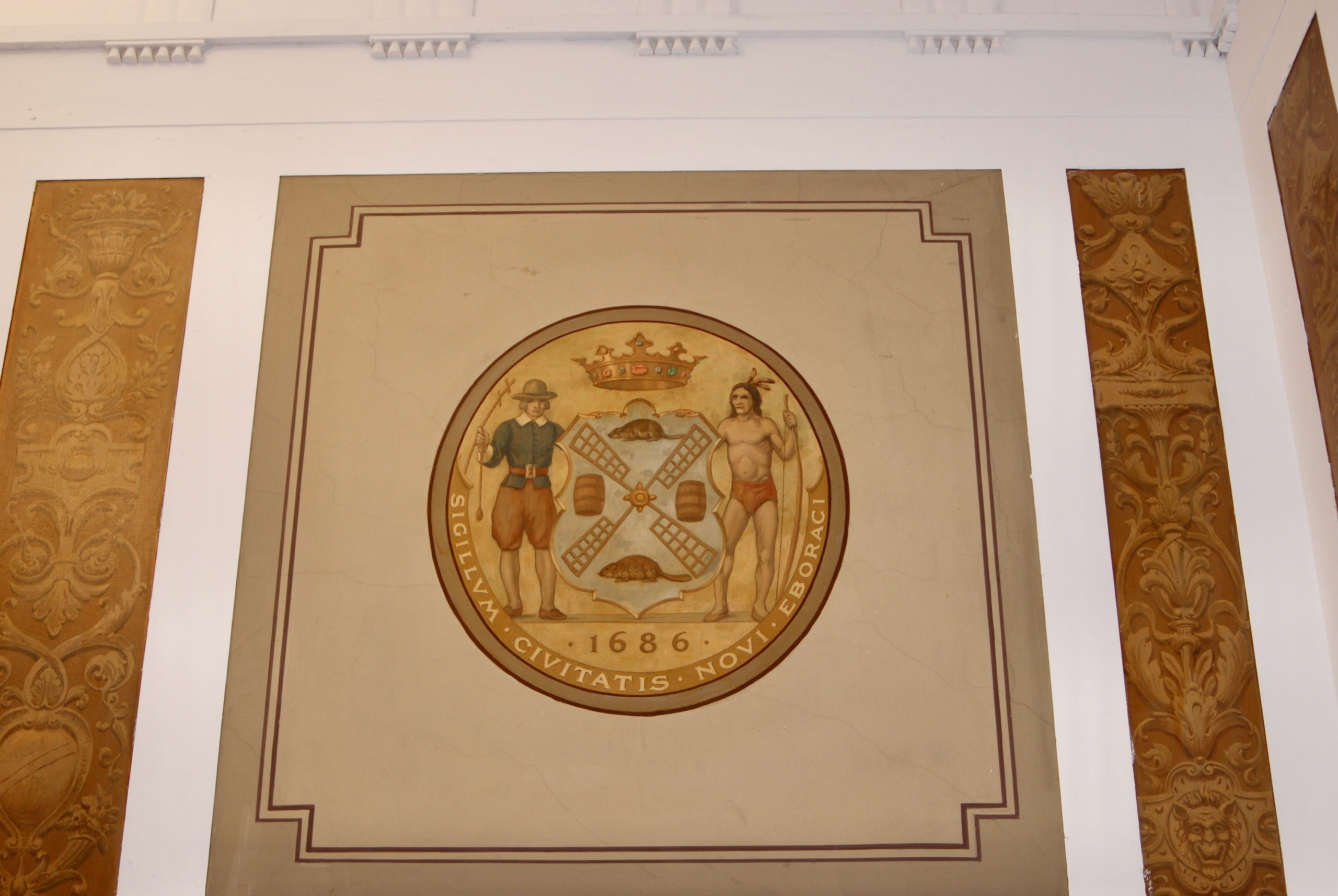
The seal on the main wall bears the date of 1686, 22 years after New Netherland became an English colony, which was when this seal was first used. It depicts a sailor and a Native American of Manhattan, the sails of a windmill, flower casks, and beavers. The human figures exemplify good relations between the settlers and the Native Americans. The citation of the casks and the animals reflects the fact that trade in flour and furs was the major economic activity in the earliest years of the colonial period. The seal bears in Latin the words “Seal of the City of New York,” the successor of New Amsterdam.
THE JURY ASSEMBLY ROOM
There are twenty murals in the Norman Goodman Jury Assembly Room on the fourth floor, where jurors wait to be called to service in trials in the courthouse.
The work on the walls of Room 452, one scholar writes, are “a gorgeous collection of paintings celebrating New York in the 1930s,” the theme of these nine paintings.
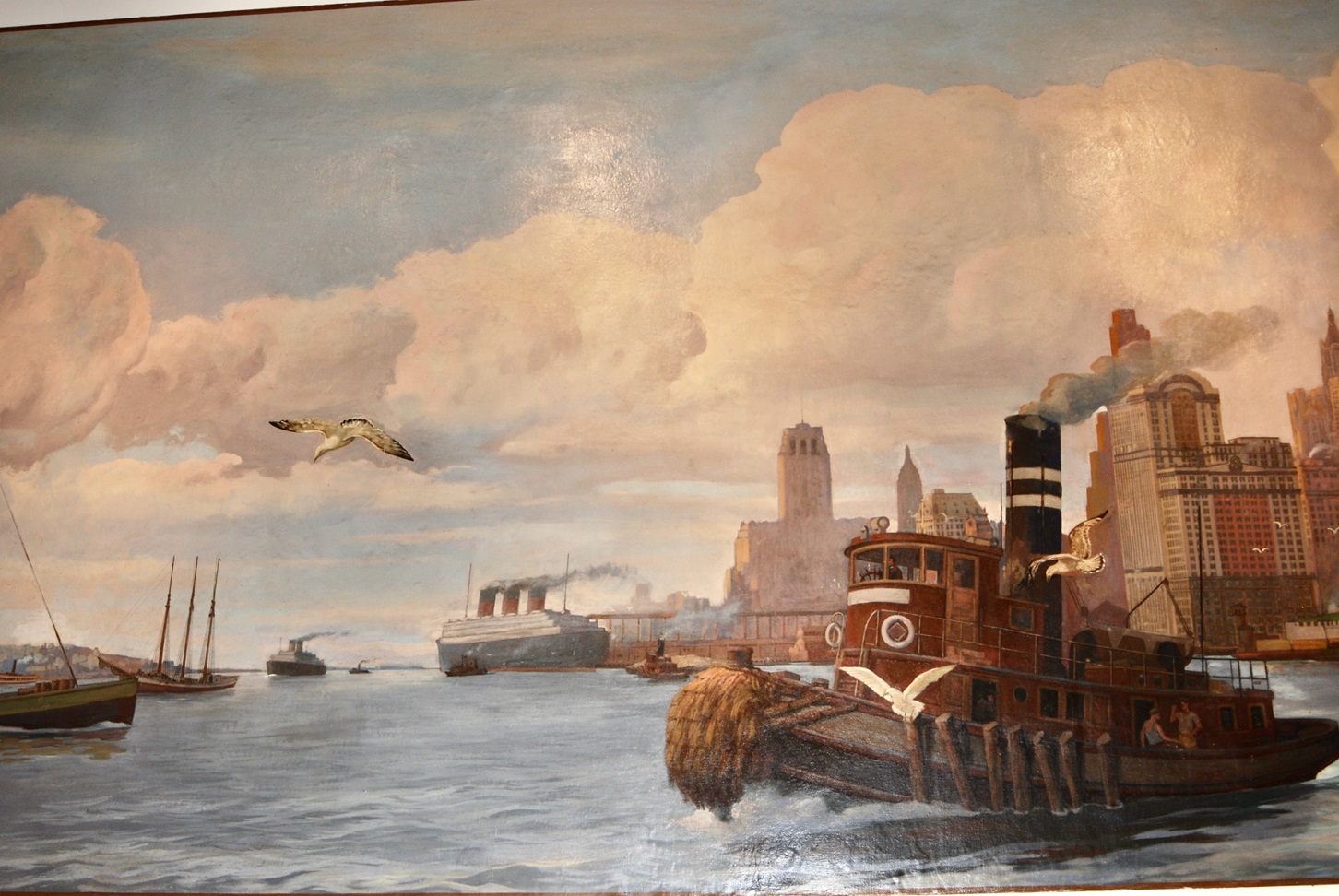
The principal and best mural is a large panorama of downtown New York and the harbor by Attilio Pusterla, who signed his name in the lower right. The skyline of a crowded and busylower Manhattan is set against a blue sky filled with beautiful billowing clouds, with the Staten Island ferry, ships at work, cruise ships underway, the Statue of Liberty, and, in the foreground, a tugboat. These characteristic images are very skillfully painted, especially the tugboat, as are those of birds in flight in the foreground, which seem almost to be real. This painting, executed in bright colors, exudes great energy. This scene, which illuminates the importance of the waterways of New York to the city’s life and its character, reflects the vibrancy of the city and the rapid pace of daily life, among the most characteristic aspects of life in the city, then and now. It is “[o]ne of the most charming visions of New York of that time to be seen anywhere,” which is why Mayor David Dinkins used this image on his Christmas card in 1991.
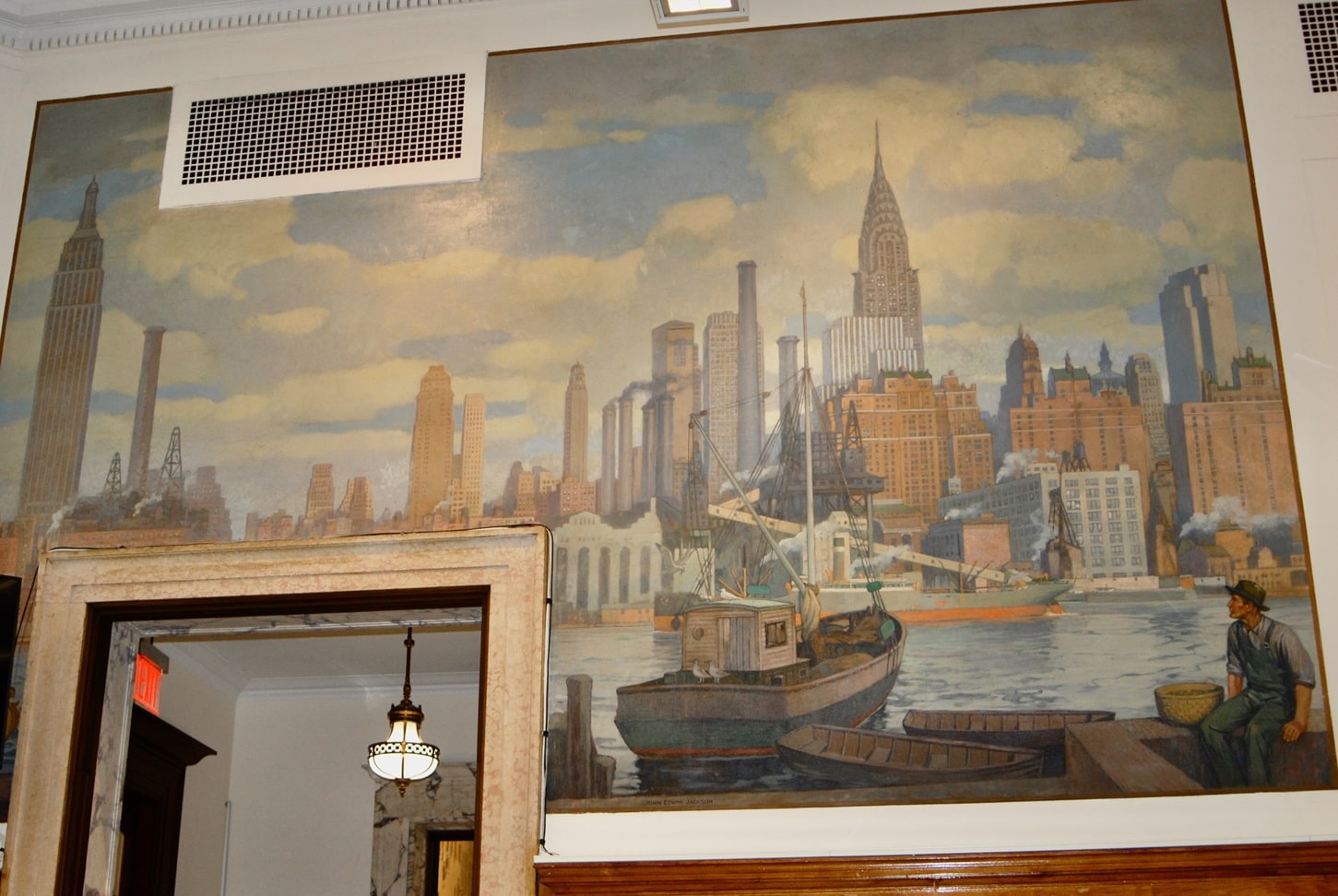
On the opposite wall is another charming scene, this one painted by John Edwin Jackson, of midtown Manhattan seen from the shoreline in Brooklyn. The colors are bright and cheerful. There is a lovely blue sky replete with clouds. We see the Chrysler Building and the Empire State Building and other edifices of that crowded part of the city. Smoke billows from smokestacks and there are boats by the Brooklyn shoreline and moving along in the East River. We see a city that seems at once busy and calm. All of this is under the eye of a worker who sits peacefully on a low wall on the Brooklyn side, resting for a moment and gazing across the river.
On that same wall is a cheerful painting of the Hudson and Riverside Drive entitled “General Grant’s Tomb and Riverside Drive.” This painting was created by Winthrop D. Turney in 1938. We can see the tomb of the President and Riverside Church. This part of the city too is very active. We see cars and a motorcycle rushing by on the highway, vessels on the river, the crowded George Washington Bridge, which opened in 1931, and, in the upper left, a group of airplanes in flight, the presence of which, as it is 1938, must be benign.
In the same room are six sepia-toned paintings of New York by Andrew T. Schwartz. These images, exhibiting a “dark and shadowy delicacy,” show a city that has in recent times been utterly transformed by growth and rapid modernization. The scenes are of Federal Hall, Wall Street, and Trinity Church (40 Wall Street was erected in 1929-1930 as the headquarters of the Manhattan Company and for a time competed with the Chrysler Building for the title of the world’s tallest building); Low Library of Columbia University, which moved from midtown to Morningside Heights in 1897 and the symbol of which, the library, was designed by Charles McKim of McKim, Mead and White and built between 1895 and 1897; the New York Public Library Building on Fifth Avenue, which had opened not all that long before, in 1911, and New Yorkers out for a stroll or on their way to work; the Woolworth Building, 233 Broadway, designed by Cass Gilbert, which had opened only a little over 20 years earlier, in 1913, and was the tallest building in the world from 1913-1929, as seen from the Municipal Building, with City Hall in the foreground; the statue of Atlas at Rockefeller Center, the first building of which was completed in 1932, five years before the painting was made; and the Brooklyn Bridge from its Manhattan end. The Chrysler Building and the Empire State Building were also recent additions, 1930 and 1931, respectively, to what today we call the skyline of New York. Each of these six paintings bears a painted plaque that identifies the subject matter of the work. These paintings of the evolving metropolis “provide the perfect counterpoint and a subtle complement to the storybook colors of the three larger panels.”
The wall nearest the center of the Jury Assembly Room is covered with the large Jackson and Turney murals and a clock. The clock consists of brass elements, but there is no painted design surrounding it. Probably there once was a painted face for this clock, perhaps a fresco, but, if so, it has been painted over. The opposite, rear wall is covered by the Pusterla painting, the largest in the room, flanked by two of the Schwartz paintings. On each side wall, between windows, are two Schwartz paintings, which are wider than those on the rear wall.
Four of these murals were signed by the artists who executed them: Jackson, Turney, Pusterla, and, on one of his six works, Schwartz. All of the paintings were created in 1937, the year in which the Art Commission gave approval for their creation, save for that by Turney, which was done the following year.
The murals in Room 452 strongly reflect the power and success that New York City and the United States had enjoyed over the then-recent past. The illustration of that power and success by these paintings, however, presents a poignant irony as at that moment serious hardship was widespread and fear and uncertainty about the future were the stuff of daily life for millions of New Yorkers and many more of their fellow citizens nationally. At that moment, things were very bad indeed, and no one could be sure how they would turn out, whether or not New York City and its people would be able to resume their upward march and, if so, when that might be. Nevertheless, it is very striking how positive and even optimistic the paintings in this room
are. The painters appear to have striven to set aside all fear, to present to the viewer the deep essence of the city while avoiding any hint of shadings that might give rise in the mind of the viewer to doubt about the ultimate triumph of the city and its people. At their heart, these paintings seem to reassure any viewer who might worry that even greater power and success lay ahead for the people of New York City, once the current grave trouble was past.
In the other assembly room, Room 448, are a group of murals, eleven in number, and ten feet high, by Robert K. Ryland. Whereas all the works in Room 452 are devoted to the New York City of the 1930’s, the murals in Room 448 are adaptations of well-known views of Manhattan in the early years of the city’s history to the colonial period and, in one instance, in the late nineteenth century (from around 1600 to 1873). These scenes of life of local Native Americans and of daily life in colonial and later New York give the viewer a sense of what New York City looked like in those years and remind us of the great length and richness of the city’s history.
On the wall closest to the center of the assembly room are two large paintings, which flank a clock. As elsewhere in the building, the clock is composed of brass elements and a painted design. This design may be a fresco, perhaps done by Mr. Pusterla. The paintings and the clock cover the whole of this wall. On the opposite, rear wall, there is a large painting, the largest of those in this room, the subject of which is a view of the city based on the Duke of York map, which is flanked by two smaller murals on each side. All of these paintings cover the entirety of the wall. There are two murals on each of the side walls, which, together with windows, cover the whole of those walls. Below the windows are decorative panels in brown on canvas.
The eleven murals are oils on canvas, five from 1937, five from 1938, and one undated. They are signed or initialed by the painter. A painted label appears on each work identifying its subject matter. The paintings depict the following subjects:
- Henry Hudson’s ship, the Half Moon, approaching Manhattan Island in 1609.
- An early Native American settlement.
- What is identified as the “Earliest View of New York, 1626-28,” which was based on an illustration of New Amsterdam in 1626-28 that was included as an engraving in a Dutch book published in 1651.
- “New Amsterdam 1651,” after a print.
- Broad Street in New Amsterdam, around 1660. Originally, the street was called Broad Canal because a canal ran down the center with paths and houses on each side. The water came from the East River. The canal was filled in in 1676, when the city was controlled by the British.
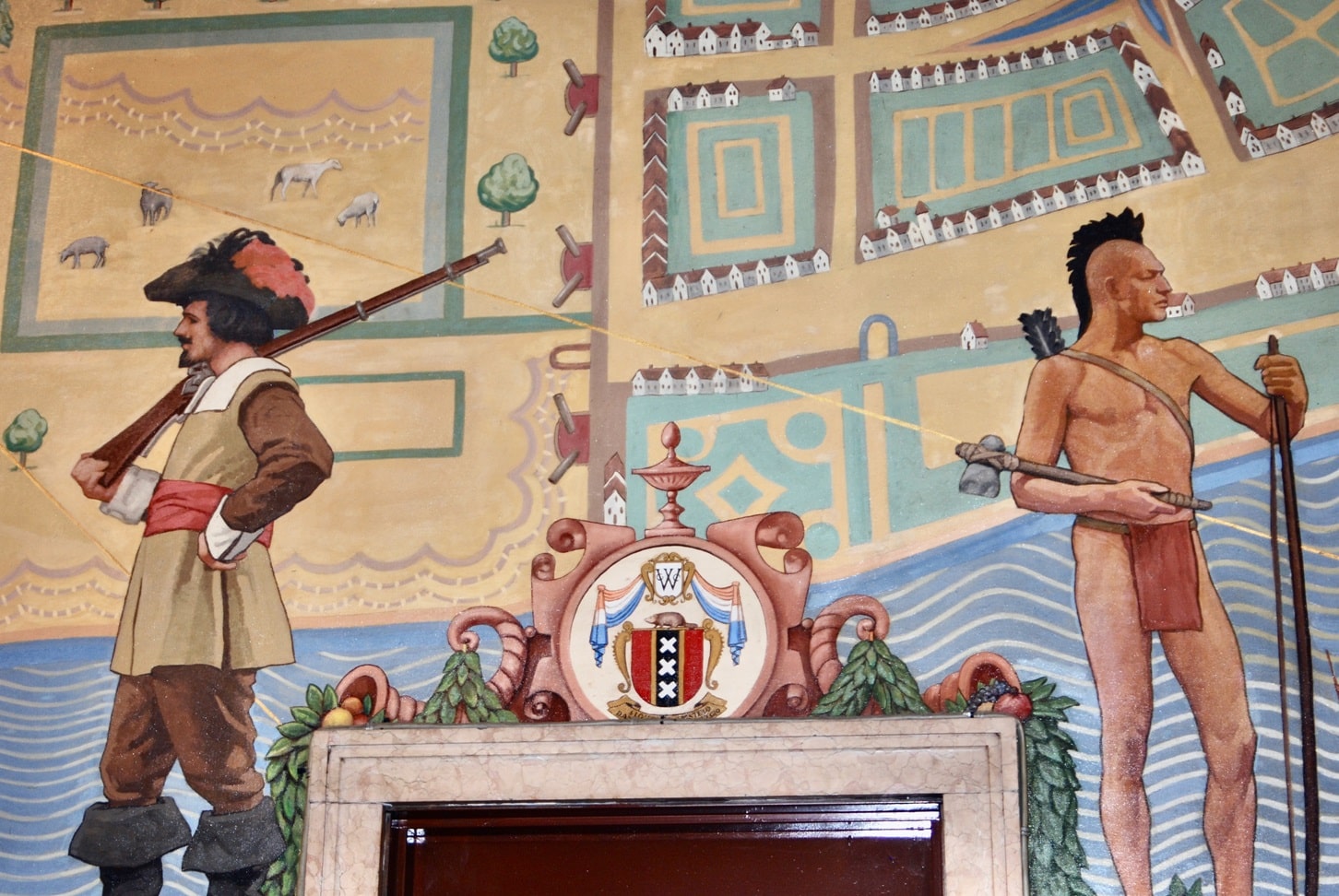
- “The Town of Mannados or New Amsterdam, 1664,” based upon “the Duke’s Plan,” the name given to a map that was presented to the Duke of York, the proprietor of the colony from whose name that of the city derived. This painting also contains impressive portraits of a Dutch soldier and a Native American, as well as the seal of New Amsterdam.
- The first city hall of New York City, 1679-80. The building served as the Stadt Huys (city hall) in New Amsterdam under the Dutch and later under the English, until a new city hall was built at a different location at the beginning of the eighteenth century.
- “Fort George and the City of New York, 1731-36.” This painting is one of the largest in Room 448. Fort George was a fort that occupied the site of the former Fort Amsterdam of New Amsterdam, which was located where the Alexander Hamilton Custom House is today. It was controlled by the English until after the end of the American Revolution, when it was surrendered to the Americans.
- Broad Street and Federal Hall, 1797.
- Collect Pond, 1798. The pond was located at today’s Leonard Street between Lafayette and Centre Street, very near to the site of the New York County Courthouse. It provided water for the city in the colonial period. The name of the pond was a corruption of the Dutch word “kolch,” for “small body of water.” Early in the nineteenth century, the pond was filled in because it had been befouled by various commercial activities. Although the pond itself is long gone, the ground in the area remains aqueous, and as a result there are to this day large water pumps in the basement of the County Courthouse.
- “New York from the East Pier of the Brooklyn Bridge,” about 1873.
These murals are painted in a restrained, realistic style that differs markedly from the style the artist used in some of his other work. Mr. Ryland’s conservative approach to the task of decorating the space was no doubt driven by a desire to create a composition that would fit in harmoniously with the classical design of the courthouse and the rest of the art in the building.
THE SEVENTH FLOOR CONFERENCE ROOM
Finally, there are murals on the walls of the conference room on the Seventh Floor. Guy Lowell designed a substantial-sized room in this space as a dining room for the Justices, with a fireplace at one end. At the opposite end, he created a lounge for the Justices. The space on this floor served these roles for decades, until after World War II, when the dining room was converted into an administrative office and the lounge became a conference room, which it remains today.
For many years, the wall of the lounge facing north was covered by plasterboard. Perhaps ten years ago, this wall was taken down, revealing a beautiful set of four original oak columns with ionic capitals.
The murals in this room, oils on canvas executed by Attilio Pusterla, mimic Gobelin tapestries and the viewer of the room at first glance at least thinks that is what they are. The illusion was achieved through the subject matter of the murals, the style of painting, and the colors used, as well as the facts that the painter employed heavy, specially-prepared canvas and that the canvases were not affixed to the walls by glue, but rather by nails on the borders, lending some flexibility to the canvases, as is characteristic of tapestries.
[*] Robert C. Meade, Jr., Esq., a member of the New York Bar, served, among other things, as First Deputy Chief Clerk of the Supreme Court, Civil Branch, New York County.
Further Reading
For a history of the murals, see our companion article:
THE MURALS OF THE NEW YORK COUNTY COURTHOUSE
PART ONE: HISTORY
For information on the murals of the first and second floors, see our companion article:
A comprehensive and annotated study of the murals is also available online: