
Part One: History
by Robert C. Meade, Jr., Esq.[*]
Since their creation during the Great Depression, the murals of the New York County Courthouse, of which there are 38, have been widely recognized as among the outstanding works of such art in the great metropolis of New York, the country’s principal center of artistic life. This article explains how they came to be created. Photographs of the murals can be found in the accompanying Photo Gallery.
THE CREATION AND FINANCING OF THE MURALS
In developing his designs for the new New York County Courthouse, the architect, Guy Lowell, envisioned that walls and ceilings in portions of the edifice would be decorated with murals, above all the main hall. He selected a muralist to do the work, Attilio Pusterla, with whom he had worked before. Pusterla prepared drawings and models of the proposed murals and submitted them to Lowell. By the time the building was opened in February 1927, the murals had not yet been executed. Lowell died a few days before the dedication ceremony. That fact and an absence of funding delayed the implementation of Lowell’s artistic vision. A little over two years after the dedication, the Great Depression descended upon the country like a dark shroud, which further complicated things for the courthouse, as it did for everyone. By 1934, all of the ceilings and walls remained blank.
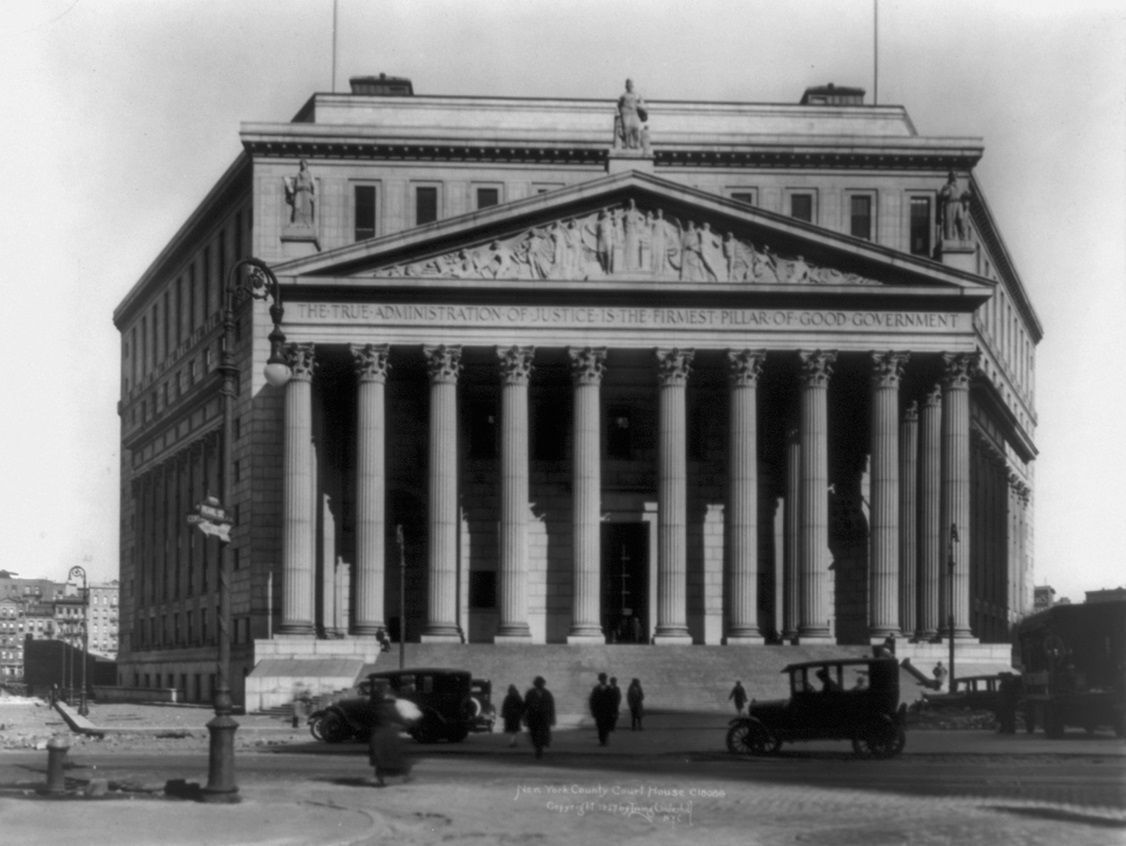
What salvaged Lowell’s aspirations was the intervention of the federal government in response to the national economic calamity. In December 1933, government officials established a program, the Public Works of Art Project (“PWAP”), to provide employment for artists on projects decorating tax-funded buildings. Almost immediately, the drawings for the murals of the New York County Courthouse were dusted off and a plan for the painting of the ceiling of the vestibule was approved by the PWAP, thus making this one of the first projects to receive assistance from a federal art program during the Great Depression. An application for the necessary approval was made to the New York City Art Commission, which gave its imprimatur. In early January 1934, work was commenced on the ceiling in the vestibule by Mr. Pusterla and assistants. The top salary paid to them under the PWAP program was reported to be $ 34 per week. Thereafter, murals were painted on the ceiling of the main corridor in the courthouse, which leads from the vestibule to the rotunda.
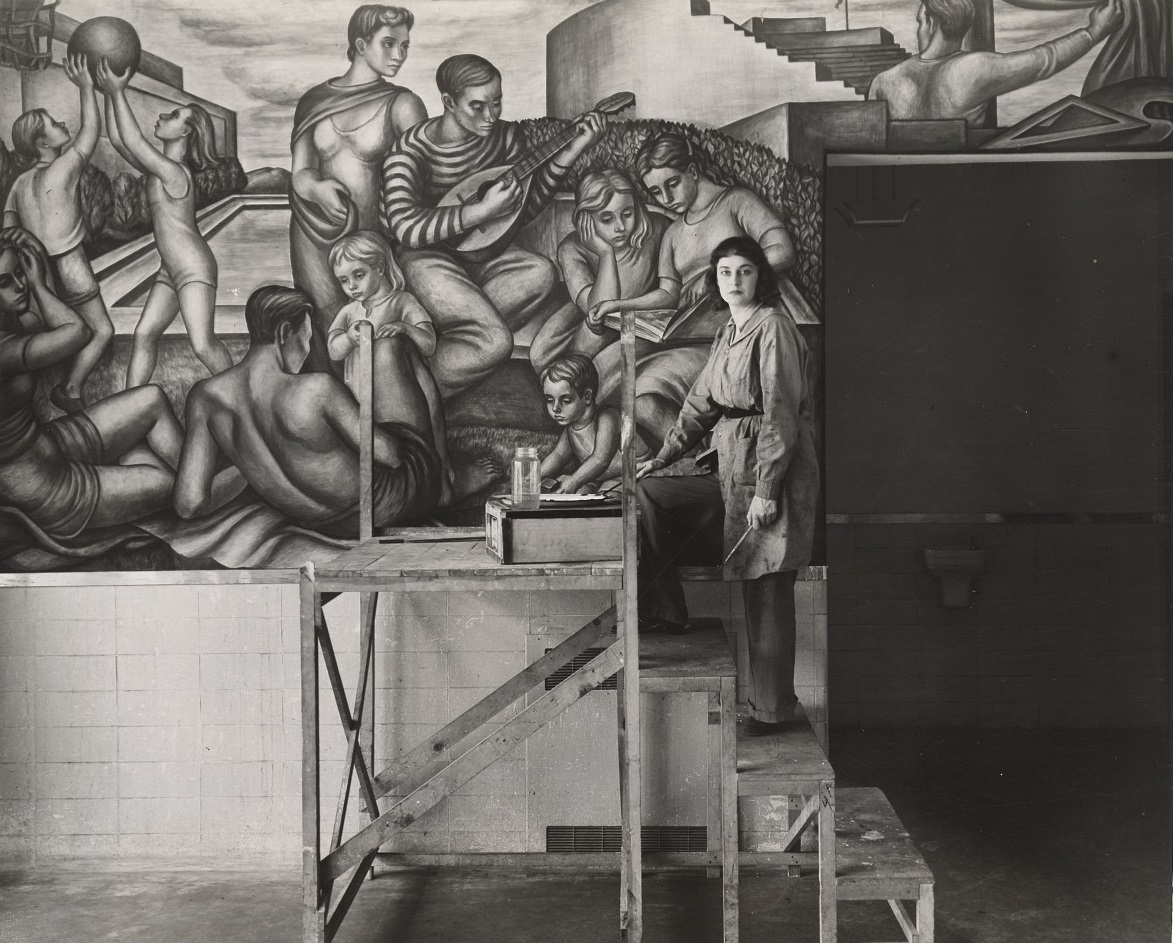
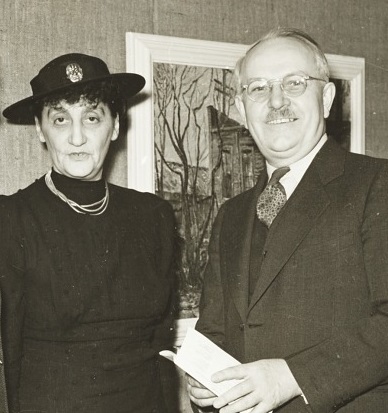
The PWAP came to an end in June 1934. Subsequently, three federal programs were created that aimed to assist artists to survive economically, to help them preserve their skills, and to bring art to the American public. Two of these, which were in the Treasury Department, awarded contracts to artists to decorate new federal buildings. The most important of the three programs for our purposes was the third, the largest such program by far, the Federal Art Project, a subdivision of the Works Progress Administration (“WPA”), which began in 1935 and endured until 1943. Led by Holger Cahill, the national director, and, in New York and New Jersey, Mrs. Audrey McMahon, the regional director, the Federal Art Project supplied financial support that made it possible for artists to create all of the murals that decorate the courthouse, except for those done under the auspices of the PWAP in the vestibule and the main corridor. The Art Project paid a modest salary to artists who employed their artistic skills in the creation of art works approved by the Project. Under the Art Project, artists had to be in financial distress and professionally competent in order to obtain an assignment. The overall artistic aims of the PWAP and the Federal Art Project were to present “the American scene” and to make a connection between art and daily life.
Because of the dire financial conditions in the country, the normal marketplace that supported the creation of art had largely collapsed. Had the PWAP and later the Federal Art Project not been introduced, it is unlikely that any murals would have been painted in the courthouse through the end of the war, and the same can be said about murals and other art throughout the country. Indeed, but for the federal programs, the ceilings and walls of the courthouse might well remain blank today.
There were some administrative difficulties and bureaucratic tensions that occurred within the art programs and between the Federal Art Project and the Treasury programs. One problem was that the WPA was primarily a relief and public works program, one that built dams and roads and other infrastructure, and was intended to aid workers on such projects or those who worked according to regular commercial standards. A program designed to create art that was staffed by artists who often worked alone fit uncomfortably within the WPA universe. Artists did not work by time clocks. Nevertheless, the federal art programs were well administered overall by those with direct responsibility for them and much valuable art was created during these years.
In late 1935, after the completion of the murals in the vestibule and the main corridor and decorative painting in other corridors on the first and second floors, and after the establishment that year of the Federal Art Project, an application was made to the Art Commission seeking preliminary approval of designs for a mural to be painted on the ceiling of the rotunda. Approval was granted and support from the Art Project was given. The ceiling is enormous and this project was said to be the largest work done in New York under the auspices of the Art Project and, indeed, must have been among the largest done anywhere in the country. Work on the ceiling was performed through 1936 and, by March of 1937, some touch-up work still remained.
Plans for mural work elsewhere in the courthouse were developed. Although not all of these plans came to fruition, murals were executed on the upper floors. Evidence of the determinative role of the federal art programs in the creation of the murals is found in plaques bearing the letters “WPA” that appear in some of the paintings.
HOW THE MURALS WERE PAINTED
The principal murals on the first and second floors are very much larger than all of the others in the courthouse. But they differ from almost all of the others in another important respect as well. The latter murals are oils on canvas. The paintings on the ceilings and walls of the first and second floors of the courthouse, on the other hand, are frescoes. In art, the word “fresco” refers to the technique of painting with a mix of water and pigment on lime-based wall plaster.
Fresco painting dates from antiquity and was used throughout the world. We were reminded of this in April 2024 when frescoes newly discovered at the site of the ruins of Pompeii (79 A.D.) were announced to the world. Fresco painting achieved its artistic apex, however, during the Italian High Renaissance. The greatest and best-known instances of fresco painting are the work of Michelangelo in the Sistine Chapel and the rooms painted by Raphael in the Vatican.
In one method of fresco painting, called “true fresco” (buon fresco), the artist paints on wet plaster. This produces a very durable painting since the paint dries into and is supported by the plaster, but the process is ferociously difficult. In another technique, called “dry fresco” (fresco secco), the artist paints on dry plaster using a paint mixture that contains a binding agent intended to attach the paint securely to the surface. Michelangelo created the Sistine ceiling using the buon fresco process. Leonardo, seeking to avoid the rigors of buon fresco, employed the second method in his Last Supper in Milan. The Last Supper illustrates the delicate nature of dry fresco as the painting deteriorated greatly after its completion. It is important, then, in fresco secco that the application of pigment with binding agent be executed carefully and with technical skill, by a painter who knows how to work and using paint and agent that have been very well prepared.
The murals on the first and second floors of the courthouse were created using the dry fresco method. The choice of this technique was no doubt influenced to some degree by the sheer difficulty of working in buon fresco, the time required to paint in this way, and the vast scale of the space that needed to be covered on the first and second floors. In addition, though, and apparently determinative of the question, Mr. Pusterla believed that the walls of the building were unsuited to the use of buon fresco and that the colors that would be produced by the dry method would be forceful. Pusterla certainly proved to be correct about the colors. Precisely what it was about the walls that dissuaded him from employing buon fresco is not known.
The artists who worked on almost all of the murals on the upper floors probably painted them in a studio or perhaps, though less likely, in dedicated space at the courthouse and applied them to the walls after their completion. The frescoes, however, obviously could not be painted that way. Rather, Mr. Pusterla created the designs for the enormous paintings in stages, first in small-scale drawings and later much larger ones, then laid out the final designs on the ceilings and walls, by itself a tremendous challenge, and he and his assistants filled in those designs with color while they were standing on scaffolds, in the case of the ceiling murals, scaffolds located far above the ground. This process would have been especially difficult in the case of the rotunda ceiling because of its great size and the height above the scaffolding to which the rotunda surface extended. The fact that the ceilings of the rotunda, vestibule, and main corridor are curved in various ways exacerbated the difficulties, whereas all of the murals on the upper floors were painted on flat canvas surfaces. Mr. Pusterla was challenged further: much of the work he did would be seen by viewers located far below the works, in contrast with the paintings on the upper floors.
THE MURALISTS OF 60 CENTRE STREET
Attilio Pusterla, the master painter who designed and created all of the murals on the first and second floors, including the rotunda ceiling, as well as some paintings on the upper floors, and who supervised all of the painting done in the building, was born in Milan in 1862. He studied at the prestigious Academy of Fine Arts of Brera in Milan. Thereafter, he lived the life of an artist in Italy. He painted on canvas and exhibited his work at many exhibitions, in Milan, Turin, Bologna, Florence, Rome, and Venice. He also did illustrations and gained experience with fresco painting. He was a social realist and was much concerned that art should reflect the social realities of his time. He was also politically active (he was a socialist) and this interest influenced his painting. Some of his paintings were controversial and became well known. One scholar has described him as “one of the most important figures in the art of Lombardy of the end of the [19th] century.”
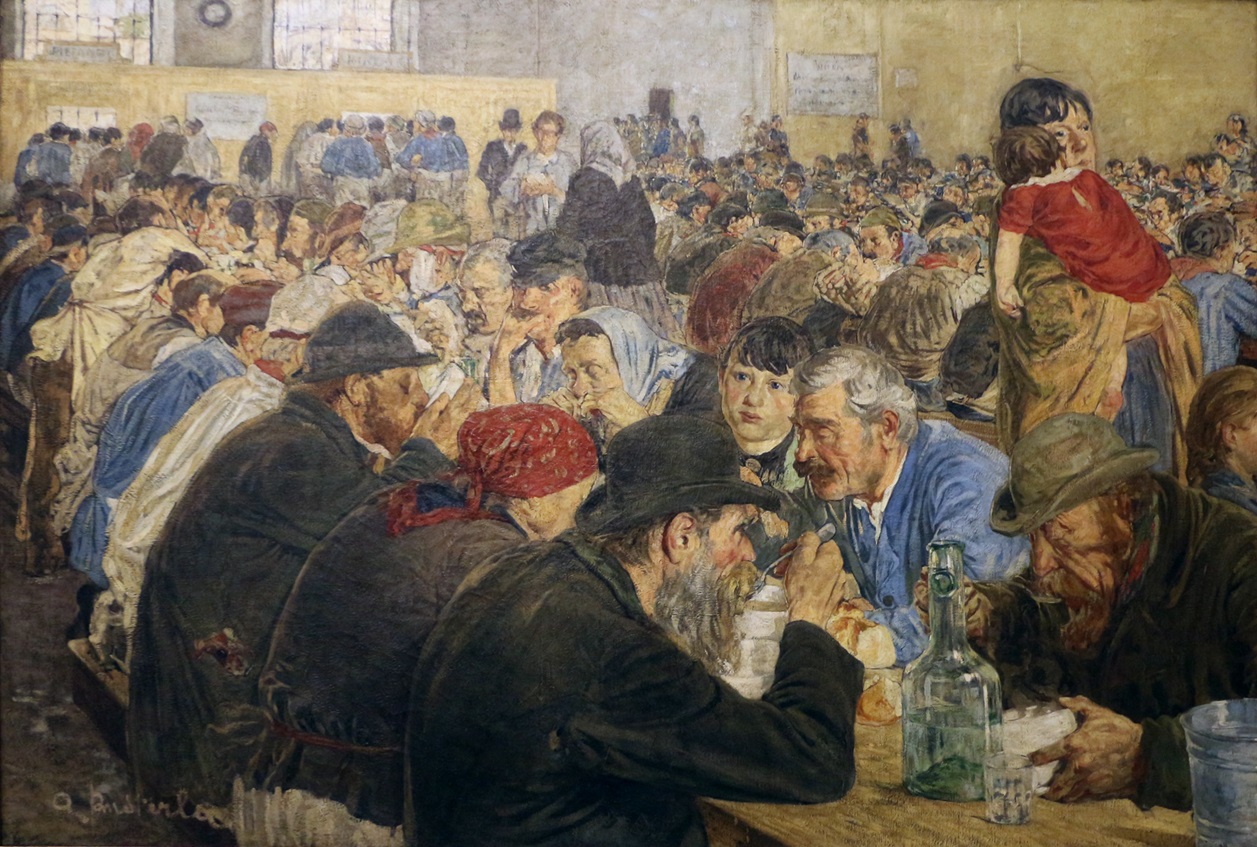
Despite the fame Pusterla achieved, art critics were not always happy with him, no doubt because of the controversial nature of some of the topics he addressed in his work and the style of some of his painting, and his work did not always sell well. Indeed, in later years he was very hard pressed financially and took on some decorative assignments to make money. Finally, discouraged by financial problems and the political climate of the time in Milan, Pusterla and his wife left Italy for the United States in January 1899, when he was 37 years old.
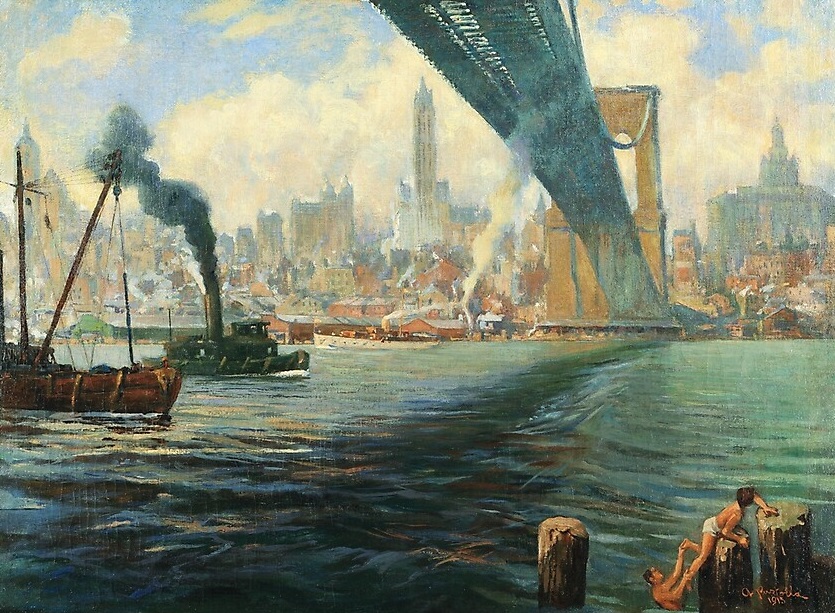
Pusterla continued to do some easel painting in the United States. He painted murals for both the Senate and the House in the national Parliament Building in Canada. He also did the decorative work on the Astoria Column in Oregon, on which he executed depictions of the history of Oregon using the ancient technique of sgraffito, a form of etching. He painted murals in private residences, which is how he came in contact with Guy Lowell. Pusterla was also interested in science. He was awarded nine patents, including one for a flying machine in the early years of the century. He invented some amusement rides, which were licensed by several amusement parks around the country, including Dreamland in Coney Island.
After his work at the New York County Courthouse, Pusterla remained active until his death in May 1941. Though he left Italy, disillusioned and perhaps in despair, 125 years ago, he is still remembered in his native country: he has been the subject of scholarly writing; paintings of his are held in museums and private collections; and he is included in art exhibitions. There even exists that most modern indicator of significance, a podcast about him, which was posted in 2023.
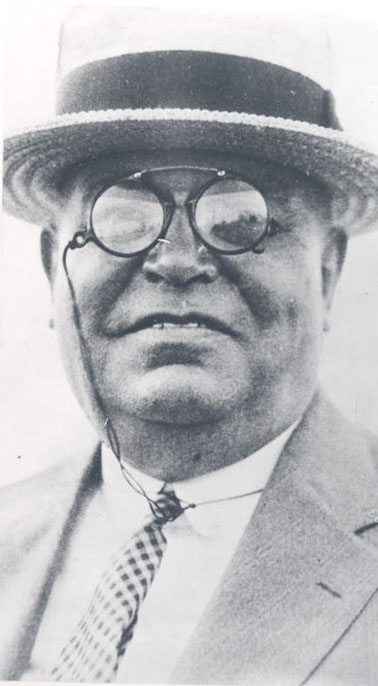
During his years working on murals at the courthouse, Pusterla was aided by a group of assistants who would have done some of the routine work under his direction. Their names have been lost in the fog of time. Pusterla taught art at the Leonardo da Vinci Art School in Manhattan, which offered low-cost and later free art classes to immigrants and workers. It is possible that some of his assistants had been his students there. Thus, the murals at the courthouse were created in part by one or more immigrants.
Four artists born in America created most of the murals on the upper floors, although Mr. Pusterla did significant painting there as well. Three of these artists were born in the south and migrated to New York to seek their professional fortunes, as so many others have done. One was a native New Yorker.
Winthrop D. Turney was born in Brooklyn in 1884. He studied at the Art Students League, as did the other three muralists. He took part in many exhibitions, including at the Whitney, Brooklyn, and Newark Museums, the Museum of Modern Art, and the Pennsylvania Academy of Fine Arts. He was active in many arts organizations, such as the Allied Artists of America, which gave him an award in 1944. Turney painted murals and, in the 1930’s and 1940’s, did watercolors. He was known for scenes of urban life, such as images of Brooklyn, as well as pastoral scenes of Gloucester, Massachusetts and Mountainville, New York. He was essentially a realist painter. He was married to the painter Agnes Millen Richmond (1870-1964). He and his wife often painted during summers they spent in Gloucester and Mountainville. Turney died in Brooklyn in 1965, the year after the passing of his wife.
Andrew T. Schwartz was born in Louisville, Kentucky in 1867 and was educated there and at the Cincinnati Art Academy. Later, he came to New York, where he attended classes at the Art Students League. He was awarded the Lazarus Prize, a scholarship for the study of mural painting, which he pursued at the American Academy in Rome. Later, Schwartz assisted one of America’s most important muralists, H. Siddons Mowbray, in painting murals for the remarkable library of the University Club and the world-renowned Morgan Library. The murals produced in these projects are exceptionally impressive, among the best of their kind in New York City.
Later, Schwartz worked on his own and further developed his reputation as a mural painter. That reputation grew as a result of an influential mural he did for a church in Vermont. Schwartz also painted murals for the New York YMCA. He painted a cycle of 11 murals on the history and evolution of art around the world for the Nelson-Atkins Museum of Fine Art in Kansas City, Missouri, and five murals by him adorn the lobby of the Kansas City Life Insurance Building. He painted murals in private homes as well.
Schwartz also devoted himself to easel painting and participated in many exhibitions, including at the Art Institute of Chicago, the Brooklyn Museum, the Pennsylvania Academy of the Fine Arts in Philadelphia, and the Syracuse Museum of Fine Arts. Schwartz was a member of the National Society of Mural Painters and many other professional groups. He served on the committee at the Metropolitan Museum that administered the Lazarus Prize for mural painting.
Schwartz passed away in 1942 while on a visit to his hometown.
Robert K. Ryland was born in Grenada, Mississippi in 1873. He studied at the Art Students League, the National Academy of Design in New York, and the American Academy in Rome (1903-05), where he went after having won the same scholarship won by Schwartz. Ryland worked as a muralist, painter, and illustrator. He exhibited at the Brooklyn Museum, the Pennsylvania Academy of the Fine Arts, the Carnegie Museum in Pittsburgh, the Art Institute of Chicago, and the City Art Museum of St. Louis, among others. He did work as an artist at the New York World’s Fair (1939-40). Ryland painted murals for the lobbies of buildings and at the Washington Irving High School in New York. As an illustrator, he did covers for Good Housekeeping and other publications. He taught at the Women’s Art School of Cooper Union and was active in arts groups. Ryland died in 1951.
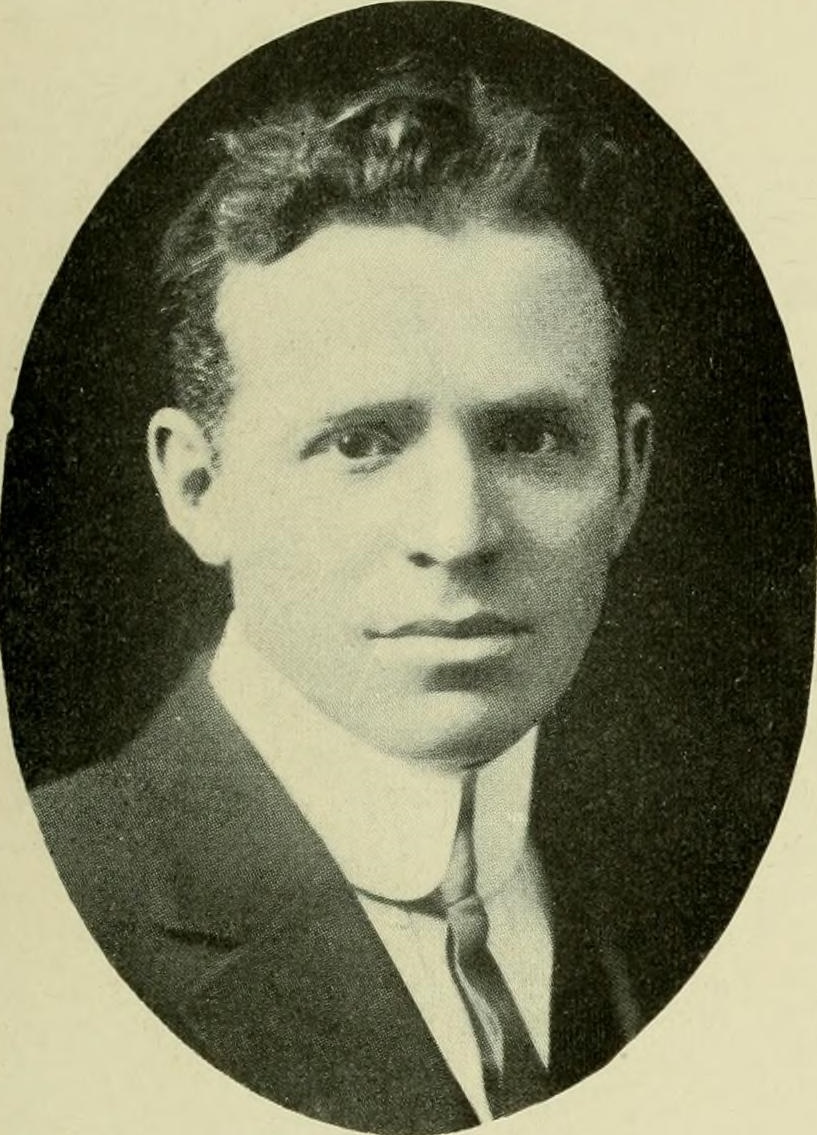
The last of the associate muralists was John Edwin Jackson. He was born in Nashville, Tennessee in 1875. He came to New York to pursue his career, studying at the National Academy of Design and the Art Students League. Jackson worked as a painter, a muralist, a lithographer, and an illustrator. In this last capacity, he illustrated covers for Scribner’s, Harper’s and the like. Jackson illustrated many books for Doubleday and other publishers. In addition to his mural work at the County Courthouse, he did such work at the New York Public Library, the New York State College for Teachers in Albany, New York and the National City Bank, New York. Jackson died in 1950.
THE MURALS ON THE UPPER FLOORS
Beginning in January 1937, a series of applications were submitted to the Art Commission seeking preliminary approval of designs for murals to be painted in various rooms, mostly on the upper floors. The Art Commission and the Federal Art Project gave approval. There were three instances in which applications were denied by the Commission and murals were never created in the rooms in question, despite the fact that two of these rejections were issued without prejudice to resubmission. Also, in one case, the Commission gave its approval to designs for murals in a particular courtroom, but they were never executed. It is not known why plans for these three courtrooms were not pursued to completion.
One of the proposed murals for which a design was approved by the Art Commission but that was never executed would have shown the operation of law in Native American society. It would have depicted tribal elders from the Manhattan Indians conducting a mediation around 1600 between tribal members who were in a dispute over the ownership of game.
Plans were executed and murals were installed in the Ceremonial Courtroom, Room 300; the Jury Assembly Room, Rooms 448 and 452; and in a conference room in what today are administrative offices on the Seventh Floor. Thirty-two murals were painted in these rooms, seven of them by Attilio Pusterla. The remaining murals were painted by the associate muralists, Schwartz, Turney, Ryland, and Jackson.
The three principal murals in the Ceremonial Courtroom (Room 300) consist of a large painting behind the judge’s bench and, on the rear wall, two smaller, but still substantial, murals. They all were the work of Andrew T. Schwartz, assisted by Winthrop Turney in one instance. There are also three smaller fresco paintings in this courtroom, which may have been done by Mr. Pusterla.
Nine murals were painted in Room 452, six of them by Andrew T. Schwartz and the largest by Attilio Pusterla. Jackson and Turney did one mural each. The paintings are 10 feet high. Four of them are signed and five are unsigned. They were painted in 1937 and, in one case, 1938.
Eleven murals were painted in Room 448 by Robert Ryland in 1937 and 1938.
Finally, six murals were created in the seventh floor conference room. These murals were the work of Attilio Pusterla.
It is not known how it came to pass that Schwartz, Turney, Ryland, and Jackson received assignments from the Federal Art Project to paint murals at the courthouse. Nor is it understood how specific work was allotted to them. It is possible that Mr. Pusterla decided who ought to paint particular murals, perhaps with input from the mural division of the Federal Art Project. It is not known precisely how the designs were created and evolved. It may be that the themes were developed and presented to the artists in sketches of a general approach and it was left to them to produce the initial detailed implementing designs. Naturally, the themes concerned the workings of the law and justice, but also the history of New York City and State.
I close this brief history with an expression of foreboding. Beginning in the late 1980’s, a construction project took place in the courthouse that was primarily directed at the installation of air conditioning for the building. Indications were noted, however, of damage to the murals on the first and second floors, including the rotunda ceiling, from the infiltration of water from the roof. There was a substantial amount of paint flaking off the rotunda mural and of exposed plaster. The conservation and restoration of the murals constituted a significant undertaking. The affected murals were restored and steps were taken to address the problem of seepage, including through the installation of a new copper roof. The hopes of that time, however, appear to have fallen short as today water apparently is again seeping in and it is causing harm to the great mural on the rotunda ceiling and some other paintings. In addition, some of the frescoes have suffered paint loss over time. Murals on the upper floors have undergone various forms of damage as well over the almost 90 years of their existence. Cleaning of the artwork may also be needed. The next order of business ought to be a careful evaluation of all of the murals by an experienced professional. The harm that has already been done to the paintings, especially the delicate frescoes, is very worrisome. It recalls to mind the many instances in which works of art have been allowed to deteriorate due to indifference or a failure to act. If the murals are to be protected and preserved for the future and if needed restoration is to be effected in timely fashion, interested individuals and groups – – the legal community, the court system, advocates and supporters of historic preservation, those interested in the history of the great City of New York, and the public generally – – will need to work together with untiring determination to bring the situation to the attention of the responsible officials and convince them of the need to take action, indeed, the urgent action that seems to be required. If not, some of these valuable works of art may begin to disappear.
[*] Robert C. Meade, Jr., Esq., a member of the New York Bar, served, among other things, as First Deputy Chief Clerk of the Supreme Court, Civil Branch, New York County. A comprehensive history and analysis of the murals by the same author, Art in Troubled Times: The Depression-Era Murals of the New York County Courthouse, can be found on the website of the Historical Society of the New York Courts.
Further Reading
For information on the murals of the first and second floors, see our companion article:
For information on the murals of the upper floors, see our companion article:
A comprehensive and annotated study of the murals is also available online: