
1832-1880
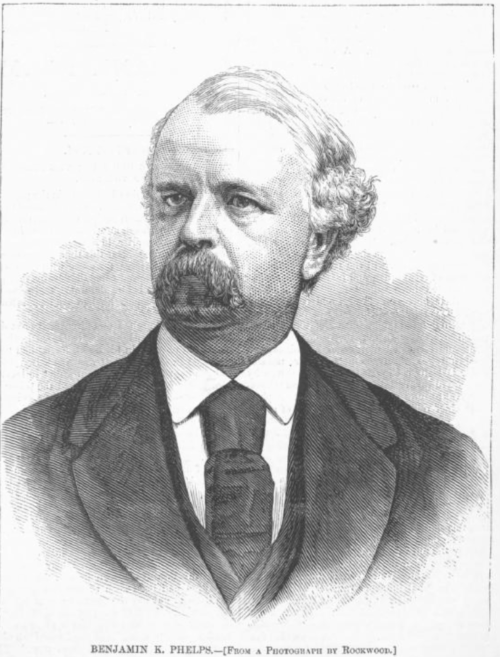 Benjamin K. Phelps, the son of a prominent Congregational minister, was born in Massachusetts in 1832. He graduated from Yale College in 1853 and studied law in New Hampshire and Westchester County, New York. He was admitted to the Bar in 1855 and began practicing law in New York City with a Yale classmate, Sherman Knevals. From 1866 to 1870, Phelps served as an Assistant United States Attorney for the Southern District of New York under U.S. Attorneys Samuel G. Courtney and Edwards Pierrepont during the Republican administrations of Presidents Andrew Johnson and Ulysses S. Grant.
In 1872, the same year that Phelps formed a new law partnership that included future President Chester A. Arthur, he was elected District Attorney of New York County on the Republican ticket. He was reelected in 1875 and 1878, defeating three different Tammany Hall candidates in all. Upon assuming office in 1873, Phelps assisted Special Prosecutors Wheeler H. Peckham and Lyman Tremain as they led the prosecution of William M. “Boss” Tweed for his massive theft of public funds. Tweed was convicted of 204 of the 220 counts in the indictment and sentenced to 12 consecutive one-year terms in prison. Tweed was incarcerated for little more than a year, however, before his conviction was reversed by the Court of Appeals on the ground that the imposition of consecutive sentences was illegal.
During his first year in office, Phelps also oversaw the second prosecution of Edward “Ned” Stokes for the murder of Wall Street titan James Fisk — Stokes’s former business partner and rival for the affections of showgirl Josie Mansfield. Stokes was convicted of first-degree murder and sentenced to hang but his conviction was reversed by the Court of Appeals, leading to a third trial that finally resulted in a manslaughter conviction.
In Phelps’s obituary, the New York Times lauded him for ushering in a “new era” of openness in which politicians with “pull” no longer had special access to the District Attorney’s office.[1]
Mr. Phelps signalized his accession to office by removing half a dozen ante-rooms and throwing the doors of every department in his office open to the humblest applicant. He received every visitor, no matter how poor or uninfluential, with courtesy, and patiently investigated every case brought to his notice. He appointed a staff of able assistants, and discharged the duties of his office with . . . vigor and determination . . . Criminals were indicted fearlessly and brought to trial promptly, and it soon became apparent that the old order of things had passed away.[2]
In addition to the Tweed and Stokes cases, District Attorney Phelps “conducted some of the most celebrated cases in the criminal annals of the city,”[3] including the conviction of Rev. Edward Cowley, an Episcopal priest, for the starvation and maltreatment of numerous children in the “Shepherd’s Fold” orphanage;[4] and William J. Sharkey, a former politician and crony of Boss Tweed, who, while awaiting the outcome of his appeal on a conviction for capital murder, made a brazen escape from the Tombs disguised as a woman.[5]
Benjamin Phelps died on December 30, 1880, in New York City, while serving this third term as District Attorney.
[1] “A Bright Career Ended,” New York Times, Dec. 31, 1880.
[2] Id.
[3] History of the Bench and Bar of New York Vol. 1, New York History Co., 1897, at 445.
[4] “Starvation of Children,” New York Times, Jan. 18, 1880; “The Case of Shepherd Cowley,” New York Times, June 30, 1881.
[5] “A Murderer’s Escape,” New York Times, Nov. 20, 1873.