
Thomas Addis Emmet (1764-1827) was born in Ireland. Educated at Trinity College, Dublin and the University of Edinburgh, he originally trained to become a physician, but changed to the law after the untimely death of an elder brother, an eminent barrister. Thomas became a part of the campaign for parliamentary reform and the end of discrimination against Catholics in Ireland, although he was himself Protestant. He was a leading member of and legal counsel to the Society of the United Irishmen. The Society later sought to promote a rebellion in Ireland. The British managed to arrest many of the leaders, including Emmet, and he spent several years in jail. After his release, he went to Brussels. He served as an emissary for the republican cause in Europe, where he lobbied, ultimately without success, for aid from the French. His younger brother, Robert, was executed by the British for leading the rebellion of 1803, and thus became one of the most famous patriots in Irish history. In 1804, Thomas and his family emigrated to New York.
Emmet died in action, as he probably would have wished, in court in 1827 while representing a client in a matter regarding the Sailors’ Snug Harbor, a home for needy seamen located on Staten Island.
A cenotaph and monument were erected in honor of Emmet in the churchyard of St. Paul’s Chapel on Fulton Street.
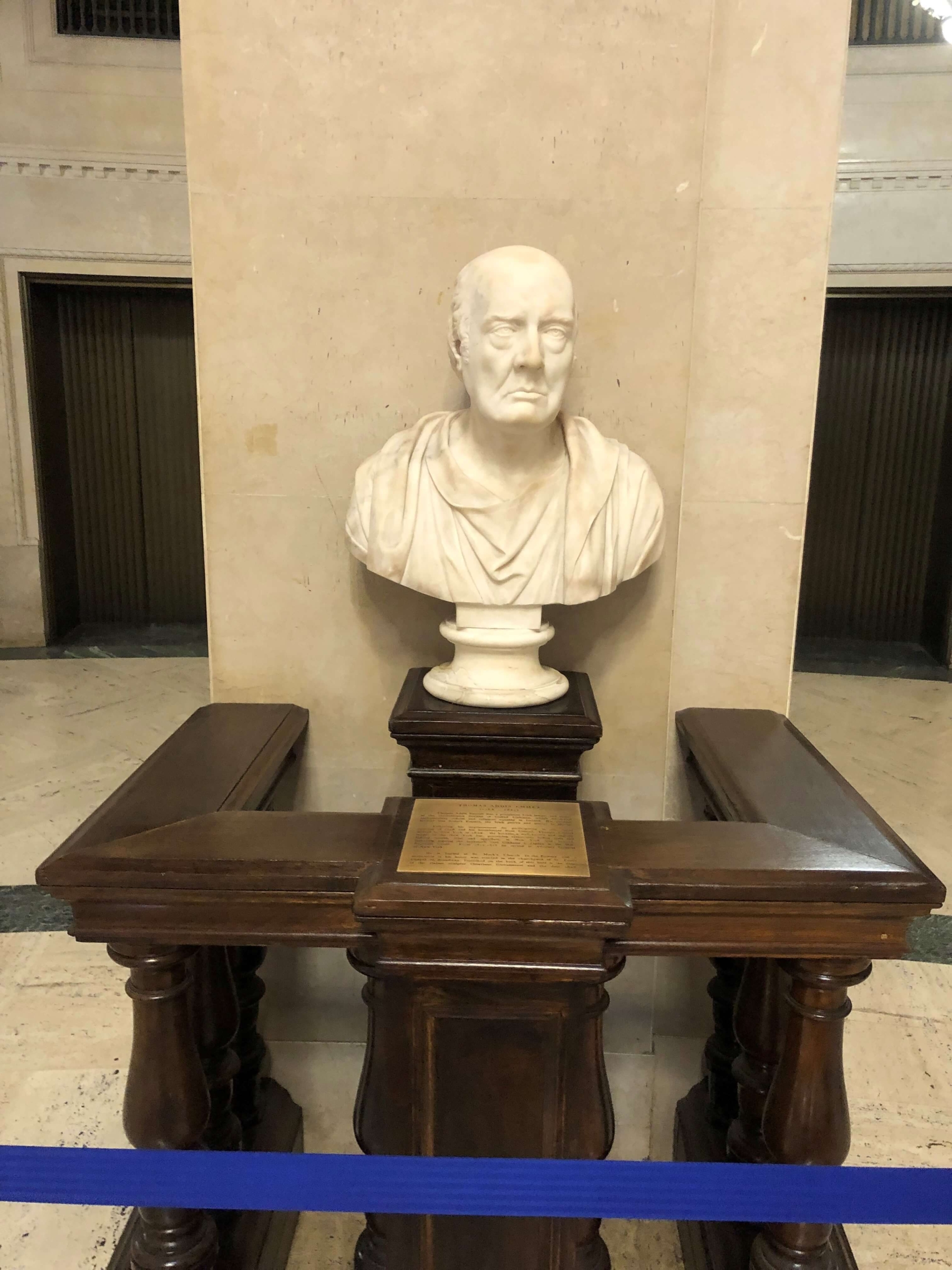
A bust of Emmet (pictured here) was commissioned by his fellow lawyers after his death. This bust was created in Florence, Italy by Ottaviano Giovannozzi in 1828. The bust is found today in the rotunda of the New York County Courthouse, on a stand created specifically for this purpose using surplus wood from the courthouse.
In New York City, Thomas established a legal practice, which thrived. He was a strong abolitionist. In one of his early legal efforts in New York, he represented a fugitive slave. He became involved with the abolitionist Society of Friends (the Quakers). In 1805, on behalf of the New York Manumission Society, he achieved an important victory against a ship’s captain under the laws prohibiting the slave trade. Emmet represented the Society, without fee, throughout his time in New York.
In 1812, Emmet became the Attorney General of the State of New York.
Emmet achieved great respect in the legal profession and was called upon, among other things, to argue cases in the United States Supreme Court. He represented Ogden in Gibbons v. Ogden, 22 U.S. 1 (1824), one of the great cases in American history, in which Chief Justice Marshall on behalf of the Court defined the rights and limits under the Commerce and Supremacy clauses of the United States Constitution. Opposing counsel in the case was Daniel Webster.
The law firm that Emmet founded was located on Nassau Street. Its successor, Emmet, Marvin & Martin, LLP, continues the practice of law today at 120 Broadway, which makes it one of the oldest law firms in the United States. Franklin D. Roosevelt was a partner in the firm, when it was known as Emmet, Marvin & Roosevelt, with offices on Wall Street.
Further Resources
Emmet, Thomas Addis
by James Quinn, Dictionary of Irish Biography (2009)
Society of United Irishmen Revolutionary and New York Manumission Society Lawyer: Thomas Addis Emmet and the Irish Contributors to the Antislavery Movement in New York
by Craig A. Landy, Esq. (2014)
From Steamboats to Cannabis: The 200 Year Journey of Gibbons v. Ogden and the Commerce Clause
by Craig A. Landy, Esq. (Judicial Notice, 2025)