
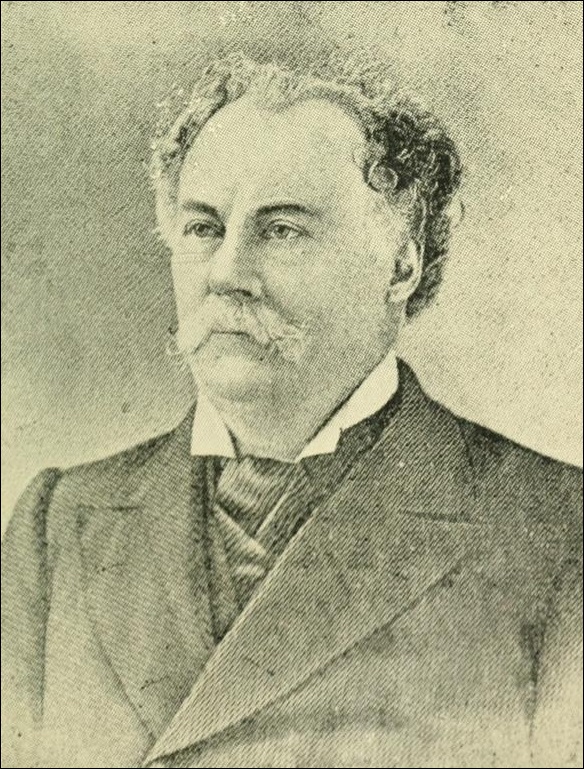
1817-1900
William Fullerton was born in Minisink, Orange County, New York, on May 1, 1817. He graduated in 1838 from Union College where, according to his obituary, he helped support himself by tutoring a classmate, John K. Porter, with whom he would later sit on the Court of Appeals and face as an adversary in the landmark trial of Tilton v. Beecher.
Fullerton joined the Bar in 1841 and served as District Attorney of Orange County later in the decade. In 1852, Charles O’Conor, one of New York’s most prominent lawyers, invited Fullerton to move to New York City to form a partnership with him. In 1853, Fullerton served as an Assistant United States Attorney under O’Conor when the latter was named United States Attorney for the Southern District of New York.
In 1867, Fullerton was appointed to fill a vacancy on the Supreme Court by Governor Fenton and served briefly as an ex-officio judge of the Court of Appeals. In September 1868, President Andrew Johnson appointed him as Special Counsel for the United States to prosecute whiskey tax fraud cases in New York City in response to corruption and breakdowns in enforcement. After Fullerton traveled to Washington to warn President Johnson and Attorney General William M. Evarts that Samuel G. Courtney, the United States Attorney for the Southern District of New York, was in league with the whiskey tax evaders, Fullerton was indicted by Courtney for allegedly shaking down a Revenue Collector. Defended by his old colleagues, John K. Porter and Charles O’Conor, Fullerton was tried and acquitted in March 1870. The trial judge, Lewis B. Woodruff, declared that “even the proof offered by the prosecution is . . . in harmony with the purest integrity of the accused.”
Fullerton was in high demand as a trial lawyer and participated in many of the leading trials of the Gilded Age. He served as one of Boss Tweed’s lead defense attorneys. Following Tweed’s conviction in 1873, Fullerton, along with five other attorneys on Tweed’s defense team, including Elihu Root, was held in contempt and fined $250 for questioning the impartiality of Judge Noah Davis. That same year, in People v. Stokes, acting on behalf of the Fisk family, he participated in the prosecution of Edward Stokes for the murder of the notorious robber baron, James Fisk, Jr. In 1875, Fullerton achieved fame as the “Great American Cross-Examiner” for his verbal jousting with, and cross-examination of, Reverend Henry Ward Beecher, accused of adultery with the wife of a former protégé, in one of the most the sensationalistic and closely followed trials of the nineteenth century. In 1891, late in his career, on behalf of the victim’s family, he assisted the District Attorney’s office in successfully prosecuting Alphonse Stephani for the murder of lawyer John Reynolds.
William Fullerton died in 1900, in Newburgh, New York.
Sources
See 2 McAdam, History of the Bench and Bar of New York, New York History Co. (1897), p. 166. Calendar of The Historical Society of the Courts of the State of New York, Jun. 2006.
“Death List of a Day: Ex-Judge William Fullerton,” The New York Times, May 16, 1900.
John D. Gordan III, “An All-Star Criminal Trial in the Gilded Age: United States v. Fullerton (March 1870),” Judicial Notice, Iss. 15, 2020, at 40.
“Contempt of Court: Tweed’s Leading Counsel Punished,” New York Times, Nov. 30, 1873.
Michael Aaron Green, “Battle in Brooklyn: The Cross Examination of Reverend Henry Ward Beecher at the Trial of the Century,” Judicial Notice, Issue 13 (2018), at 21.
The Judges of the New York Court of Appeals, ed. Hon. Albert M. Rosenblatt, New York, Fordham University Press, 2007, at 1000.