
1849-1926
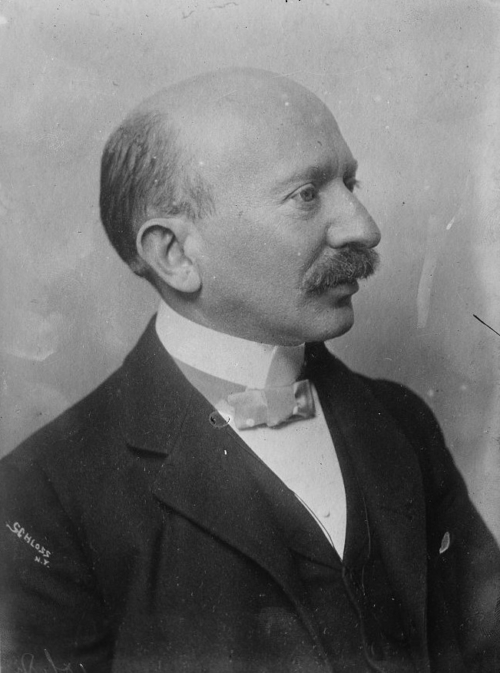 Abraham Hummel was the junior partner of Howe and Hummel, the most notorious law firm of the Gilded Age. Little is known of Hummel’s origins except that he was born in Boston in 1849, came to New York as a young boy and grew up on the Lower East Side. In 1863, William F. Howe hired the 14-year-old Hummel as an office boy in his law firm. Six years later they became law partners in an office conveniently located at 89 Centre Street, across from the Tombs, New York City’s infamous jail.[1] The pair grew their practice by befriending Tombs officials and paying them for client referrals.
Howe and Hummel were a study in contrasts. “Howe was tall, broad-shouldered and massive, while Hummel was short, slender and spare, but with a very large head for his body. Howe was addicted to fancy clothes, while Hummel always wore the most conventional black.”[2] Howe was known for his courtroom oratory and showmanship, particularly in high-profile murder cases. Hummel excelled in the “subtler arts” and was “masterful at teasing out legal inconsistencies.”[3] Their combined expertise, skills and ingenious tactics benefited many clients who “enjoyed almost miraculous escapes from sentences of death.”[4] Their ability to detect and exploit legal errors and statutory loopholes (People v. Rosenzweig) allowed many of clients to go free or win new trials on appeal.[5] And when their legal acumen was insufficient to win the day, they were not overly reluctant to bribe judges or suborn perjury.[6]
In the early 1870s, Howe and Hummel were implicated in the New York City Bar Association’s investigation of the corrupt Tweed Ring judges, including Albert Cardozo, who accepted bribes to release hundreds of the firm’s clients from prison. Howe & Hummel appear to have avoided accountability in this matter (as they did generally throughout their careers), although Hummel was disbarred for several years for a different bribery offense before being reinstated in the mid-1870s.[7]
Howe & Hummel were products of their time, when “[b]ribery and corruption of law enforcement officers became as commonplace as it was in the mainstream business world.”[8] In the wake of the Civil War, a professional criminal class that sprung out of the chaos of New York City’s massive immigration and urbanization was able to flourish within a broader nexus of rampant municipal and police corruption.[9] The legal profession had yet to organize and formulate the more exacting bar admission qualifications and ethical practice standards that exist today.[10] Indeed, the New York City Bar Association, founded in 1870, came into being largely to deal with the above-noted judicial bribery scandal.
Over the course of their long partnership, Howe and Hummel defended over 1,000 defendants charged with murder or manslaughter, but Hummel, eulogized in his obituary as “a famous divorce lawyer,”[11] played more of a supporting role in the firm’s criminal practice. Hummel was “an acknowledged expert in theatrical and matrimonial law”[12] and a “sort of general counsel to the theatrical profession in every kind of case,”[13] with a client list that included P.T. Barnum, Buffalo Bill Cody, boxer John L. Sullivan, Mark Twain and actress Lillian Russell, among other celebrities of the day. Hummel specialized in lucrative “breach of promise” suits brought by young actresses and other women involved in romantic relationships with wealthy, upper class men, often married, who would pay substantial settlements to avoid the public embarrassment of a lawsuit.[14]
The highlight of Hummel’s career, and the last major case Howe and Hummel tried together, was likely his defense of English actress Olga Nethersole, prosecuted for public indecency in 1900 for her role in the play, Sapho, depicting a young man’s affair with a notorious Parisian courtesan. Several newspapers began an editorial crusade attacking the risqué play, which attracted large audiences, as lewd and immoral. When a reporter filed a formal complaint with District Attorney Asa Bird Gardner, Gardner ordered the arrest of the main actors and the theater owner. The trial garnered enormous public attention, with daily testimony focused on clinging costumes, diaphanous dresses and naked legs.[15] When the topic of Ms. Nethersole’s breasts arose, Hummel “directed the witness’s attention to the figures of ‘Liberty’ and ‘Science’” painted on the courtroom walls and asked: “Did Miss Nethersole show as much skin as either of these?” The witness was compelled to answer “no.” The jury took twelve minutes to return a verdict of not guilty.[16] The case was hailed as a victory for artistic expression.
After William Howe’s death in 1902, Abe Hummel continued to practice law until 1905 when he was indicted by District Attorney William Travers Jerome , an old adversary, for conspiracy and subornation of perjury in submitting false affidavits to fraudulently obtain a court order vacating and setting aside a valid divorce judgment.[17]
Hummel was tried, found guilty and sentenced to a year in jail and a $500 fine. Following Hummel’s conviction, District Attorney Jerome stated: “This man has been a menace to this community for twenty years.”[18] Hummel was suspended from the practice of law in July 1906 following his unsuccessful appeal to the Appellate Division, First Department, and later disbarred when his appeal to the Court of Appeals also failed.[19] The New York Times noted that it was “not the first time that Hummel has been deprived of the right to practice his profession. At the very outset of his career he was accused of being implicated in the attempted bribery of a Judge in a felony case. He was disbarred, but three years later was reinstated through an application made by several prominent lawyers, who said that Hummel was a young man who had been led astray by an older one.”[20]
Hummel was jailed on Blackwell’s Island in 1907. He spent most of his time seriously ill in the prison hospital.[21] Upon being released he moved to London where he lived for most of his remaining years until his death in 1926.
[1] Cait Murphy, Scoundrels in Law, Smithsonian Books, 2010, at 3.
[2] “’Abe’ Hummel Dies in London,” New York Times, Jan. 24, 1926.
[3] Murphy, at xv.
[4] “William F. Howe, Dean of Criminal Bar, Dead,” New York Times, Sept. 3, 1902.
[5] Murphy, at 27.
[6] Id., at xxii-xxiii, 10-11.
[7] “A. H. Hummel Suspended by Appellate Division,” New York Times, July 13, 1906.
[8] Edwin G. Burrows and Mike Wallace, Gotham: A History of New York City to 1898, Oxford Univ. Press, 1999, at 1001.
[9] “Decadence of New York’s Criminal Bar; Death of Mr. Howe, the Last of a Long Line of Distinguished Criminal Lawyers,” New York Times, Sept. 7, 1902.
[10] Murphy, at 9.
[11] New York Times, Jan. 24, 1926.
[12] Murphy, at xvi.
[13] New York Times, Sept. 3, 1902.
[14] Murphy, at xv.
[15] “Court Cuts Short the ‘Sapho’ Trial,” New York Times, Apr. 5, 1900.
[16] Murphy, at 219, 221.
[17] People v. Hummel, 119 AD 153 (1st Dept., 1907).
[18] “Hummel Very Ill in Penitentiary,” New York Times, Dec. 16, 1907.
[19] New York Times, July 13, 1906.
[20] Id.
[21] New York Times, Dec. 16, 1907