
1832-1917
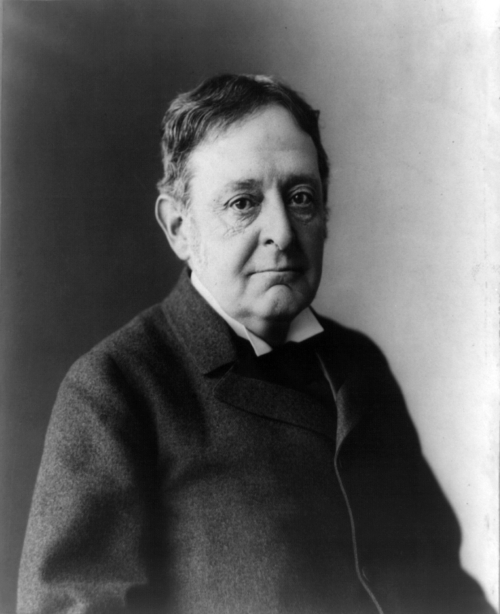 Joseph H. Choate, one of the most prominent lawyers of his generation, was born in 1832 in Salem, Massachusetts. The son of a physician, Choate graduated from Harvard College in 1852, where he was a classmate of Horatio Alger, Jr., and his brother, William, who graduated first in their class and would go on to serve on the United States District Court for the Southern District of New York from 1878 to 1881. Joseph Choate graduated from Harvard Law School in 1854 and was admitted to the Bar of Massachusetts in 1855 and the Bar of New York in 1856.
Choate moved to New York City in 1856. Armed with a letter of introduction from his father’s cousin, Rufus Choate, a former U.S. Senator from Massachusetts and one of the best known lawyers of the pre-Civil War era, Choate became associated with William M. Evarts, a future United States Attorney General and Secretary of State. In 1859, Choate became a junior partner in the Wall Street law firm that eventually became known as Evarts, Choate & Beaman where he represented some of the nation’s largest corporations, including Standard Oil and American Tobacco, and took on some of the most famous cases in American legal history.[1] It was once said of him, “[t]hat a case was not a case unless Choate appeared in it. It was more than a case when he did appear in it.”[2]
Joseph Choate was a key member of Samuel Tilden’s Committee of Seventy, which independently investigated and prosecuted of William M. “Boss” Tweed for the systematic looting of New York City’s public treasury. He was counsel of choice in high-profile will contests, representing the widow of railroad tycoon Cornelius Vanderbilt; upholding Samuel Tilden’s bequest that created the New York City Public Library; and contesting the will of financier Russell Sage on behalf of his niece. Choate also represented the New York State Republican Party in the Stolen Senate cases of 1891. In addition:
“He kept Stanford University’s endowment from being taken over by the federal government, preserved the Bell System’s hold on the telephone patent, and won legal sanction for the building of the Brooklyn Bridge. Disputes over wills, club membership rules, and even over an America’s Cup race competed for his efforts with grave constitutional issues.”[3]
Choate was a leading advocate before the United States Supreme Court. He was lead counsel for the plaintiff in the landmark case which struck down an income tax on certain corporate profits and gifts, a decision that was eventually superseded by the 16th Amendment to the U.S. Constitution authorizing Congress to levy income taxes.[4] In the Kansas Prohibition Cases, Choate represented the liquor industry in arguing that state use of police powers to ban alcohol was an unconstitutional interference with private property rights. While unsuccessful, his arguments helped formulate the substantive due process doctrine that was later invoked to strike down many economic regulations.[5] He also challenged — though unsuccessfully — the Geary Act of 1892, which authorized deportation of Chinese residents who lacked proof of identification and legal entry.[6]
Choate was an exceptional trial lawyer and litigator especially admired for his skills as a cross-examiner. A contemporary, Allen Wardwell, said: “He was charming, very affable and very genial,” so that “when he was going to hit, you couldn’t know.”[7] In a celebrated case, Martinez v. Del Valle, Choate faced off against another accomplished trial lawyer of his generation, William A. Beach. In 1875, Ms. Eugénie Martinez, aged 21, slipped and fell on the ice in front of a New York City hotel. Juan Del Valle, a middle-aged Cuban banker and widower, rushed to her assistance. A romantic relationship quickly blossomed. Del Valle installed Ms. Martinez in a hotel under an assumed name and later leased a country house and engaged her as his housekeeper. After several months, Ms. Martinez retained Mr. Beach and threatened to sue for breach of promise of marriage, demanding $50,000 in damages (approximately $1.47 million in 2025). Del Valle retained Choate. “Public interest was intense, largely because of Miss Martinez, who was described in a newspaper as having ‘raven black hair and melting eyes shadowed by long, graceful lashes, the complexion of a peach, and a form ravishing to contemplate.’”[8]
In The Art of Cross-Examination, Francis H. Wellman devoted a chapter of his book to the Martinez trial, which he called “[o]ne of the most brilliant trials in the annals of the New York courts,” with Choate’s cross-examination of the plaintiff considered by lawyers who heard it as “the most brilliant piece of work of the kind Mr. Choate ever did.”[9] At trial Choate attacked Ms. Martinez’s motives, suggesting that she was “not a mere, inexperienced young girl,” but a gold digger “already an adept in the ways of New York life.”[10] He introduced testimony showing that she and her mother and sister had financially supported their domineering, unemployed stepfather for many years:
Upon her own evidence nothing can be clearer that never did a privateer upon the Spanish Main give chase to and board a homeward-bound Indiaman with more vigor than that with which this family proposed to board this rich Cuban and make capture of him. He was a big bonanza to them.[11]
Even Choate’s best efforts could not win the day, but all was not lost. While the jury found that Miss Martinez had indeed been misled and wronged by Del Valle, they awarded her only $50 — not the $50,000 she was demanding.
Choate never held political office but he was an influential voice in Republican affairs, “a confidant of presidents, negotiator of international treaties, and seemingly permanent fixture on the national scene.”[12] In 1897, he sought a seat on the United States Senate as a reform candidate, but with Senators then chosen by vote of the state legislature he was crushed 142 to 7 by Thomas C. Platt, the state’s Republican Party boss. In January 1899, he was appointed Ambassador to the United Kingdom by President William McKinley, a position he held until 1905 under President Theodore Roosevelt.
Choate made his reputation representing the richest of the rich, but he had a genuine concern for the public interest and was known to offer his legal services, pro bono, to public causes and clients too poor to pay a fee. Early in his career, as violent mobs attacked and lynched Black New Yorkers during the New York City Draft Riots, Choate and his wife “sheltered fugitive blacks in their house—risking its destruction by the mob for doing so—until Lincoln dispatched troops to restore order.”[13]
Choate served as President of the American Bar Association (1898-99); President of the New York City Bar Association twice (1888-89 and 1902-03); and President of the New York State Bar Association (1906-07). Choate also served as President of the New York State Constitutional Convention of 1894, which significantly reformed state government and created the Appellate Division of the Supreme Court. Choate played an active role in drafting the proposed Constitution and securing the bipartisan support that led to its ratification by a substantial majority of voters.
Addressing the topic of “Our Profession” at an ABA dinner in the early 1900s, Choate expressed a vision of lawyers as public citizens with special responsibilities for protecting the legal system:
So long as the Supreme Court exists to be attacked and defended . . . ; so long as the public credit and good faith of this great nation are in peril; so long as the right of property which lies at the root of all civil Government . . . and the three inalienable rights to life, liberty and happiness, which the Declaration of Independence proclaimed and the Constitution has guaranteed alike against the action of Congress and of the states, are in jeopardy, so long will great public service be demanded of the bar.[14]
In his later years, Choate continued to practice law at a reduced pace and served as the U.S. Representative to the 1907 Second Hague Conference, an idealistic international effort that sought to prevent war by arbitrating differences between nations according to international law.
Choate used his status as a civic and bar leader and close connections to the business community to help found New York City cultural landmarks like the American Museum of Natural History and the Metropolitan Museum of Art.
Many of Choate’s contemporaries commented on his oratorical skills, avuncular social charm and sharp wit. “He didn’t take things too seriously, including himself. Almost alone of the outsized figures of the Gilded Age he had charm. He didn’t even have to turn it on; like the waters at Saratoga, it kept bubbling up.”[15]
William H. Choate died of a heart attack at his New York City home on May 14, 1917. His many eulogists included former President Teddy Roosevelt, who related a scene he had witnessed personally:
I shall never forget one incident at a reception at the then Vice President Morion’s. There was present a thoroughly nice lady—of possibly limited appeal—to whom Choate spoke; whereupon, with a face of woe, she began to relate how much she had suffered since she had last seen him on account of an attack of appendicitis and of the operation thereby rendered necessary. After Choate had expressed his sympathy two or three times the lady said, ‘” didn’t know whether I had changed so that you would not recognize me.” Mr. Choate replied, “Madame, I hardly did recognize you without your appendix.”[16]
[1] “Joseph Hodges Choate Dies Suddenly,” New York Times, May 15, 1917.
[2] Id.
[3] D.M. Marshman, Jr., The Ages of Joseph Choate, American Heritage, Vol. 26, Iss. 3, April 1975.
[4] Pollock v. Farmers’ Loan & Trust Company,157 U.S. 429 (1895), aff’d on rehearing, 158 U.S. 601 (1895).
[5] Mugler v. Kansas, 123 U.S. 623 (1887).
[6] Fong Yue Ting v. United States,149 U.S. 698 (1893); see “Chinese and the Geary Act,” New York Times, May 11, 1893.
[7] John Oller, White Shoe, Dutton, 2019, at 139.
[8] D.M. Marshman, Jr., supra.
[9] Id., quoting from Francis H. Wellman, The Art of Cross-Examination, 2nd ed., 1904
[10] Id.
[11] Id.
[12] Peter S. Canellos, The Great Dissenter, Simon & Schuster, 2021, at 314.
[13] D.M. Marshman, Jr., supra.
[14] New York Times, May 15, 1917.
[15] D.M. Marshman, Jr., supra.
[16] Id.