
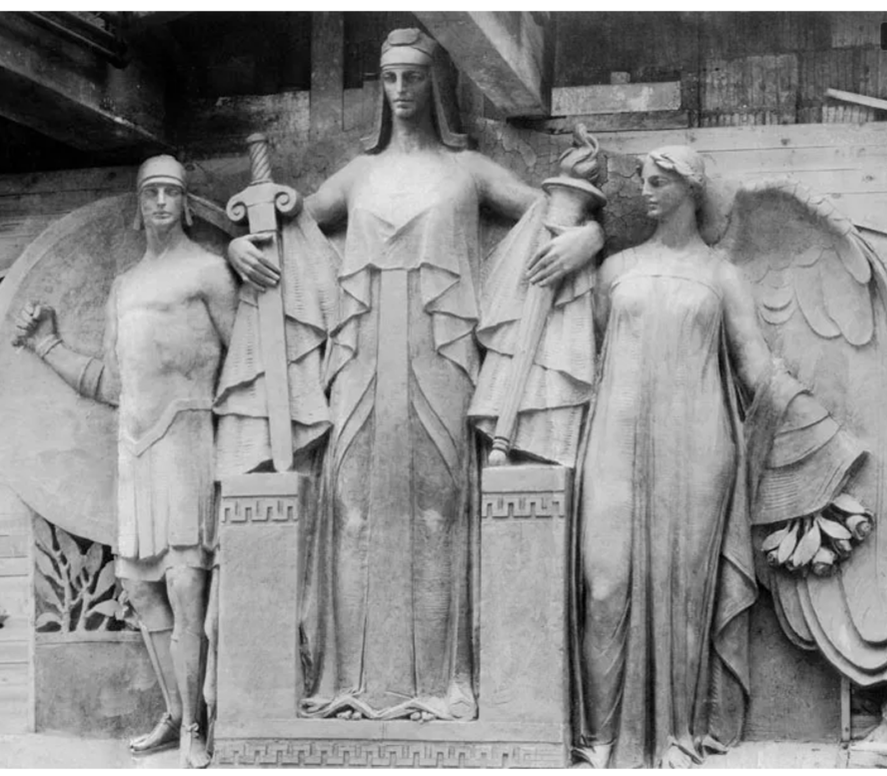
Over the portico of the New York County Courthouse is a pediment, a triangular-shaped decorative space. A competition was held for the commission to create sculptural elements to adorn the pediment of the courthouse and Allen was chosen by Guy Lowell, who knew him from their work together on Lowell’s Museum of Fine Arts in Boston. The 104-foot pediment is sixteen feet high at its center. Allen did the work in 1924-26, while the building was under construction. There are 13 figures in Allen’s design, with a group of three at the center. The figures are mostly classical in inspiration, but Allen gave them a modernist tone, as one can see in a closeup view of the three central figures. A pediment presents the sculptor with an obvious challenge, which is to address the narrowing of the space due to the corners. In the case of the courthouse, Allen met the challenge, including full human figures in the narrow spaces.
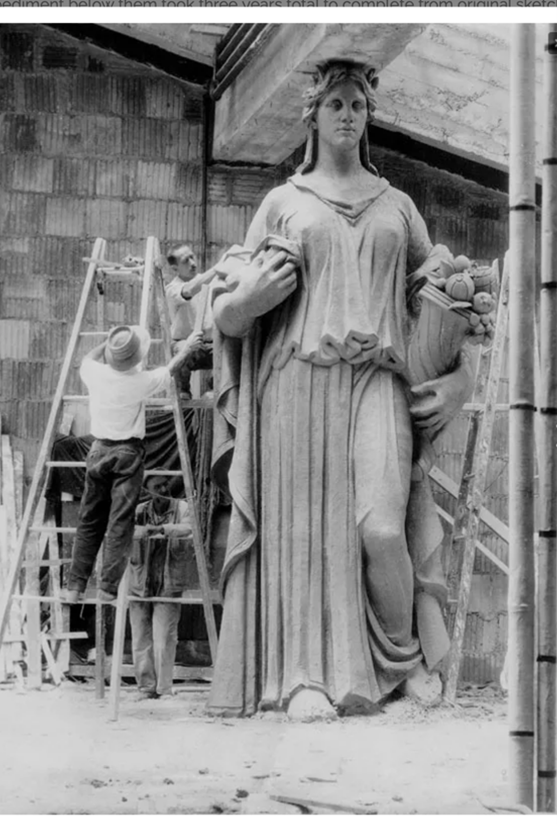
At the center and corners above the pediment are three granite figures by Allen approximately 13 feet high. The central figure is Moses. He represents Law because in the bible it was he who received the Ten Commandments on Mount Sinai and through him they were made known to the people. In Allen’s depiction, he rests a hand on fasces or lictor sticks, which were symbols of the authority of the magistrate in ancient Rome, and he holds a book in his other hand, both symbolizing the law. The female figure on the northern end of the pediment represents the spirit of Truth. She holds a mirror, a symbol of man’s true knowledge since the mirror reflects back whatever is present in reality. The figure on the southern end is Equity. She holds a horn of plenty filled with fruit, representing the fair distribution of goods. All three figures stand for things that the courthouse is to provide to the citizenry through its daily work.
In addition to his work as a sculptor, Allen taught for decades at the School of the Museum of Fine Arts in Boston. Born in 1888, Allen retired in 1957 and died in 1961.
An inscription was carved in the entablature above the columns. It is taken almost completely from a letter of George Washington to his Attorney General in 1789, when Washington was working on the establishment of the judiciary. The inscription reads: “The true administration of justice is the firmest pillar of good government.” (The original letter used the word “due.”)
Further Resources
60 Centre Street: A Look Back and Some Ruminations About the Future
by John F. Werner and Robert C. Meade, Jr., Esqs. (2023)