
1819-1887
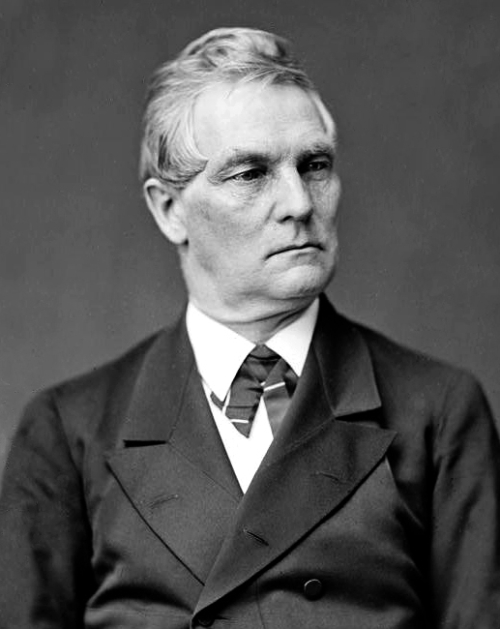
William A. Wheeler, the 19th Vice President of the United States under President Rutherford B. Hayes, was born in 1819 in Malone, New York. At age eight, Wheeler’s father, a promising young attorney, died at 37, leaving a wife and three children. Wheeler briefly attended the University of Vermont but left without graduating to support his family. He served as Town Clerk and School Commissioner and studied law under Asa Hascall, an attorney and politician from Northern New York, and was admitted to the Bar in 1845.[1]
From 1846 to 1849, Wheeler served as District Attorney of Franklin County. He began his political career as a Whig and was elected to the New York State Assembly, serving from 1850 to 1852. In 1851, he gave up the practice of law due to a throat affliction and took a position with a bank before becoming President of the Northern Railroad.[2] Wheeler, an active abolitionist during the 1850s, joined the Republican Party and was elected to the New York State Senate in 1857.[3] In 1859, he was elected to Congress and served one term.
In 1867, Wheeler was elected a Delegate to the New York State Constitutional Convention. Chosen to serve as President of a Convention whose members included two future presidential candidates, Samuel J. Tilden and Horace Greeley, Wheeler gave an acceptance speech identifying equal rights for Black New Yorkers “as a solemn obligation.”[4] The Republican-majority Convention eventually proposed a new constitution that eliminated the property ownership requirements that effectively denied the vote to most Black males. Democrats, however, “hammered the Republicans with blatantly racist attacks aimed at kindling white prejudice in the electorate,” leading to a two-year delay in submitting the proposed constitution to the voters.[5] When finally submitted, the proposed constitution, split into several sections, was rejected except for the Judiciary Article, which, among other amendments, created a newly structured Court of Appeals of seven judges popularly elected to 14-year terms.
In 1869, Wheeler was again elected to Congress where he served continuously until taking office as Vice-President in 1877. In 1873, when Congress voted itself a salary increase retroactive to 1868, Wheeler gained national attention for not only voting against the “salary grab” but returning his raise to the Treasury. During a scandal plagued era, Wheeler was assiduously honest. The foreword to John F. Kennedy’s Profiles in Courage celebrated Wheeler’s “courageous integrity,” exemplified by the following colloquy between him and Senator Roscoe Conkling:
“Wheeler, if you will act with us, there is nothing in the gift of New York to which you many not reasonably aspire.” Conkling was practically boss of New York. Replied Wheeler: “Mr. Conkling, there is nothing in the gift of New York which will compensate me for the forfeiture of my self-respect.”[6]
Wheeler was a delegate to the 1876 Republican National Convention that nominated Rutherford B. Hayes for the Presidency. Many Republicans outside New York saw Wheeler as an attractive running mate. He was a respected and experienced legislator who had very few enemies. Moreover, at a time when corruption scandals plagued the nation he was not associated with Senator Conkling’s Republican machine and had an impeccable reputation for honesty and independence. He was so obscure, however, that when a reporter predicted that the Republican ticket would be Hayes and Wheeler, Hayes wrote to his wife, Lucy: “I am ashamed to say. Who is Wheeler?”[7] Indeed, Wheeler’s eventual nomination “struck the country at large as a surprise.”
There is not an important career in recent history about which the public have known so little as Mr. Wheeler’s. . . . For twenty years before he was nominated for Vice President he had been in public life, always industrious, careful, and influential. Yet, except where he lived, little public attention ever attached to him until the Convention of 1876 thrust him before the gaze of the country. . . . His aptitude for legislation won him a front place at Washington. Work upon several important committees engaged him . . . He was active in nearly every important measure . . . No doubt much legislation was shaped by his influence. His name rarely traveled, however, beyond the scene of his labors . . . Legislators and public men who had seen him at work appreciated him. Beyond that small circle his name rarely penetrated.[8]
A biographer with a less charitable view of Wheeler’s rise described him as an “excessively cautious politician—to the point of timidity—[who] straddled the various factions in his party, avoided all commitments, and advanced himself politically while covering himself with obscurity.”[9]
Despite suffering the death of his wife in 1876, Wheeler accepted the nomination, but he declined to actively campaign, even at Hayes’s urging, citing poor health and chronic insomnia: “[n]o resident of the grave or a lunatic asylum has suffered more from this cause than I have.” He also expressed regret at not declining the nomination and remaining in the House to become its Speaker instead.[10] Wheeler also played no active role in the compromise that resolved the contested election of 1876 in favor of Hayes in return for the removal of federal troops from southern states and the effective end of Reconstruction.
Once in office Wheeler proved to be a competent, industrious Vice President who “met all expectations,”[11] but to his frustration he was never part of Hayes’s inner circle of advisors even though he otherwise formed “an unusually friendly relationship” with President and First Lady Hayes who “became a surrogate family to the lonely vice president, a sixty-year old widower with no children.”[12] When President Hayes announced that he would not run for a second term Wheeler returned to New York and promptly ran for an open seat on the U.S. Senate in 1881. Although he was defeated, Wheeler may have taken solace in knowing that his candidacy contributed to Senator Conkling’s defeat as well.
William A. Wheeler retired from public life in 1881 following his failed Senate campaign. He died on June 4, 1887, in Malone, New York.
[1] “William A. Wheeler Dead,” New York Times, June 5, 1887.
[2] Id.
[3] McAdam, et al., History of the Bench and Bar of New York Vol. 1, New York History Co., 1897, at 520.
[4] Peter J. Galie, Ordered Liberty: A Constitutional History of New York, Fordham Univ. Press, 1986, at 120.
[5] Id. at 120; 131-34.
[6] Allan Nevins, Foreword, in John F. Kennedy, Profiles in Courage, Harper & Bros., 1955, at xvi.
[7] Hans L. Trefousse, The American Presidents Series: Rutherford B. Hayes: The 19th President, Henry Holt & Co., 2002, at 68.
[8] New York Times, June 5, 1887.
[9] Mark O. Hatfield, Vice Presidents of the United States, 1789-1993, Senate Historical Office, 1997, at 1, available at www.senate.gov.
[10] Id. at 4.
[11] New York Times, June 5, 1887.
[12] Hatfield, at 4.