
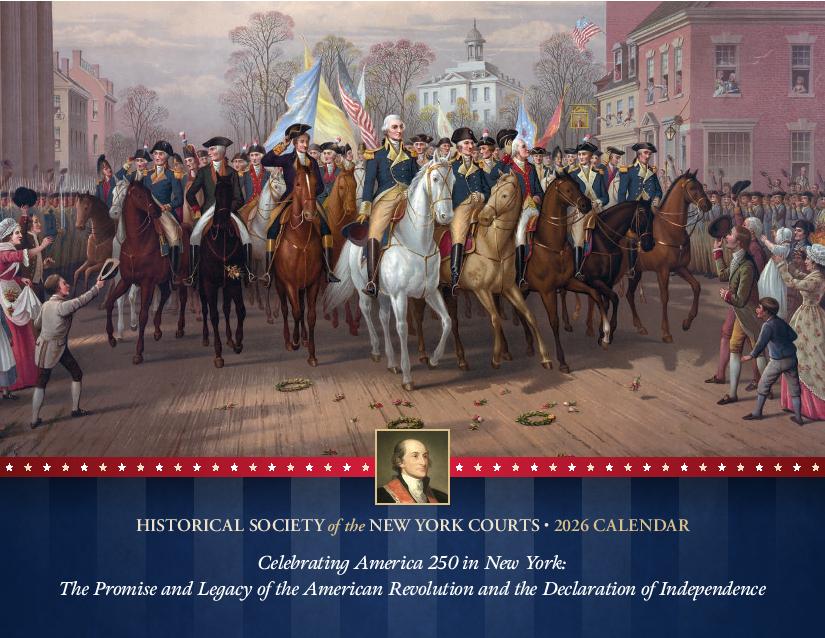
This year, 2026, marks the 250th anniversary of the Declaration of Independence, and the Historical Society of the New York Courts is celebrating New York’s role in the creation of our nation and its legacy with our annual calendar. It was with this document that American colonists broke free from the tyranny of British monarchical rule.
We hold these truths to be self-evident, that all men are created equal, that they are endowed by their Creator with certain unalienable Rights, that among these are Life, Liberty and the pursuit of Happiness.
With these words, a new form of government could begin—one that is by the people and for the people.
However, at the time of its writing, the promises of the Declaration could not be realized. At the national level, slavery continued to exist for nearly 100 years after the document’s creation, and women would not receive the right to vote nationally until 1920 when the 19th Amendment to the Constitution was ratified. Nevertheless, rights activists such as Frederick Douglass and Susan B. Anthony, both of whom are featured in the calendar, persevered, to help establish greater equality in American society. They strived to ensure that the Declaration’s legacy can be realized for all Americans, and it is our responsibility as good citizens to carry this torch and uphold the principles of freedom in the Declaration of Independence—much like Lady Liberty does in New York Harbor.
We invite you to follow along each month as we share a uniquely New York contribution to the Declaration of Independence, the American Revolution, and the promise of the U.S. Constitution!
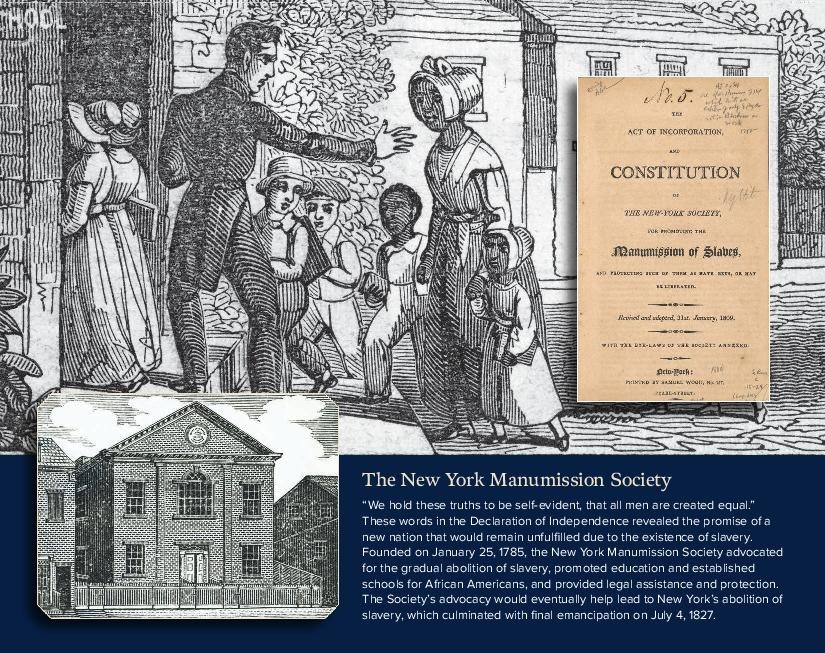
January: The New York Manumission Society
“We hold these truths to be self-evident, that all men are created equal.” These words in the Declaration of Independence revealed the promise of a new nation that would remain unfulfilled due to the existence of slavery. Founded on January 25, 1785, the New York Manumission Society advocated for the gradual abolition of slavery, promoted education and established schools for African Americans, and provided legal assistance and protection. The Society’s advocacy would eventually help lead to New York’s abolition of slavery, which culminated with final emancipation on July 4, 1827.
Image Captions
Engraving of African Free School, No. 2, New York, 1860. Schomburg Center for Research in Black Culture, Photographs and Prints Division, The New York Public Library.
A formerly enslaved, and now free, woman escorting her children to school, 1862. Schomburg Center for Research in Schomburg Center for Research in Black Culture, Manuscripts, Archives and Rare Books Division, The New York Public Library.
“The Act of Incorporation and Constitution of the New York Society for Promoting the Manumission of Slaves: and protecting such of them as have been, or may be liberated. Revised and adopted, 31st January, 1809. With the bye-laws of the society annexed,” Schomburg Center for Research in Black Culture, Manuscripts, Archives and Rare Books Division, The New York Public Library.