
1832-1903
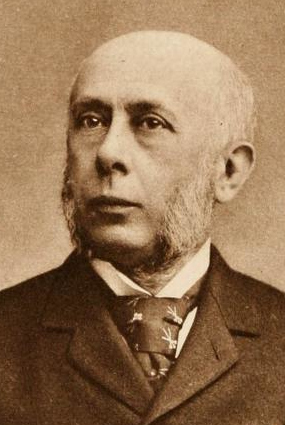 Frederic R. Coudert Sr. was born in New York City in 1832. His father, Charles, an officer and intimate of Napolean Bonaparte, fled France in 1824 for his role in the failed conspiracy to put the Duke of Reichstadt (Napolean II) on the French throne. Coudert was educated in New York City at his father’s French School. At age 18 he graduated from Columbia College as Valedictorian of the class of 1850. He studied law under Edward Sanford, a distinguished lawyer of the era, and was admitted to the bar in 1853.
Together with his brothers, Louis and Charles, Jr., Frederic founded Coudert Brothers, one of the oldest law firms in the nation until its dissolution in 2005. With a branch office in Paris, the firm handled a large volume of international business, including patent, trademark and extradition cases, “numbering among its clients many of the governments of Europe.”[1] The firm’s reputation grew quickly and for the next half century “practically all of the French, German, and Italian estate law business transacted in this country has gone through the firm.”[2] In light of his expertise in international law, Coudert was appointed to represent American diplomatic and business interests on many occasions, including the International Congress on the Law of Nations in 1877 and 1892. The New York Times credited Coudert’s “pure French” for much of his success in international affairs, observing that “[b]efore an international tribunal a barbarous French accent would discredit the profoundest wisdom.”[3]
Coudert was active in Democratic Party politics as President of the Young Men’s Democratic Club of New York City and, later, on behalf of his personal friend, Samuel J. Tilden. During the controversy over the contested Tilden-Hayes election of 1876, Coudert was selected by Democrats to “go to New Orleans and assist in securing a fair count of the vote for Louisiana,” one of the states whose electoral votes were in doubt. He was also one of Grover Cleveland’s most prominent supporters when Cleveland was nominated for the Presidency a second time in 1892. Despite his political connections Coudert never sought elected office and declined President’s Cleveland’s offer to nominate him to the United States Supreme Court as well as offers to serve on the New York Court of Appeals.[4] In 1894, Coudert publicly referenced his Catholic faith as the basis for declining public office: “I know that there are certain offices to which neither I nor mine can aspire.”[5]
Coudert’s career was distinguished by extensive public service, including leadership roles on the boards of numerous charitable, religious and civic boards. He declined a salary to serve on the New York City Board of Education and as Commissioner of New York City Public Schools in the 1880s. He was President of the New York City Bar Association in 1890-91 and chaired the committee that investigated Deputy State Attorney General Isaac Maynard’s role in the Stolen Senate of 1891, ultimately leading to Maynard’s decisive defeat when he ran for a seat on the Court of Appeals in 1893.
Coudert was also a prolific author on many topics outside the law, and a sought-after speaker whose “distinctly French accent of mind, a gayety of spirit and lightness of touch which made him one of the most charming of after-dinner and occasional orators, as well as serving to enliven his most serious and learned arguments.”[6]
Frederic R. Coudert Sr. died at his Washington D.C. home on December 20, 1903. Coudert Brothers remained one of the nation’s leading Wall Street law firms until its dissolution in 2005.[7]
[1] McAdam et al., History of the Bench and Bar of New York State Vol.1, New York Hist. Co., 1897, at 103.
[2] “Death of F. R. Coudert,” New York Times, Dec. 21, 1903.
[3] Id.
[4] McAdam, at 104.
[5] New York Times, Dec. 21, 1903.
[6] Id.
[7] Ellen Rosen, “The Complicated End of an Ex-Law Firm,” New York Times, Feb. 9, 2007.