
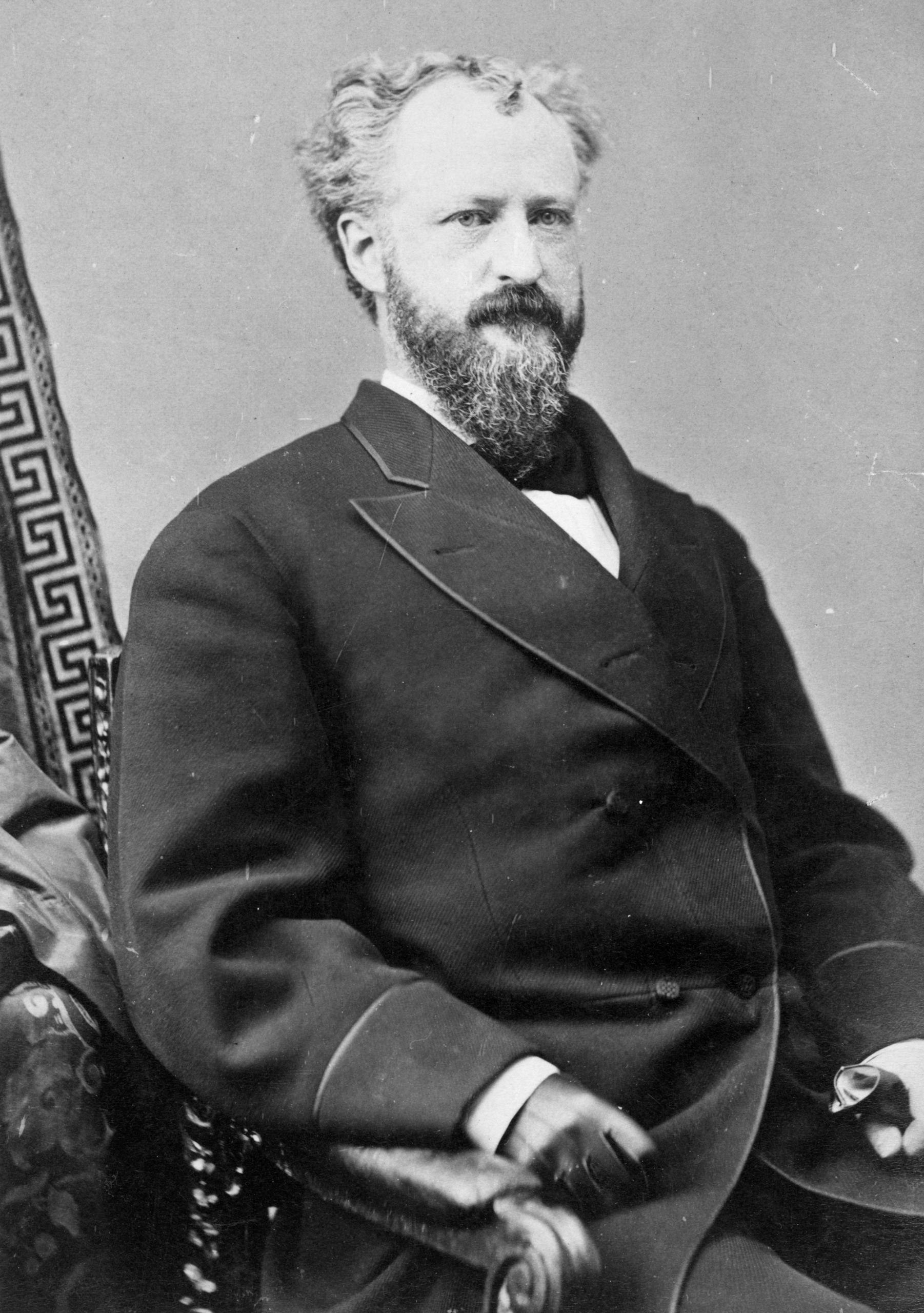
1829-1888
Roscoe Conkling was born in Albany, New York, in 1829. His father, Alfred, was a member of Congress from 1821 to 1823 and a Judge of the United States District Court for the Northern District of New York from 1825 to 1857.
Conkling grew up in Auburn, New York, and moved to Utica as a 17-year-old to study law under two prominent lawyers, Joshua A. Spencer, a former United States Attorney for the Northern District of New York (1841-1845), and Frances Kernan, a future Congressman and United States Senator. Conkling was admitted to the bar in 1850 and started a law practice in Utica, then a thriving city on the Erie Canal.
Early Career
In 1850, the not yet 21-year-old Conkling, who had grown up around politics and politicians, was appointed interim District Attorney of Oneida County by Governor Hamilton Fish.[1] Conkling kept himself “well in the background in court appearances” until he reached the age of majority later in the year.[2] Conkling’s youth contributed to his defeat in the ensuing election for District Attorney. In 1852, he formed a legal partnership with former Utica Mayor Thomas R. Walker and soon earned a reputation as one of the ablest lawyers in central New York.
Congress
In 1858, Conkling was elected Mayor of Utica. In 1859, he was elected as a Republican to Congress. He served for two terms but lost his seat to his former mentor, Frances Kernan. Conkling avenged his loss to Kernan in the next election and returned to Congress in 1865. He resigned in 1867 upon his election to the United States Senate. Aligned with the Radical Republicans in Congress, Conkling gained a national reputation for his oratory while sponsoring key anti-slavery legislation at President Lincoln’s request. Conkling befriended President Lincoln and played a leading role in his renomination for a second term.[3] In New York, Conkling was soon “recognized as a man of greater influence than any one else in his party.”[4]
Political Boss and Stalwart
From 1870 until his controversial resignation from the Senate in 1881, Conkling was the undisputed political boss of New York’s Republican Party and one of the most powerful men in the nation. Conkling led the Republican “Stalwarts,” a national faction that rejected all attempts at civil service reform and strictly adhered to the so-called “spoils system” of placing party loyalists into lucrative positions without regard to experience or qualifications.
A handsome man of undeniable ability . . . Conkling subjected his Republican followers in New York to a degree of discipline that would have won him rapid advancement in the army of Frederick the Great. He shunned theories and principles, despised reformers, and believed that the spoils system was the cornerstone of party government. He fought his opponents in his own party as viciously as he did the Democrats, and those who dared to question his leadership were summarily dispatched to a political Siberia in which there were no jobs for party workers. In what has been accurately termed ‘the age of the spoilsman’ Conkling was the greatest spoilsman of them all.[5]
Conkling’s status as a political boss was solidified in 1870 when President Ulysses S. Grant appointed Conkling’s choice, Thomas Murphy, as the Collector of the Port of New York. This move enabled Conkling to control the New York Customs House, the nation’s richest source of federal revenue and jobs. When Murphy proved too corrupt for the job, Conkling recommended his political protégé, “the honest, efficient, and courteous Chester Alan Arthur.”[6] Arthur ran the port well and helped Conkling build a powerful statewide political machine that controlled over 7,000 federal jobs.[7]
Feud with Blaine
Conkling was “a man who thrived on battling perceived enemies.”[8] He pursued a long political feud with James G. Blaine, a prominent Republican from Maine who led the “Half-Breeds” faction that supported civil service reform and believed the spoils system had fueled the many scandals that embarrassed and weakened the Grant administration. The deep enmity between the two men was sealed in 1866 when Blaine ridiculed Conkling on the House floor.
The contempt of that large-minded gentleman is so wilting; his haughty disdain, his grandiloquent swell, his majestic, super-eminent, overpowering turkey-gobbler strut has been so crushing to myself and all the members of this House that I know it was an act of the greatest temerity for me to venture upon a controversy with him.[9]
When President Grant declined to run for a third term, Blaine was the frontrunner for the Republican nomination. At the Republican National Convention, Conkling, also vying for the nomination, could not muster enough support to mount a serious challenge. Even though he distrusted Hayes as another Half-Breed reformer, he threw New York’s support to Hayes in order to block Blaine’s nomination. When the 1876 Tilden-Hayes election resulted in a deadlock, Conkling played a key role in creating the Congressional Commission charged with declaring a victor. Although he was a Republican, Conkling personally believed that Tilden had won the election and referred to Hayes as “Rutherfraud B. Hayes.”[10]
Presidents Hayes and Garfield
Once in office, President Hayes tried to break Conkling’s grip on the Collector position, but Conkling rallied enough support in the Senate to defeat Hayes’ nominees. Eventually, Conkling managed to secure the reappointment of Arthur until he was fired by Hayes in 1878 after an investigation by John Jay II, grandson of the first Chief Justice of the United States, uncovered significant corruption in the Customs House. Conkling was not able to block Arthur’s replacement, Theodore Roosevelt, Sr.
When President Hayes declined to run for a second term in 1880, Conkling helped convince Grant to take another run at the White House. Entering the Republican National Convention, the party was hopelessly split between Grant’s Stalwarts and Blaine’s Half-Breeds. The deadlock was broken by the compromise nomination of James A. Garfield, who was associated with neither faction. Chester A. Arthur received the party’s vice-presidential nomination as a consolation to the Stalwarts. Once in office, Garfield, who once described Conkling as “a great fighter, inspired more by his hates than his loves,”[11] appointed William H. Robertson, a Half-Breed enemy of Conkling, to the position of Collector.
Downfall
In May 1881, the furious Conkling and fellow Republican Senator Thomas Platt resigned from the Senate in protest. Conkling’s plan was to have the state legislature promptly reelect him and Platt as a public rebuke to Garfield. Conkling overestimated his support, however. In late July 1881, he and Platt were defeated in a protracted special election. Their defeat came three weeks after President Garfield was shot by Charles Guiteau, a deranged Republican patronage seeker who upon his arrest told the police: “I am a Stalwart of the Stalwarts . . . Arthur is president.”[12]
President Garfield did not have long to enjoy his political victory over Conkling. He died from his wounds in September 1881. Guiteau was hanged for his crime in June 1882. In January 1883, President Arthur signed a landmark Civil Service Reform Act which replaced the spoils system with a merit-based hiring system administered by a Civil Service Commission.
Conkling’s failed gambit effectively ended his political career. In February 1882, President Arthur nominated him to the United States Supreme Court and the Senate quickly confirmed him, but Conkling declined the appointment. In 1873, at the height of his power, Conkling had famously rejected President Grant’s written offer to nominate him as the Chief Justice of the United States Supreme Court. Reluctant to give up political power, he believed that as a judge “I would forever be gnawing at my chains.”[13]
A Striking Figure
Conkling was one of the most striking political figures of the Gilded Age.
“Lord Roscoe,” many called him, and he carried himself like a member of the higher peerage. Roscoe Conkling steps from the pages of history angry, haughty, larger than life. Although he was vindictive and overbearing, he was handsome, intelligent, and capable of orating for hours at a time without losing either a word of his memorized speech or a listener; gaudy as a peacock, he makes the political leaders of our era pale into shadows in comparison. He was not a pleasant man, but he stirred strong emotions, and he had a considerable impact on American history.[14]
Few descriptions of Conkling fail to mention his impressive physical appearance.
He stood six feet, three inches tall, was “erect and muscular,” and blond. He sported a “Hyperion” curl on his forehead that was the delight of political cartoonists; at a time when the sartorial standard for men was black, Conkling made an elegant figure, sporting colorful vests of yellow or lavender and light-colored trousers. He was an advocate of physical fitness, a skilled and avid horseman and an enthusiast for boxing.[15]
Even though Conkling is remembered as one of the Gilded Age’s greatest political bosses and power brokers, he does not appear to have been personally corrupt. Early in his career he was known to oppose “jobbery and corruption” and the consensus seems to be that, while fiercely partisan, he “does not appear to have benefitted financially from his political wire pulling.”[16] Indeed, Conkling, was nearly broke when he resigned from the Senate.[17]
Civil Rights and Reconstruction
Conkling was a stalwart advocate of Reconstruction and Black civil rights. As a member of the Joint Congressional Committee on Reconstruction, he played a key role in drafting the Fourteenth Amendment guaranteeing citizenship and equal protection of the laws to freed Blacks. Conkling also took the position that the southern states could not be readmitted to the Union unless they first ratified the Fifteenth Amendment granting Black men the right to vote. In 1875, when Mississippi Senator Blanche K. Bruce, the first Black elected to a full term on the U.S. Senate was shunned by his colleagues, Conkling made a point of welcoming Bruce and accompanying him to the rostrum when he took his oath of office.[18]
Cold, Proud and Pompous
In his private life, Conkling had a distant relationship with his wife and stopped speaking to his daughter and only child when she married someone he did approve of. In the 1870s, Conkling had an affair with Kate Chase Sprague, the wife of Senator William Sprague and daughter of Chief Justice Salmon Chase. Conkling ended the affair in 1881 when Sprague filed for divorce and the relationship became public.[19] According to his obituary, “beneath a cold, proud, and pompous exterior,” Conkling could “unbend upon occasion,” showing a “warm heart” and maintaining “ardent and lasting” friendships.[20]
Return to Law Practice
Following his resignation, Conkling resumed the practice of law in New York City where he soon put himself in a comfortable financial position and became a highly respected advocate. “For about two years he did the hardest work of his life in his law office,” such that “[w]ithin three years the country knew that he stood deservedly among the leaders of the legal profession.”[21] Conkling’s clients included large railroads and corporations, Wall Street financier Jay Gould and Thomas Edison. Conkling also served on a State Senate Committee that investigated a bribery scandal involving the New York City Board of Aldermen and the award of the Broadway streetcar franchise to horsecar magnate Jacob Sharp.
Corporations as Persons Under the 14th Amendment
In 1882, Conkling appeared before the United States Supreme Court in San Mateo County v. Southern Pacific Railroad as counsel for the railroad in a tax case. Conkling argued that the “equal protection” clause of the 14th amendment was intended to protect corporations as well as individuals.[22] As one of the original drafters of the 14th Amendment, Conkling was in a unique position to argue that the drafters of the phrase “nor deny to any person . . . the equal protection of the laws” intended to include corporations within the meaning of the word “person.”
San Mateo was settled before the court could issue an opinion. When the same issue arose in Santa Clara County v. Southern Pacific Railroad,[23] the court ruled in favor of the railroad on narrow grounds. Even though the opinion did not address corporate constitutional rights under the 14th Amendment, the court reporter’s headnote somehow summarized the case as follows: “The Court does not wish to hear argument on the question whether […] the Fourteenth Amendment […] applies to these corporations. We are all of the opinion that it does.”[24] The Supreme Court later began citing to Santa Clara to hold that the 14th Amendment protected corporations. Scholars have posited that Conkling’s claims about the intent of the drafters of 14th Amendment were fraudulent.[25] Thus it was that two decades after he helped draft the 14th Amendment to protect former slaves from racial discrimination Conkling played a pivotal role in transforming the same language into a weapon used primarily by corporations to strike down unwanted regulation.
Struck Down by the Great Blizzard of 1888
Roscoe Conkling died on April 18, 1888, from an abscess in his right ear brought on by severe exposure suffered during the great blizzard of March 1888. Leaving court with the city at a complete standstill, the 58-year-old Conkling, “still a strapping figure of a man, proud of his strength,” powered through two and a half miles of drifting snow and gale force winds: “I had an ugly tramp in the dark…drifts so high that my head bumped against the signs… and fallen telegraph wires.”[26]
Ironically, Dr. D. Hayes Agnes, who had attended President Garfield, was called to Conkling’s bedside. By early April, an operation was necessary. A hole was drilled into Conkling’s head with a mallet and chisel to relieve a buildup of pus. It was hoped that the strong, athletic Conkling would pull through. He did not. He fell into a coma and died on April 18, 1888, at the age of 58.[xxvii]
[1] “Mr. Conkling’s Career,” New York Times, Apr. 18, 1888.
[2] Id.
[3] Ellis, Frost, Syrett & Garman, A Short History of New York State, Cornell Univ. Press, 1957, at 364.
[4] “Mr. Conkling’s Career,” supra.
[5] Id., at 363.
[6] James A. Garfield National Historic Site, “The Remarkable Roscoe: Friend and Nemesis of Presidents (Part 1),” National Park Service, available at www.nps.gov.
[7] Ellis, et al., at 364
[8] James A. Garfield National Historic Site, “Stalwarts, Half-Breeds and Political Assassination,” National Park Service, available at www.nps.gov.
[9] “The Remarkable Roscoe,” supra.
[10] Id.
[11] “Roscoe Conkling,” HarpWeek, available at HarpWeek | Hayes vs. Tilden: The Electoral College Controversy of 1876-1877.
[12] “Stalwarts,” supra.
[13] Alfred R. Conkling, The Life and Letters of Roscoe Conkling: Orator, Statesman, Advocate, C.L. Webster & Co., 1889, at 461.
[14] “The Remarkable Roscoe,” quoting David M. Jordan, Roscoe Conkling in the Senate: Voice of New York, Cornell Univ. Press, 1971.
[15] Id.
[16] Id.
[17] “New Publications: Roscoe Conkling,” New York Times, Jan. 5, 1890.
[18] “The Remarkable Roscoe,” supra.
[19] “Roscoe Conkling,” HarpWeek, supra.
[20] “Mr. Conkling’s Career,” New York Times, Apr. 18, 1888.
[21] Id.
[22] 116 U.S. 138 (1885)
[23] 118 U.S. 394 (1886)
[24] Ryan Azad, “The Long March of the Corporate Rights Movement,” Los Angeles Review of Books, March 22, 218; see also Adam Winkler, We the Corporations: How American Businesses Won Their Civil Rights, W.W. Norton & Co., 2018.
[25] Id.
[26] “The Remarkable Roscoe Part III,” National Park Service, available at www.nps.gov; see also Nat Brandt, “The Great Blizzard of ’88,” American Heritage, Vol. 28, Iss. 2, Feb. 1977.
[27] Id.; see also “Conkling Near Death,” New York Times, Apr. 10, 1888.