
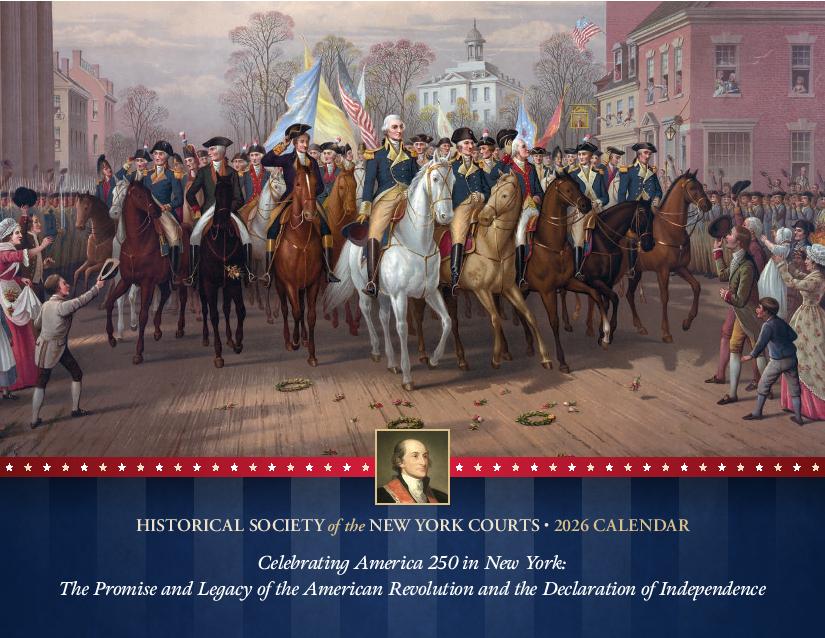
In our continuing series in celebration of the 250th anniversary of the Declaration of Independence, the Historical Society of the New York Courts is highlighting New York’s role in the creation of our nation and its legacy through its annual calendar. In March, we are spotlighting the Stamp Act.
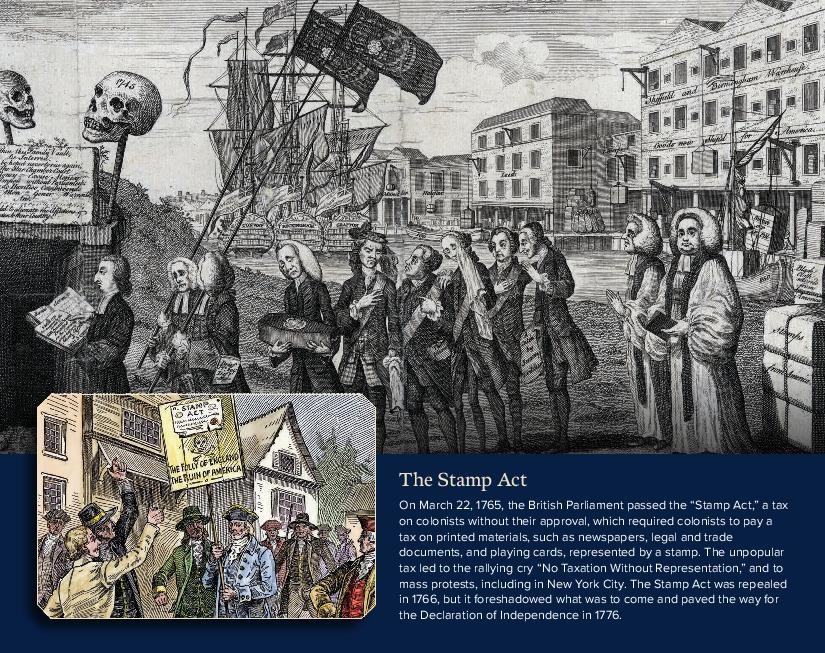
March: The Stamp Act
On March 22, 1765 the British Parliament passed the “Stamp Act,” a direct tax on colonists without their approval, which required colonists to pay a tax represented by a stamp on printed materials including newspapers, legal and trade documents, and playing cards. The unpopular tax led to the rallying cry “No Taxation Without Representation,” and to mass protests and vandalism in New York City. The Stamp Act was repealed in 1766, but it foreshadowed what was to come and paved the way for the Declaration of Independence in 1776.
Image Captions
Woodcut print of a Stamp Act protest in New York, c. 1765. North Wind Picture Archives/Alamy.
An engraving depicting the British Parliament’s repeal of the Stamp Act in 1766 in the wake of protests by colonists. “The repeal, or the funeral procession of Miss America-Stamp,” 1766. The Miriam and Ira D. Wallach Division of Art, Prints and Photographs: Print Collection, The New York Public Library.