
1846-1920
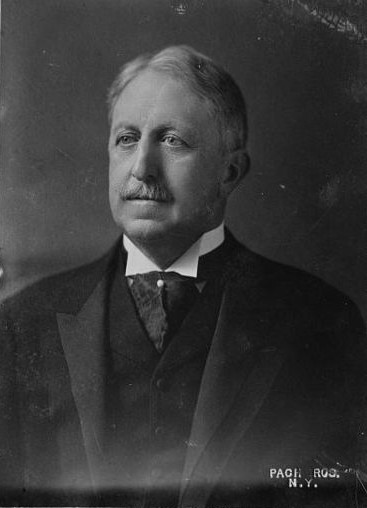 Francis L. Stetson was born in 1846 in Keeseville, New York, in Clinton County, near the Canadian border. His father, Lemuel Stetson, was an accomplished lawyer, jurist, state legislator and Congressman. Stetson graduated from Williams College in 1867 and Columbia Law School in 1869. He was admitted to the bar in 1869 and practiced law in New York City with an uncle, William S. Hascall, until 1875, when he became Secretary to Democratic Governor Samuel J. Tilden. During the controversy over the Tilden-Hayes disputed election of 1876, Stetson served as Tilden’s counsel and point man on the battle over the disputed returns in Florida. At the conclusion of the affair, Stetson joined New York City Corporation Counsel William C. Whitney as an Assistant Corporation Counsel.[1]
In 1880, Stetson joined with Francis N. Banks, “probably the leading lawyer of New York City” at the time, to form Banks & Stetson, the precursor to Davis Polk & Wardwell.[2] Stetson became the personal counsel and intimate friend of J. P. Morgan and was known as “J. P. Morgan’s attorney general for his work counseling the financier on industrial and railroad reorganizations.”[3] Stetson became corporate law expert and represented some of the largest corporations in the world, including J.P. Morgan’s United States Steel, the United States Rubber Company and numerous railroads. He was “a courtly yet steely gentleman” who “tried his best to keep his famous client [Morgan] out of trouble, which was no easy task.”[4]
Stetson was “formal and ill at ease in public,” but in private he was a “warm and congenial” presence “versed in the art of politics” who knew how to make powerful friends.[5] In 1882, he befriended Grover Cleveland shortly after he became Governor. Stetson turned down a position as Secretary of the Treasury in Cleveland’s Administration in 1884. After Cleveland’s reelection loss in 1888, he joined Stetson’s firm, taking the coveted corner office there until he re-entered the White House in 1892.[6] In 1882, Stetson also befriended a young State Assemblyman, Theodore Roosevelt, as the latter investigated New York State Supreme Court Justice Theodore Westbrook for bribery and corrupt judicial rulings that aided Wall Street financier Jay Gould’s takeover of the Manhattan Elevated Railway Company.[7] Westbrook ultimately escaped trial for impeachment.
The arc of Stetson’s professional career reflected a larger transition taking place in the legal profession, particularly in New York City. After beginning his career trying cases and appearing regularly in court, Stetson ended it as one who “devoted his attention to corporation work and was not often seen in court.”[8] Stetson and the law firm that became Davis Polk & Wardwell represented a new practice model tailored to the increasing complexities of the business world where lawyering took place in the conference room rather than the courtroom. In 1911, a reporter for the Omaha Bee described Stetson as “the greatest of the new school of business lawyers—men who are experts first and lawyers afterward.”[9]
J.P. Morgan first encountered Stetson in the latter’s role as counsel to William Vanderbilt’s New York Central Railroad. Morgan, “who preferred cooperation to ruinous competition,” was so impressed with Stetson’s skills as a counselor and negotiator that he hired him away from Vanderbilt and eventually made him “our regular attorney in everything.”[10]
Stetson served as President of the New York State Bar Association in 1908, and as President of the New York City Bar Association in 1910-11.
Stetson was active in Episcopal Church affairs, serving as Senior Warden of the Church of the Incarnation, Trustee of the General Theological Seminary and drafting the canon on divorce and marriage in the Episcopal Church.[11]
Francis L. Stetson died in his New York City home on December 5, 1920.
[1] “Francis L. Stetson, Lawyer, Dies at 74,” New York Times, Dec. 6, 1920.
[2] Id.
[3] Edwin G. Burrows & Mike Wallace, Gotham: A History of New York City to 1898, Oxford Univ. Press, 1999, at 1047.
[4] John Oller, White Shoe, Dutton, 2019, at 4.
[5] Id. at 19.
[6] Id. at 19-20.
[7] “Found Dead in His Room,” New York Times, Oct. 7, 1885.
[8] New York Times, Dec. 6, 1920.
[9] Oller, at 21.
[10] Id. at 20-21.
[11] New York Times, Dec. 6, 1920.