
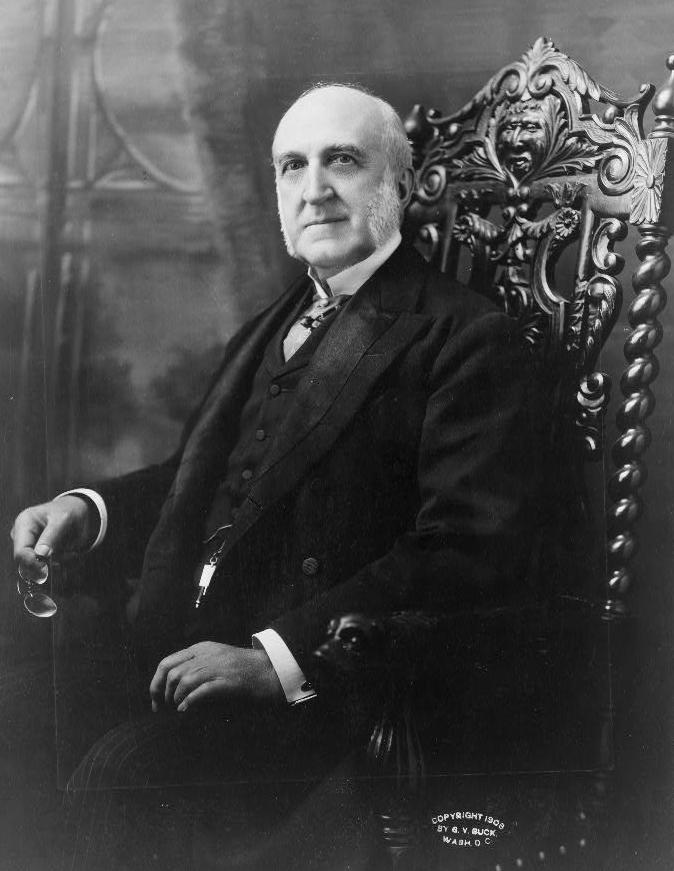
1834-1928
Chauncey M. Depew was born in 1834 in Peekskill, New York, the son of a prosperous merchant. He graduated from Yale College in 1856, studied law under William Nelson in Peekskill, and was admitted to the bar in 1858.
Depew was active in Republican politics from an early age. He attended the 1860 Republican National Convention that nominated Abraham Lincoln for President and every subsequent National Convention through 1920. In 1861, Depew was elected to the New York State Assembly. During his second term, he was positioned to become Speaker of the Assembly but “gave it up for a trade . . . by which a Democrat became Speaker, and . . . Edwin D. Morgan, a Republican, [became] United States Senator. This sacrifice for the sake of sending a Republican to Washington to support President Lincoln’s Administration gained Mr. Depew a national reputation and the lasting gratitude of his party.”[1] In 1863, Depew was elected New York’s Secretary of State.
During the Civil War, Depew served in the New York National Guard as Adjutant of the 18th Regiment and Colonel and Judge Advocate of the 5th Division.[2] Following the war, Depew moved to New York City expecting to become Collector of the Port of New York, but his appointment fell victim to discord between President Andrew Johnson and Senator Edwin D. Morgan. In 1865, DePew turned down an appointment as United States Minister to Japan. He decided instead to take a position as counsel to Cornelius Vanderbilt’s “first ventures in railroading” — the New York & Harlem and Hudson River Railroads — purchased in 1862 and 1864 respectively. When Depew told Vanderbilt that the railroad position entailed a significant pay cut for him, the Commodore replied: “Railroads are the career for a young man; there is nothing in politics. Don’t be a damned fool.”[3]
In 1875, Depew was promoted to General Counsel of Vanderbilt’s fast-growing railroad empire after it was extended from Albany to Chicago. He became President of the Railroad in 1885 and Chairman of the Board of Directors in 1898.
Depew ably represented Vanderbilt’s railroad interests for the rest of his life, but he did not heed the Commodore’s command to give up politics. In 1872, he ran unsuccessfully for Lieutenant Governor of New York on the Liberal Republican line. In 1881, he ran for one of the open seats in the United States Senate vacated by the resignations of Senators Roscoe Conkling and Thomas Platt. Depew started out as a leading candidate but could not muster enough votes in the legislature and withdrew his candidacy. Three years later, he declined to run again despite a two-thirds Republican majority in the state legislature that would have assured his election.
In 1888, Depew arrived at the Republican National Convention as New York’s favored son. He “withdrew from that race because of the hostility shown by delegates from the Western States against anybody connected with railroads.”[4] Depew threw his support to Benjamin Harrison, who was nominated and elected President. Depew later declined President Harrison’s offer to serve as Secretary of State.[5] In 1898, with Elihu Root presiding at the New York State Republican Convention, Depew nominated Theodore Roosevelt for Governor of New York.
In 1899, Depew was finally elected to the United States Senate. He was reelected in 1905. Depew chaired the Senate Committee on Revision of the Laws but was not a particularly active legislator, preferring to assert his influence behind the scenes. Depew was criticized for his close ties to large railroad and corporate interests and for favoring their interests over the public good. He was the primary target of a highly influential series of muckraking articles, “The Treason of the Senate,” published in William Randolph Hearst’s Cosmopolitan magazine in 1906. The series “helped turn public opinion against the conservative leaders who controlled the Senate, strengthened Theodore Roosevelt’s hand in enacting his legislative program, and contributed substantially to the movement for the popular election of senators.”[6] Depew returned to his law practice in 1911 after New York’s Democrats retook control of the legislature and his reelection bid failed.
Depew enjoyed a national reputation as a distinguished orator. Many of his speeches were recorded and sold to the public on gramophone discs beginning in the 1890s. In 1891, he gave the presidential nominating speech for Benjamin Harrison at the Republican National Convention. On October 28,1886, at the unveiling of the Statue of Liberty, Depew delivered a lengthy keynote speech that celebrated the history of democracy. His oration balanced words of welcome for the world’s poor and persecuted with a warning for dissenters and disturbers of the peace.
The rays from this torch illuminate a century of unbroken friendship between France and the United States. Peace and its opportunities for material progress and the expansion of popular liberties send from here a fruitful and noble lesson to all the world. It will teach the peoples of all countries that in curbing the ambitions and dynastic purposes of princes and privileged classes, and in cultivating the brotherhood of man, lies the true road to their enfranchisement. . . . The rays from this beacon, lighting this gateway to the continent, will welcome the poor and the persecuted with the hope and promise of homes and citizenship. It will teach them that there is room and brotherhood for all who will support our institutions and aid in our development; but that those who come to disturb our peace and dethrone our laws are aliens and enemies forever.[7]
Depew died an admired and respected figure on April 5, 1928.
While Depew became rich in business . . . [and] was also an important figure in the inner circles of the Republican Party, in both the State and nation . . . Mr. Depew . . . was a unique personality—an orator, a philosopher, and one of the wise men of the Western world . . . recognized by New York City, by a good part of the United States . . . as a true “happy warrior,” an oracle of how to live a useful and contented life . . . a man who never got old, at least in spirit . . . his charm never diminished, and his wit and humor never grew stale.[8]
[1] “Chauncey M. DePew Dies of Pneumonia in His 94th Year,” New York Times, Apr. 5, 1928.
[2] McAdam et al., History of the Bench and Bar of New York State Vol.1, New York Hist. Co., 1897, at 130.
[3] New York Times, Apr. 5, 1928.
[4] Id.
[5] McAdam, at 131.
[6] “The Loyalty of the Senate: Washington Correspondents in the Progressive Era,” The Historian, Vol. 51, No. 4, Aug. 1989, at 574.
[7] “Oration by Hon. Chauncey M. Depew at the unveiling of the Bartholdi Statue of Liberty enlightening the world, October 28, 1886,” available at www.columbia.edu/cu/lweb/digital/collections/cul/texts/ldpd_5655298_000/ldpd_5655298_000.pdf.
[8] Id.