
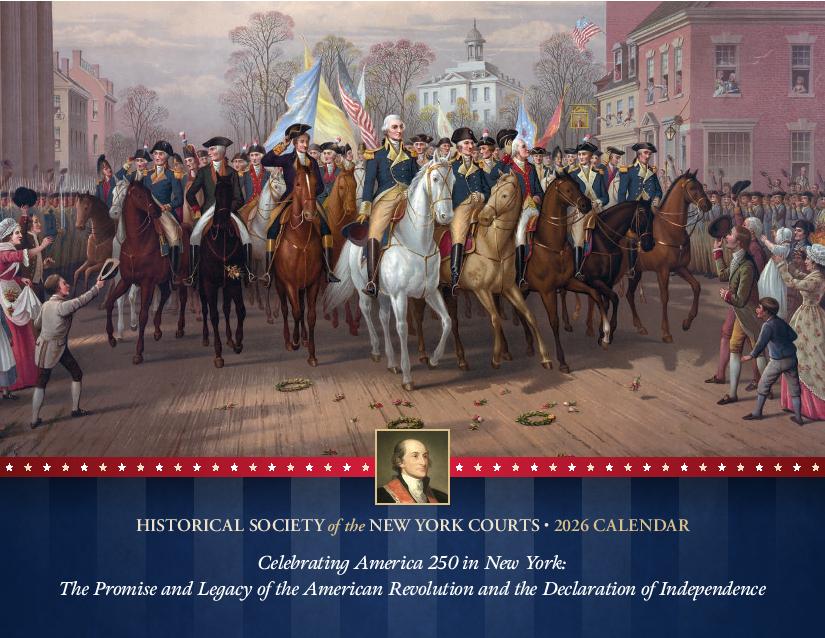
In our continuing series in celebration of the 250th anniversary of the Declaration of Independence, the Historical Society of the New York Courts is highlighting New York’s role in the creation of our nation and its legacy through its annual calendar. In April, we are spotlighting growing tensions with the British.
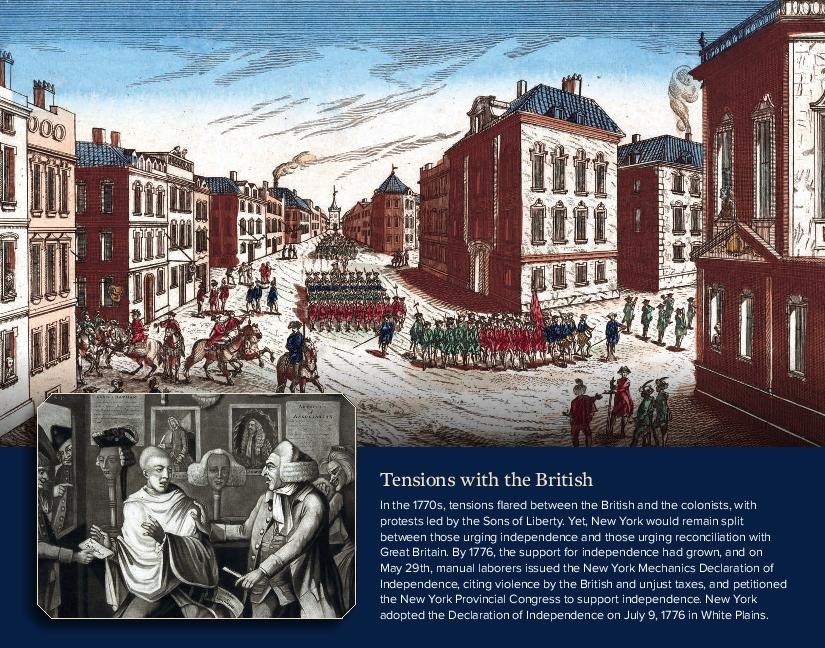
May: Tensions with the British
In 1774, tensions flared between the British and the colonists, with protests led by the Sons of Liberty, yet New York would remain split between those urging independence and those urging reconciliation with Great Britain. By 1776, the support for independence had grown, and on May 29th, manual laborers issued the New York Mechanics Declaration of Independence, which cited unjust taxes and petitioned the New York Provincial Congress to support independence. New York signed the Declaration of Independence in August 1776, as the British began to capture New York City.
Image Captions
Engraving of British troops marching in New York by Jacques-François Chereau, 1777. The Protected Art Archive/Alamy.
“The Patriotick Barber of New York, or the Captain in the Suds,” attributed to Philip Dawe British, published by Robert Sayer and John Bennett British in London, England, February 14, 1775. This satirical image depicts Captain John Crozer, commander of a British ship, who has been recognized in the barbershop of Jacob Vredenburgh, a New York Son of Liberty, who refuses to finish shaving him. It is meant to demonstrate how New Yorkers refused to cooperate with British troops garrisoned in New York City in the autumn of 1774. The Metropolitan Museum of Art has provided the image (in public domain) as well as the description, which is available through the Museum’s digital collection.